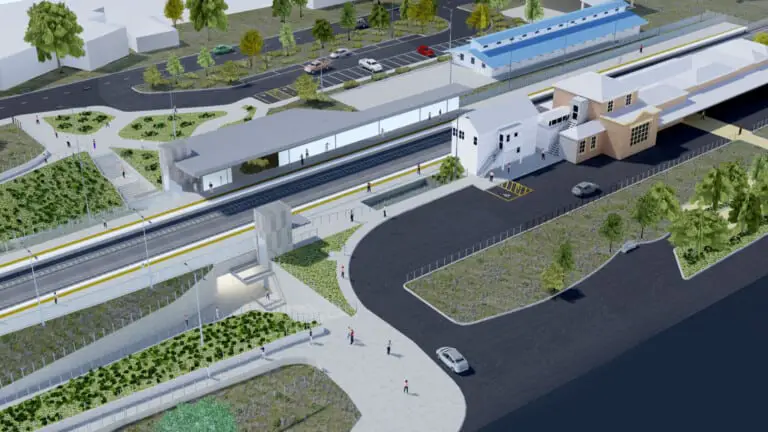
The Wangaratta Rail Project, a centrepiece of Inland Rail’s works in regional Victoria, has been delivered, with the transformed station precinct officially opened and the surrounding corridor moving into an operational role within a now significantly reshaped national freight programme. Responding to enquiries from Construction Review Online, Inland Rail confirmed that the Wangaratta station precinct works are complete and pointed the publication to the official ministerial record of the opening.
The station was officially opened on 27 May 2025, marking completion of major works on Inland Rail’s Beveridge to Albury (B2A) Tranche 1 project. The works centred on freight clearance: the precinct was modified and the adjacent Green Street bridge replaced to allow sufficient clearance for double-stacked freight trains along the Melbourne–Albury (North East) corridor.
What was delivered at Wangaratta
Working with construction partner McConnell Dowell, Inland Rail relocated the east track to form a new west track, added a new western platform, and removed two footbridges, replacing them with a single pedestrian underpass. Crews also lowered the tracks under Green Street bridge and replaced that bridge on the same alignment. The upgraded station gained a new western carpark, new pathways, lifts, ramps and stairs, and 35 security cameras, improving accessibility and safety across the precinct.
Beyond the station, Inland Rail lowered tracks under the Murray Valley Highway at Barnawartha North and replaced bridges over the rail line at Glenrowan and Seymour–Avenel Road. Inland Rail confirmed to Construction Review Online that Wangaratta is the centrepiece of B2A Tranche 1, which also upgraded sections of the 262km of existing rail between Beveridge and Albury. Tranche 2, which completes the Victorian section of Inland Rail, is already under way.
Economic and regional impact
The project delivered substantial local benefit. Almost 1,650 people worked on B2A Tranche 1, including 59 First Nations people, 124 women, 39 apprentices and 176 workers under the age of 25. Of the total workforce, 1,578 were residents from across the region and 488 were from Wangaratta itself.
On the business side, 346 local businesses — 10 of them First Nations-owned — secured contracts worth $161.3 million. Of that, $18 million went to 43 Wangaratta businesses delivering services ranging from electrical work, plumbing and traffic management to precast concrete, equipment hire, accommodation and catering. At the opening, Infrastructure Minister Catherine King described Inland Rail as essential freight infrastructure for a growing population, noting the line is projected to carry around 70 per cent domestic-use goods, while then–Inland Rail CEO Nick Miller framed the high local participation as the legacy the programme wants to replicate along the corridor.
Wangaratta within a consolidated Inland Rail programme
While the Wangaratta works were completed under Inland Rail’s original Melbourne–Brisbane vision, the wider programme has since been sharply reshaped. In May 2026, the Australian Government announced it would “consolidate” Inland Rail, committing to complete construction only between Beveridge in Victoria and Parkes in New South Wales by the end of 2027. Independent cost-assurance work by ACIL Allen had confirmed the full Melbourne–Brisbane project would now exceed $45 billion — more than three times the budget allocation — and could not be delivered until at least 2036.
That cost trajectory rose steeply over time: the project was announced in 2017 at $9.3 billion, revised to $16.4 billion in 2020, then estimated at $31.4 billion in Kerry Schott’s 2023 independent review, before the 2026 figure. Works north of Parkes will now focus on preserving the rail corridor and protecting sites for future intermodal terminals in Queensland, effectively deferring the Brisbane leg indefinitely. The government also framed the surviving section’s payoff as enabling double-stacked freight between Melbourne and Perth via Parkes, alongside a further $1.75 billion investment in the wider freight rail network.
Wangaratta therefore stands as a completed, operational reference point within the revised strategy. Elsewhere on the corridor, work continues: the Albury to Illabo section in southern NSW is on track for completion by the end of 2027, and construction on Illabo to Stockinbingal is expected to begin in mid-2026. The programme is also under new leadership, with Collette Burke appointed permanent chair and Sean Sweeney, former chief executive of Auckland’s City Rail Link, due to start as Inland Rail CEO on 1 July 2026.
The Wangaratta project reflects Australia’s broader strategy of rail-led regional development, complementing larger national ambitions such as the Sydney–Newcastle High Speed Rail Project, which targets high-speed passenger connectivity and housing-led corridor development along the east coast.
Read Also: Botany Rail Duplication Project in Australia Begins Bridge Development Works
Project Fact Sheet
- Project Name: Wangaratta Rail Project (Inland Rail station precinct upgrade)
- Programme: Inland Rail — Beveridge to Albury (Tranche 1)
- Location: Wangaratta, Victoria, Australia
- Project Type: Rail station upgrade and freight corridor enhancement
- Delivery Agency: Australian Rail Track Corporation (ARTC) / Inland Rail Pty Ltd
- Construction Partner: McConnell Dowell
- Construction Start: 2023
- Official Opening: 27 May 2025 (B2A Tranche 1 complete)
- 2026 Status: Completed, operational node within the consolidated Beveridge–Parkes programme
- Key Works Completed: new western platform and relocated track; pedestrian underpass replacing two footbridges; Green Street bridge replacement and track lowering; new carpark, lifts, ramps, stairs and 35 security cameras
- Rail Corridor: Melbourne–Albury (North East Line)
- Purpose: Enable double-stacked freight and improve regional passenger connectivity
- Ownership: Australian Government
- Passenger Operator: V/Line
- Workforce: ~1,650 workers; 488 from Wangaratta
- Local business spend: $161.3 million across 346 businesses ($18 million in Wangaratta)
Project Team
- Project Owner: Australian Government
- Lead Delivery Authority: Australian Rail Track Corporation (ARTC)
- Programme Manager: Inland Rail Pty Ltd
- State Partner: Victorian Government
- Construction Partner (Wangaratta / B2A Tranche 1): McConnell Dowell
- Passenger Rail Operator: V/Line
- Local Government Stakeholder: Rural City of Wangaratta Council
- Funding Partners: Australian Federal Government and Victorian State Government

Leave a Reply