
The Sydney–Newcastle High Speed Rail Project is emerging as a potential answer to Australia’s housing shortage, as policymakers link faster regional transport with new housing supply. The proposed $66 billion corridor would connect Sydney and Newcastle in about an hour, unlocking major residential development along the route while allowing more people to live outside Sydney and commute efficiently. The initiative is also expected to stimulate regional growth, improve mobility and support long-term economic development across New South Wales.
Australia’s housing affordability pressures have intensified in recent years, prompting governments to explore infrastructure that can widen access to more affordable markets. Rather than concentrating growth within Sydney, the railway would spread development across several regional centres. According to recent assessments, the project could support roughly 160,000 new homes along the corridor — which is why planners increasingly treat it as a housing-enabling project rather than a transport investment alone.
Contacted by Construction Review Online, Central Coast Council clarified that while it strongly welcomes the project, the railway will be delivered by the Federal Government — through the High Speed Rail Authority — rather than by the Council. The Council pointed Construction Review Online to its Key Enabling Projects 2026 document, which sets out why it regards the railway as important and beneficial to the region, and confirmed it welcomes the High Speed Rail Authority’s announcement that Gosford will be the location of the Central Coast’s fast rail station.

Sydney–Newcastle High Speed Rail Project Could Transform Housing Development
The railway would sharply cut travel times between major population centres, letting workers access Sydney employment while living in more affordable communities. The proposed route would connect Sydney, the Central Coast and Newcastle through dedicated high-speed infrastructure, with Central Coast commuters reaching Sydney or Newcastle in around 30 minutes.
That improved accessibility could open large areas for residential development, and local governments expect greater housing investment near future stations and transport hubs. By distributing population growth more evenly across the region, the railway could ease pressure on Sydney’s property market and encourage developers to accelerate projects in emerging growth centres. The line would also improve access to education, healthcare and employment, making regional communities more attractive to homebuyers and investors.
Sydney–Newcastle High Speed Rail Project Advances Planning Phase
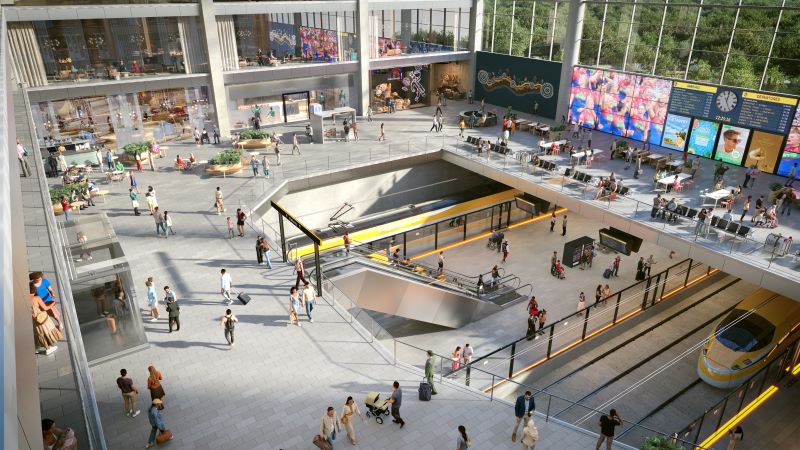
The Australian Government continues to advance planning and development for the railway, with funding allocated to route refinement, environmental assessments and engineering studies. The High Speed Rail Authority is overseeing development of the first stage between Sydney and Newcastle, and has confirmed Gosford as the site of the Central Coast’s high-speed station. Construction Review Online reached out to the High Speed Rail Authority (Australia), which shared a series of artist impressions showcasing the project’s striking high-speed trains and supporting infrastructure. Technical teams are evaluating station locations, tunnelling requirements and land acquisition needs.
Authorities aim to complete detailed planning before moving toward construction readiness, and industry engagement along the corridor has increased. The first stage forms part of a broader vision for an east-coast high-speed network that could eventually connect Brisbane, Sydney, Canberra and Melbourne. Government estimates put the potential economic benefit at around $176 billion over several decades, supporting nearly 99,000 jobs across development, construction and operations, while a shift from cars to rail would help lower transport emissions in line with national sustainability goals.
Why the Central Coast Backs the Project
For the Central Coast, the railway is treated as a nationally significant opportunity rather than a local delivery responsibility. In its Key Enabling Projects 2026 document, the Council lists high-speed rail among its transport and connectivity priorities — an advocacy position, reflecting that the project is federally led. The Council argues the line would connect the region directly into key education, skills and health hubs while reinforcing internal movement between centres such as Gosford, Wyong and Warnervale.
That position sits within a fast-growing region. The Central Coast’s population is around 363,424 in 2026 and is forecast to reach about 412,502 by 2046, placing growing pressure on housing, transport and services. The Council frames enabling infrastructure — with Gosford as the region’s confirmed high-speed rail station and regional capital — as central to unlocking coordinated housing supply, supporting workforce participation and lifting regional productivity.
Long-Term Economic Impact Strengthens Project Support
Support for the railway continues to grow among policymakers, businesses and regional communities, with many viewing it as essential infrastructure for future population growth. Stronger economic links between Sydney and regional centres would give businesses access to larger labour markets and workers access to wider employment. Construction itself would generate substantial value, with demand for engineering, tunnelling, station development and rail systems supporting thousands of jobs.
Challenges remain before construction begins, including land acquisition, environmental approvals and funding arrangements. Even so, the project has advanced further than many previous Australian high-speed rail proposals. As planning progresses, the Sydney–Newcastle High Speed Rail Project increasingly stands out as a transport investment with the potential to address housing shortages, stimulate regional development and reshape population growth across eastern Australia.
The focus on rail-led regional development mirrors other transport investments nationally. The Wangaratta Rail Project in Victoria, though far smaller, shows how strategic rail upgrades can support economic growth and improve mobility between regional communities and major centres. The Sydney–Newcastle project takes the approach further by using high-speed transport to unlock new housing along one of Australia’s fastest-growing corridors.
Also read: $90 Billion Sydney-Newcastle High Speed Rail Project in Australia Faces Construction Hurdles
Project Fact Sheet
- Project Name: Sydney–Newcastle High Speed Rail Project
- Project Type: High-speed passenger railway
- Location: New South Wales, Australia
- Estimated Cost: $66 billion
- Corridor Length: Approximately 191 km
- Route: Sydney–Central Coast–Newcastle
- Central Coast Station: Gosford (confirmed by the High Speed Rail Authority)
- Maximum Operating Speed: Up to 320 km/h
- Estimated Travel Time: About one hour between Sydney and Newcastle; around 30 minutes from the Central Coast to either city
- Delivery Authority: High Speed Rail Authority (Australian Government)
- Current Phase: Planning and development
- Construction Readiness Target: 2028
- Expected Opening: 2039
- Housing Potential: Approximately 160,000 new homes
- Estimated Economic Benefit: Around $176 billion over 50 years
- Estimated Jobs Created: Approximately 99,000
- Future Expansion: Brisbane–Sydney–Canberra–Melbourne network
Project Team
- Project Owner / Deliverer: Australian Government, via the High Speed Rail Authority (HSRA)
- Supervising Department: Department of Infrastructure, Transport, Regional Development, Communications and the Arts
- Development Lead: High Speed Rail Authority executive team
- Supportive Regional Stakeholders / Advocates (welcome and advocate for the project; not delivery bodies):
- New South Wales Government
- Central Coast Council
- Lake Macquarie City Council
- Newcastle local authorities
- Likely Technical Disciplines (future procurement): rail engineering, transport planning, environmental assessment, tunnel engineering, rail systems and rolling stock
- Funding: Australian Federal Government, with potential private investors and infrastructure financing partners



Leave a Reply