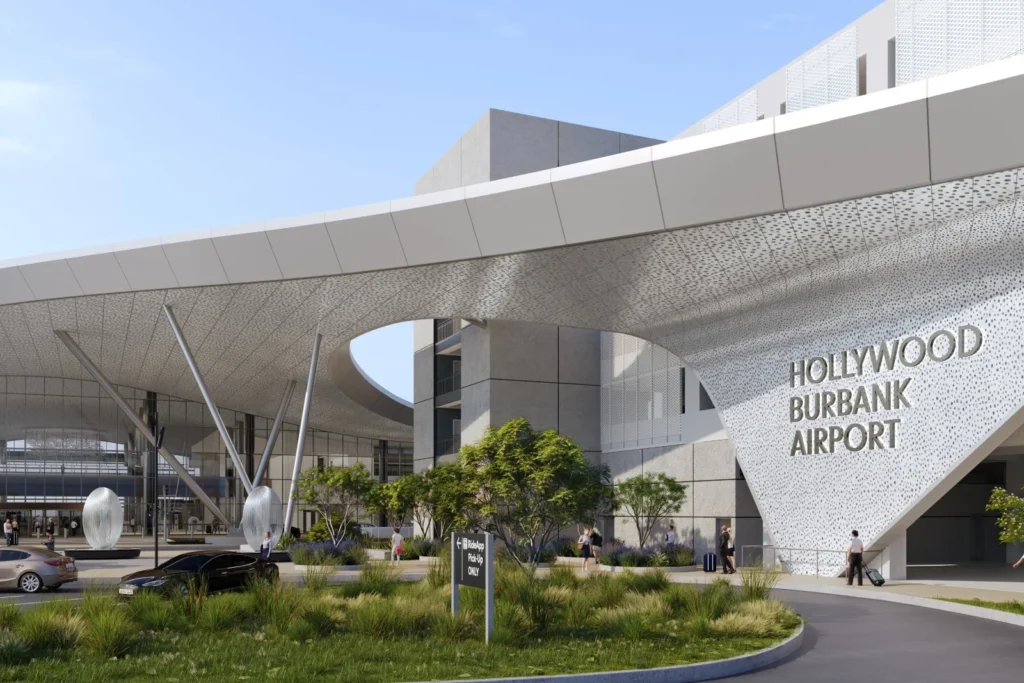
Hollywood Burbank Terminal Project is approaching a major construction milestone as Hollywood Burbank Airport (BUR) prepares to open its new $1.3 billion passenger terminal on October 13, 2026. The project will replace the airport’s historic terminal, which first opened in 1930, with a larger and more resilient facility designed to meet modern aviation standards. Located about 12 miles north of downtown Los Angeles, the airport has long served as a convenient alternative to larger regional hubs. The new terminal aims to improve passenger comfort, operational efficiency, and long-term safety while preserving the airport’s unique character.
BUR serves approximately 30 nonstop destinations through nine commercial airlines, including Allegiant Air. The airport is also the closest major aviation gateway to popular attractions such as Universal Studios Hollywood and the Warner Bros. Studio Tour. As passenger expectations evolve and regulatory requirements tighten, airport leaders have accelerated efforts to deliver infrastructure capable of supporting future growth.
Hollywood Burbank Terminal Project Replaces Aging Infrastructure
The existing terminal has served travelers for nearly a century. However, airport officials acknowledge that the facility can no longer support modern aviation demands. The two-concourse, 14-gate building offers limited space for passenger amenities, concessions, and seating areas.
Furthermore, the terminal struggles to satisfy current accessibility requirements under the Americans with Disabilities Act. The structure also falls short of California’s seismic standards and fails to comply with Federal Aviation Administration runway separation requirements.
According to Patrick Lammerding, Deputy Executive Director of Operations, Security and Safety Management Systems at BUR, renovating the existing structure was not a practical option. Consequently, airport authorities pursued a replacement project on a separate site north of the current terminal.
This approach allowed construction teams to continue airport operations throughout the development period. Once the new terminal becomes operational, crews will begin demolishing the existing facility and redeveloping the surrounding area.
The replacement terminal expands the airport’s footprint significantly. The facility will offer approximately 335,000 square feet of space, compared to the current terminal’s 232,000 square feet. In addition, the project includes a larger parking garage and upgraded supporting infrastructure.
Hollywood Burbank Terminal Project Prioritizes Passenger Experience
The new terminal maintains 14 gates while delivering substantial operational improvements. Rather than increasing capacity, designers focused on creating a more efficient and comfortable passenger experience.
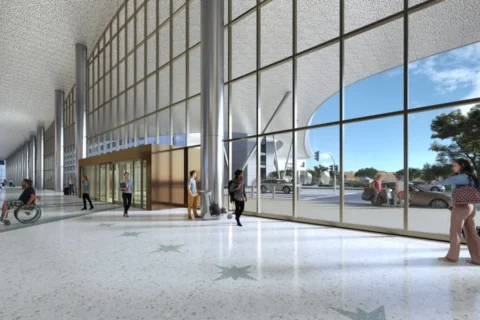
Travelers will access flights through a centralized eight-lane TSA security checkpoint. The facility will also feature floor-to-ceiling glass walls, allowing more natural light throughout the terminal.
Additional improvements include a modern baggage screening system and a consolidated baggage claim area with three carousels. Passengers will also benefit from upgraded restrooms, pet relief facilities, and expanded retail and dining options.
Despite these upgrades, airport leaders chose to preserve one of BUR’s most distinctive features. Passengers will continue boarding aircraft outdoors without jet bridges. Travelers will still walk across the tarmac and use air-stairs to access their flights.
Community feedback played a significant role in shaping this decision. Public consultations revealed strong support for maintaining the airport’s simple and convenient travel experience. As a result, planners incorporated modern functionality while retaining the airport’s unique identity.
Hollywood Burbank Terminal Project Draws Inspiration from Hollywood Heritage
The design-build team behind the project consists of Holder, Pankow, TEC Joint Venture (HPTJV), while Corgan serves as lead architect in association with CannonDesign.
Designers drew heavily from Hollywood’s Golden Age and the region’s film industry heritage. A large silver metallic canopy links the terminal to the parking structure while referencing the silver screen era of cinema.
Meanwhile, angled structural columns resemble the searchlights that historically illuminated Hollywood movie premieres. Inside the terminal, terrazzo flooring incorporates spotlight-inspired patterns that assist passenger wayfinding.
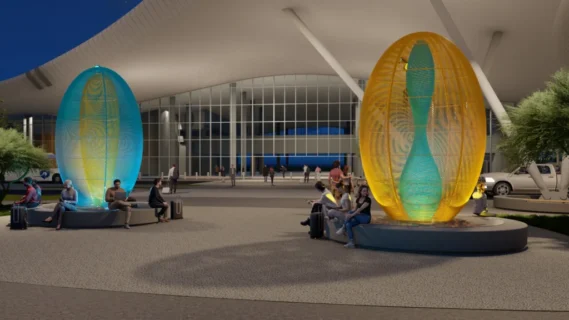
The project also integrates significant public art installations. Outside the terminal, Cliff Garten’s “The Two Electras” features illuminated sculptural forms inspired by the Lockheed Model 10E Electra Special. The aircraft was built at the site in 1936 and later flown by Amelia Earhart during her famous round-the-world attempt.
Inside the terminal, artist Glenn Kaino’s suspended artwork, “When We Reflect,” honors the site’s aviation and social history. The installation references the former Lockheed manufacturing operations that once occupied the area, including the legendary Skunk Works program, which developed iconic aircraft such as the U-2, SR-71 Blackbird, and F-117 Nighthawk.
With construction nearing completion and commissioning activities underway, the Hollywood Burbank Terminal Project is poised to become one of the most notable airport infrastructure developments in Southern California.
The Hollywood Burbank Terminal Project joins a broader wave of airport modernization projects across the United States. In California alone, major aviation hubs are investing billions of dollars to replace aging facilities and improve passenger experience. One notable example is the ongoing San Diego International Airport Terminal 1 redevelopment, a project that received regulatory approval in 2021 and has since advanced into construction phases. The multi-billion-dollar program is replacing the airport’s outdated terminal with a modern 30-gate facility, upgraded roadways, and expanded passenger amenities, reflecting the growing emphasis on resilient and future-ready airport infrastructure across the state
Also read: RDU Airport Expansion Advances with $2.5 Billion Runway, Terminal and Parking Construction Works
Also read: Hollywood Burbank Airport, $1.2 Billion Terminal Project Advances towards 2026 Completion
Project Fact Sheet
Project Name: Hollywood Burbank Terminal Project
Airport: Hollywood Burbank Airport (BUR)
Location: Burbank, California, United States
Project Cost: $1.3 billion
Project Type: Airport terminal replacement project
Opening Date: October 13, 2026
Terminal Size: 335,000 square feet
Existing Terminal Size: 232,000 square feet
Number of Gates: 14
Security Lanes: 8 TSA screening lanes
Baggage Claim: Three baggage carousels
Key Features:
- Centralized security screening
- Modern baggage handling system
- Floor-to-ceiling glazing
- Expanded concessions and dining
- Improved accessibility
- Pet relief areas
- Earthquake-resistant design
- Larger parking garage
- Outdoor passenger boarding
Current Status: Construction nearing completion
Next Milestone: Terminal opening and operational transition in October 2026
Project Team
Project Owner: Burbank-Glendale-Pasadena Airport Authority (BGPAA)
Airport Operator: Hollywood Burbank Airport (BUR)
Design-Build Contractor: Holder, Pankow, TEC Joint Venture (HPTJV)
Lead Architect: Corgan
Architectural Partner: CannonDesign
Public Art Designer: Cliff Garten Studios
Featured Artist: Glenn Kaino
Regulatory Agencies:
- Federal Aviation Administration (FAA)
- California State Regulatory Authorities
Executive Leadership: Patrick Lammerding, Deputy Executive Director of Operations, Security and Safety Management Systems
Key Stakeholders:
- City of Burbank
- City of Glendale
- City of Pasadena
Airlines Serving BUR:

Leave a Reply