Guinea is seeking international investors and development financing for a proposed $1.9 billion Simandou/Moribaya deep-sea port project as the West African country looks to expand its maritime infrastructure and support its growing mining industry. Guinea also positions the port as a means to strengthen its position in regional and international trade.
According to Guinea’s Minister of Mines and Geology, Bouna Sylla, the government has completed feasibility studies and is engaging potential financiers from the United States, China and multilateral development institutions. The proposed facility is expected to accommodate Capesize vessels carrying up to 200,000 metric tons, with a planned draft of 20 meters.
Speaking to Reuters on November 16, 2026, Sylla identified potential financing partners as the US International Development Finance Corporation (DFC), Chinese investors, and the US-headquartered World Bank. The African Development Bank (AfDB), Africa Finance Corporation (AFC) and the International Finance Corporation (IFC) are also been sought after for financing.
The government has not yet announced a timeline for selecting investors or commencing construction.
The proposed $1.9 billion Moribaya deep-sea port project is expected to become one of the largest infrastructure developments in Guinea, following the approximately $20 billion Simandou iron ore project. Unlike dedicated mining export facilities, however, the new port is being developed as a multi-user infrastructure intended to serve mining companies, container shipping operators and industrial businesses.
Guinea Deep-Water Port Project to Accommodate 200,000-Ton Vessels
The Simandou deep-sea port project is also intended to address longstanding limitations in Guinea’s maritime logistics infrastructure. This will be particular to the country’s dependence on mining companies developing dedicated export terminals and associated transport facilities.
Guinea is also the world’s largest bauxite producer and possesses substantial mineral resources. However, the development of its mining industry has historically been accompanied by infrastructure arrangements tailored to individual mining operations rather than facilities accessible to multiple commercial users.
The proposed billion-dollar port is intended to change this model. Simandou sea port will establishing shared maritime infrastructure capable of supporting different categories of cargo and commercial activity.
According to project information presented during recent investment discussions, the Simandou sea port is planned to include four berths and a bauxite storage area designed for potential expansion to accommodate alumina. It will also feature a container terminal and a general cargo terminal. The Guinea sea port project also incorporates a railway loop intended to facilitate cargo movement between the port and inland transport networks.
Its planned 20-metre draft would also allow it to accommodate Capesize vessels carrying up to 200,000 metric tons. This capacity is expected to improve bulk cargo handling and reduce some of the logistical constraints associated with transferring minerals between smaller vessels and larger ocean-going carriers.
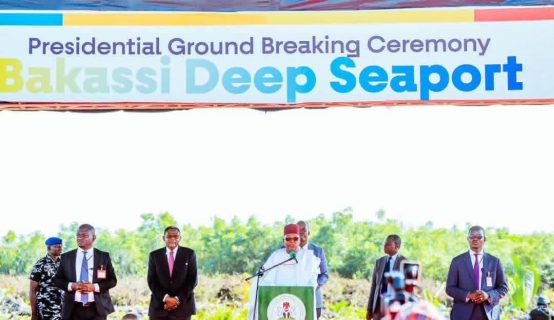
The project is also intended to serve international shipping routes. Like the $3.5 billion Bakassi Deep Seaport Project in Nigeria, it will serve international industrial operators and businesses, rather than concentrating exclusively on mineral exports.
Royal Haskoning Undertook Feasibility Studies for the Port Development
The proposed Simandou/Moribaya deep-water port project has already progressed through several preparatory stages, including feasibility studies and environmental and social assessments.
The African Development Bank supported the project’s preparation through a $2 million grant approved in 2019 to finance feasibility studies. The project is also registered under the bank’s transport infrastructure portfolio as the Feasibility Study of a Deep Sea Port in the North-West Region of the Republic of Guinea.
Royal Haskoning, an international engineering and consultancy firm based in Netherlands, undertook the feasibility work.
The studies reached the preliminary design stage in November 2025. This is while environmental and social assessment findings were presented in June 2026, according to reporting on the project’s development.
The African Development Bank subsequently published project documentation on October 28, 2026. AfDB identified Kouffin, in the rural commune of Kamsar, Boke Prefecture, as the selected site. The proposed location is approximately eight kilometers south of Kamsar.
The completion of these preparatory studies represents an important milestone, although the project still requires financial structuring and investor selection. It will also need to develop schemes of implementation before construction can proceed.
Guinea Seeks US, Chinese and Multilateral Financing for the Simandou/Moribaya Deep-Water Port Project
Financing is now a central consideration in advancing the proposed $1.9 billion development.
The Guinean government is exploring a diversified financing structure involving international development institutions, private investors and potential strategic partners from the United States and China.
The US International Development Finance Corporation is among the institutions identified by Sylla as a potential financing partner. Chinese investors are also being approached, reflecting China’s established commercial interests in Guinea’s mining and infrastructure sectors.
Other potential financing institutions include the World Bank, African Development Bank, Africa Finance Corporation and International Finance Corporation.
The government intends to establish a special-purpose vehicle (SPV) to support the project’s financing and development structure. This approach could also allow different financing partners to participate in the development. This is while providing a framework for coordinating investment and project implementation.
The financing discussions also gained momentum during the Simandou Mining Summit, where Guinea presented the proposed port to international development institutions, investors and infrastructure operators.
Participants in the investment discussions included the African Development Bank, World Bank, Islamic Development Bank, DP World and Tanger Med, among other organisations.
Deep-Sea Port to Complement Guinea’s $20 Billion Simandou Project
The proposed sea port project also forms part of Guinea’s broader ambitions to use its mineral wealth as a foundation for industrialization and economic diversification.
One of the most significant infrastructure developments in the country is the approximately $20 billion Simandou iron ore project. The iron ore project includes a railway network extending approximately 600 kilometers and a dedicated deep-water export terminal.
The project involves international partners including Rio Tinto, China’s Baowu Steel and other consortium participants. Its infrastructure is primarily designed to transport iron ore from the Simandou deposits to export markets.
The proposed $1.9 billion sea port would therefore pursue a different approach withing the broader scheme. It would provide shared infrastructure for mining companies, shipping operators and industrial businesses.
This distinction is also important because Guinea’s mineral exports have historically relied heavily on infrastructure developed by individual mining companies. A shared port could provide additional export capacity and at the same time create opportunities for businesses that cannot independently finance large-scale maritime infrastructure.
The government also hopes that the facility will support the development of downstream industrial activities. These include mineral processing and other manufacturing operations that require reliable access to international markets.
Beyond Guinea, the port could strengthen maritime trade connections with neighboring West African countries and also reinforce the country’s ambitions to become a regional logistics and commercial hub.
What Next for the $1.9 Billion Simandou Deep-Sea Port in Guinea?
The completion of feasibility studies places the proposed development beyond its initial conceptual stage. However, securing the $1.9 billion investment remains a significant requirement before the project can transition into construction.
The immediate priorities include finalising the financing structure, identifying strategic investors and establishing the arrangements required to develop and operate the multi-user facility.
The selection of an appropriate port operator and the appointment of EPC contractors will also be important subsequent milestones.
The government has also not announced a construction start date or a timeline for selecting the project’s financing partners.
If implemented, the Simandou sea port could significantly expand Guinea’s maritime cargo-handling capabilities. It could also provide additional logistics infrastructure for the country’s mining and industrial sectors.
Project Fact Sheet for the Simandou/Moribaya Deep-Sea Port in Guinea
Cost: US$1.9 billion
Location: Kouffin, Kamsar, Boke
Port type: Multi-user deep-water port
Planned draft: 20 meters
Vessel capacity: Up to 200,000 metric tons (Capesize)
Proposed facilities: Four berths, bauxite storage facilities, container terminal, general cargo terminal and railway loop
Feasibility consultant: Royal Haskoning
Feasibility studies: Completed
Environmental and social assessments: Undertaken
Feasibility study financing: US$2 million AfDB grant
Potential financiers: US DFC, Chinese investors, World Bank, AfDB, AFC and IFC
Proposed financing structure: Special-purpose vehicle (SPV)
Project status: Proposed
Government programme: Guinea’s broader infrastructure and industrial development agenda, including Simandou 2040
Who is Involved in the Guinea Deep-Water Port Project?
-
Government of Guinea as project sponsor
-
Guinea Ministry of Mines and Geology for mining infrastructure policy and project coordination.
-
Ministry of Economy, Finance and Budget for investment mobilization and financing discussions.
-
Ministry of Transport for maritime and transport infrastructure oversight.

Leave a Reply