Chile’s Committee of Ministers has officially upheld the environmental approval for the $4.45 billion San Antonio Port Expansion in the Valparaíso Region.
This decision reinforces major South American Pacific logistics investments, building upon deep-water infrastructure benchmarks set by the Chancay Port: A Revolutionary Project on the Peruvian Coast to meet expanding transpacific trade demand.
State-owned port authority Empresa Portuaria San Antonio (EPSA) will oversee the megaproject, locally known as “Puerto Exterior,” which triples the port’s container throughput.
Government officials confirmed that the environmental ruling clears the path to initiate main civil works tenders along the central coastline. 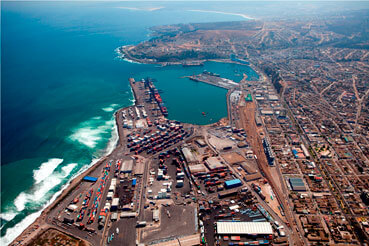
Port leadership designed the complex facility to handle up to six million twenty-foot equivalent units (TEUs) annually upon full buildout. The infrastructure program allows the port to berth eight 400-meter-long container ships simultaneously.
Engineering Scope and Infrastructure Capital for San Antonio Port Expansion
Development teams structured the multi-billion-dollar initiative into public infrastructure works and private terminal concessions.
Empresa Portuaria San Antonio provides $1.95 billion directly to construct a massive 4-kilometer breakwater, execute deep-water basin dredging, and build road-rail connection corridors.
Private terminal operators will contribute an additional $2.5 billion through long-term operational concessions to install ship-to-shore gantry cranes and terminal automation systems.
- Breakwater and Channel Works: Civil engineering crews build a 3,950-meter concrete breakwater to create a calm harbor basin reaching depths of 17.5 meters.
- Terminal Dock Concessions: Contractors will build two specialized container terminals, each featuring 1,730 meters of continuous quay wall.
- Intermodal Rail Connectivity: Logistics planners integrate dedicated freight rail lines to haul over 40% of container cargo directly into Santiago’s distribution hubs.
Engineers engineered the marine layout to withstand high seismic activity and severe Pacific ocean swells. Constructing the protective outer breakwater requires millions of tons of quarried armor stone and prefabricated concrete dolos units.
Environmental Mitigation and Project Roadmap for San Antonio Port Expansion
Environmental authorities subjected the mega-development to a rigorous six-year assessment process before granting final clearance.
EPSA committed to extensive mitigation measures, including establishing the Lagunas de Llolleo Park to safeguard nearby coastal wetlands and native bird habitats.
Civil works on the primary breakwater infrastructure target start dates in 2027. Project managers expect the first terminal berth to begin commercial operations by 2036, delivering long-term capacity for regional exporters across South America.
The massive port development will create approximately 2,200 direct construction jobs during peak breakwater assembly.
Permanent port operations will sustain over 8,000 long-term technical, logistics, and marine service positions across the Valparaíso Region.
Project Fact Sheet
Name: San Antonio Outer Port (“Puerto Exterior”) Expansion Project.
Type: Deep-Water Port Expansion, Outer Breakwater Construction & Container Terminal Concessions.
Location: San Antonio, Valparaíso Region, Chile.
Total investment: $4.45 Billion USD ($1.95B Public Breakwater & Dredging / $2.5B Private Terminal Concessions).
Developer: Empresa Portuaria San Antonio (EPSA) & Ministry of Transport and Telecommunications (MTT).
Status: Environmental Approval Upheld; Civil Engineering Design & Breakwater Procurement Phase.
Construction employment: Estimated 2,200+ direct civil construction workers, marine engineers, and heavy equipment operators.
Permanent employment: Over 8,000 permanent terminal operators, logistics coordinators, stevedores, and tugboat crews.
Timelines and production targets: Breakwater construction starts in 2027; Phase 1 berth operational by 2036; full completion targets 6 Million TEU annual throughput capacity.
Technology integration: Automated Terminal SCADA Systems, Electric Ship-to-Shore (STS) Gantry Cranes, Smart Gate OCR Access, Deep-Water Vessel Tracking.
Raw material supply: Armor quarry stone, reinforced concrete dolos, high-grade structural steel piling, marine geotextiles, and ballast.
Economic impact: Triples Chilean container handling capacity, lowers maritime freight costs, and secures South American Pacific trade corridors.
Key infrastructure needs: 3,950m Outer Breakwater, 17.5m Dredged Channel, 3,460m Total Quay Wall, Intermodal Freight Rail Yard.
Delivery risks: Heavy ocean swell conditions during breakwater placement, seismic risks, strict wetland environmental compliance.
Primary target markets: South American Mining & Agricultural Exporters, Transpacific Shipping Lines, Asian-Latin American Trade Lanes.
Project Team
Project Authority & Developer: Empresa Portuaria San Antonio (EPSA)
Lead Government Ministry: Ministry of Transport and Telecommunications (MTT, Chile)
Environmental Regulator: Environmental Assessment Agency (SEA) & Committee of Ministers (Chile)
Regional Economic Partners: Valparaíso Regional Government & Municipality of San Antonio



Leave a Reply