
King Salman Airport construction has reached another major procurement milestone after contractors submitted prequalification documents for several key construction packages in Riyadh. The latest progress signals accelerating delivery of the estimated $100 billion aviation development, which remains central to Saudi Arabia’s Vision 2030 transport strategy. Moreover, the submissions move the project closer to tendering major works that will transform the existing King Khalid International Airport into one of the world’s largest aviation hubs.
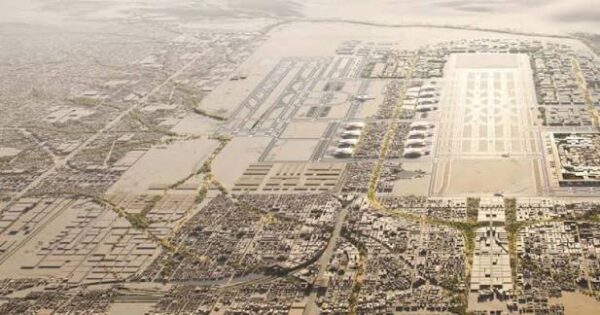
The latest prequalification process covers critical infrastructure, including the third runway, taxiways, the Iconic Terminal, and Terminal 6. Consequently, King Salman International Airport Development Company (KSIADC) continues preparing the market for large engineering, procurement and construction contracts while maintaining its ambitious completion schedule.
Saudi Arabia considers the airport a strategic investment that will strengthen tourism, logistics and international connectivity. Furthermore, the development supports the Kingdom’s broader objective of becoming a leading global aviation and logistics hub by 2030.
Also read: $50bn Jeddah Airport Expansion Project Advance Through Singapore’s Surbana Jurong Partnership
King Salman Airport Construction enters key procurement phase
KSIADC received prequalification submissions for multiple construction packages after inviting qualified contractors earlier this year. The latest submissions include contracts covering the third runway, taxiways, and the first development phase of the Iconic Terminal and Terminal 6.
Unlike traditional procurement, the terminal package will follow an Early Contractor Involvement (ECI) model. Therefore, shortlisted contractors will contribute construction methodologies alongside detailed design proposals before full execution begins.
The airport development remains divided into eight principal assets. These include the Iconic Terminal, Terminal 6, private aviation facilities, central runway infrastructure, hangars, landside transport systems, cargo buildings and supporting real estate developments.
Earlier prequalification exercises also covered engineering services, specialist systems, modular construction, environmental services, health and safety, professional consultancy and enabling works. As a result, the client has established a broad procurement pipeline supporting parallel construction activities.
The runway package represents another important milestone because the third and fourth runways will complement the existing two runways at King Khalid International Airport. Eventually, those facilities will become part of the expanded King Salman International Airport.
King Salman Airport Construction supports Saudi aviation ambitions
The airport occupies approximately 57 square kilometers, making it among the world’s largest airport developments. Additionally, the masterplan includes six parallel runways, 12 square kilometers of airport support facilities, residential districts, commercial developments and logistics infrastructure.
Once operational, the airport aims to serve 120 million passengers annually by 2030. Thereafter, annual capacity should increase to 185 million passengers by 2050. Meanwhile, cargo handling capacity will reach 3.5 million tones every year.
The project also supports Saudi Arabia’s aviation strategy, which targets 330 million annual passengers, over 250 global destinations and 4.5 million tones of annual cargo by 2030. Therefore, the airport will become a cornerstone of national transport expansion.
Industry observers expect procurement activity to continue throughout the year as KSIADC advances additional packages across the development. Consequently, construction opportunities will expand for international and regional contractors specializing in airport infrastructure, terminals, transport systems and aviation support facilities.
Saudi Arabia is simultaneously expanding its aviation network through several landmark developments. While the King Salman Airport Project aims to establish Riyadh as a global aviation and logistics hub, the proposed Mecca Airport Project focuses on improving access for millions of Hajj and Umrah pilgrims. Together, the two projects demonstrate the Kingdom’s coordinated investment in world-class airport infrastructure to support Vision 2030, boost passenger capacity and strengthen regional connectivity.
King Salman Airport Construction design team prepares for large-scale delivery
KSIADC previously appointed several international consultants to guide project delivery. Foster + Partners leads the airport masterplan, including terminal architecture, six runways and the surrounding mixed-use development. Meanwhile, Jacobs provides specialist consultancy for runway planning and technical design.
Mace serves as the program delivery partner, supporting overall project management and implementation. In addition, Nera manages the airspace design consultancy required for future airport operations.
Construction activities will continue through multiple procurement phases before the airport reaches full operational capacity. Consequently, the project remains one of the world’s most significant aviation infrastructure investments and a flagship component of Saudi Arabia’s long-term economic diversification program.
Also read: King Salman International Airport Construction Reaches New Phase in $100bn Riyadh Aviation Expansion
Project Fact Sheet
Project name: King Salman International Airport Project
Estimated value: $100 billion
Location: Riyadh, Saudi Arabia
Client: King Salman International Airport Development Company (KSIADC)
Owner: Public Investment Fund (PIF)
Project type: Greenfield airport expansion and aviation infrastructure
Development area: Approximately 57 square kilometers
Runways: Six planned parallel runways
Current milestone: Prequalification submissions received for runway and terminal construction packages
Major assets: Iconic Terminal, Terminal 6, private aviation terminal, cargo facilities, hangars, landside transport, central runway infrastructure and real estate developments
Delivery approach: Early Contractor Involvement (ECI) for terminal package
Target passenger capacity: 120 million annually by 2030
Long-term passenger capacity: 185 million annually by 2050
Cargo capacity: 3.5 million tones annually by 2050
Target completion: 2030 for initial operational objectives
Strategic objective: Support Saudi Vision 2030 and national aviation expansion
Project Team
Owner: Public Investment Fund (PIF)
Client: King Salman International Airport Development Company (KSIADC)
Masterplan architect: Foster + Partners
Runway engineering consultant: Jacobs
Program delivery partner: Mace
Airspace design consultant: Nera
Future EPC contractors: To be selected following the ongoing prequalification and tender process
Engineering, procurement and construction packages: Multiple international and regional contractors to be appointed across terminals, runways, cargo facilities, landside infrastructure and specialist systems.




Leave a Reply