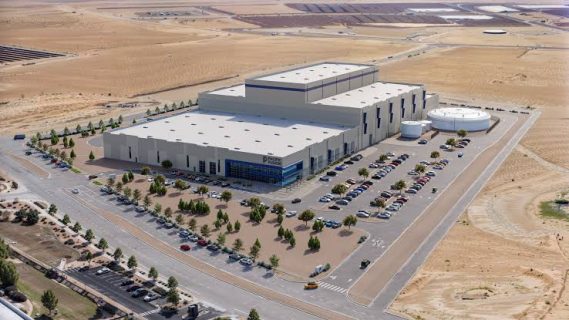
$1bn Albuquerque Research and Manufacturing (ARM) nuclear campus by Pacific Fusion makes headway as New Mexico clears tritium use for the fusion facility. The state has granted its first-ever radioactive materials license to a private fusion company, Pacific Fusion, which is developing a facility on campus. In addition, the New Mexico Environment Department permit allows the company to store and operate tritium at the plant. In the meantime, site construction began in August, about a year after Pacific Fusion chose New Mexico for the project.
Nevertheless, the license is a first for the state in terms of regulation. In addition, Pacific Fusion will continue to collaborate closely with regulators as construction progresses towards readiness. Now engineers at the plant are racing to test a pulsed-power fusion machine by 2030. This means that the permit removes a major material obstacle before that deadline.
Other Projects
On a related note, EmberClear has unveiled the Dunbar Power Project with a 1.4GW gas plant. In addition, the complex combines a 28.3 million square feet data center site with a 1.4 GW gas plant. The Houston-based developer is offering the complex on an 837-acre parcel in Dunbar Township. In addition, the land is located north of Penn State-Fayette campus. In addition, approximately 650 acres east of the plant parcel would be used for the potential data center project. A final investment decision is scheduled for 2028, meanwhile.
Scope of the ARM Nuclear Campus by Pacific Fusion
Therefore, Pacific Fusion sets a higher bar than previous fusion experiments. Previous laser and magnetic attempts were limited in scope. They compared the energy that struck the fuel capsule with the energy that was released by the reaction. In addition, the startup evaluates the efficiency of the entire plant. The reaction must produce more energy than the machine can store for net facility gain. Moreover, that comparison is for the total electrical energy stored prior to the shot being fired. That has never been accomplished in a laboratory, and the benchmark is the foundation for getting clean, affordable fusion energy to the grid.
The engineering track is pulsed-power inertial confinement. The system eliminates the need for large arrays of lasers or magnetic coils in a tokamak. Rather, it emits high-intensity electrical pulses into a target. In addition, the high current pulse generates very high magnetic pressure, which compresses a small fuel capsule very quickly to start the fusion process. In the meantime, the power systems are built from modular, standard electrical components, using widely available industrial materials, which keeps manufacturing costs low.
The regulatory framework is commensurate with the lower risk profile of fusion. NMED regulates fusion under a framework similar to hospitals and research labs because it does not have the risks associated with fission. In addition, the small amount of tritium is contained in a closed system during operation. Also, any radioactive waste that is shipped out of state for disposal at a licensed facility.
Outlook for the New Mexico fusion ecosystem
State leaders tie the project to broader energy goals. The campus is committed to the goals of the Energy Transition Act of New Mexico, which calls for a zero-carbon electricity future. In addition, Environment Secretary James Kenney congratulated the milestone. It demonstrates the state’s talent and infrastructure to lead clean energy innovation, he said. Moreover, he added that the project will create good-paying jobs while safeguarding public health and the environment.
Pacific Fusion attributes the state’s rapid pace to its leadership. Carrie von Muench, co-founder and Chief Operating Officer, commended regulators for their swift and responsible action on the first-of-its-kind facility. In addition, she said, New Mexico is well-positioned for scientific expertise and advanced manufacturing. The state can thus serve as a hub for the new fusion economy in America. “This is a great milestone for Pacific Fusion, but it’s a great milestone for the jobs, investment and long-term economic opportunity that fusion can provide to New Mexico,” Muench concluded.
Finally, the timeline has been extended from the license to ongoing construction to the 2030 machine test. After that, the net facility gain attempt comes, which no laboratory has ever achieved. As a result, New Mexico is home to the first privately licensed tritium operation. In the meantime, the $1 billion campus is carrying the state’s hopes for fusion.


Leave a Reply