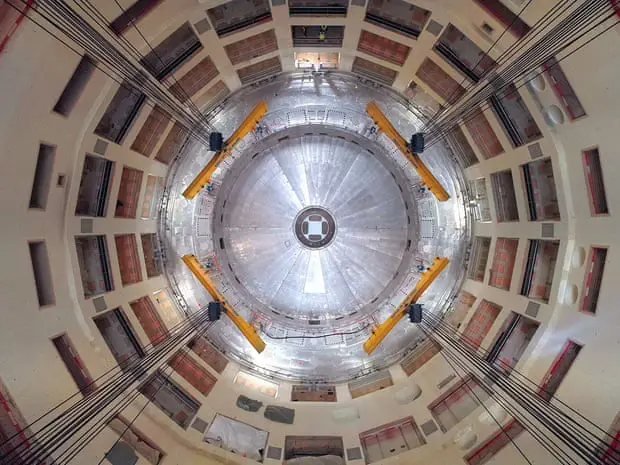
The ITER nuclear fusion project in southern France has entered a major construction milestone as assembly of its tokamak accelerates. The international project aims to demonstrate whether fusion can produce sustained energy at an industrially relevant scale.
The ITER Organization now reports that six of nine tokamak sector modules sit inside the reactor pit. The latest installation occurred on July 28, 2026, nearly six months ahead of the assembly schedule.
ITER nuclear fusion project accelerates tokamak construction
The latest milestone places two-thirds of the tokamak’s toroidal core in position. The sixth sector module weighs approximately 1,100 tones without its lifting equipment. The complete suspended load reached nearly 1,400 tones during the installation operation.
ITER teams have installed sector modules progressively since April 2025. They now target installation of the ninth and final module during 2027. Furthermore, experience from successive lifting operations has improved assembly speed and predictability.
The project involves seven international members: China, the European Union, India, Japan, Korea, Russia, and the United States. Together, these members coordinate the supply of thousands of components for the experimental fusion facility. The tokamak will use powerful magnetic fields to confine extremely hot plasma. ITER aims to demonstrate 500 MW of fusion power from 50 MW of heating input. That target corresponds to a fusion energy gain factor, Q, of at least 10.
ITER nuclear fusion project adopts revised construction baseline
The project has undergone significant schedule changes since its assembly phase. The original article expected first plasma in late 2025, but ITER no longer follows that timeline. ITER Members endorsed the Baseline 2024 approach after reviewing schedule, technical and licensing challenges.
The revised strategy prioritizes a more robust start to research operations while reducing technical risks. Under the revised research plan, ITER targets deuterium-deuterium fusion operations in 2035. The program will then progress toward deuterium-tritium operations and the project’s Q=10 objective.
Meanwhile, civil construction at the southern France site is largely complete. Machine assembly now represents the central construction activity, while commissioning of early subsystems has also started.
The project has also advanced beyond major civil works into complex equipment integration. For example, teams energized the first transformer serving the poloidal field coil power supply system in June 2026.
ITER nuclear fusion project expands advanced energy construction
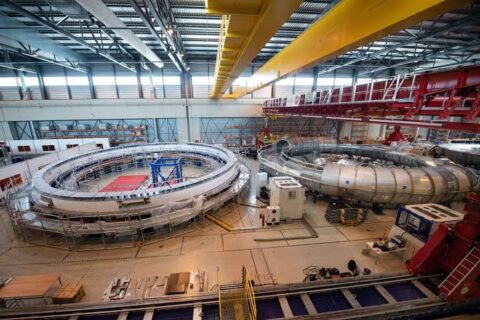
ITER remains one of the most technically demanding energy projects under construction globally. The machine will weigh about 23,000 tones and incorporate approximately 3,000 tones of superconducting magnets. Those magnets connect through roughly 200 kilometers of superconducting cables maintained at cryogenic temperatures.
The project’s cost also requires careful qualification because ITER Members procure components through different national currencies. ITER states that converting the entire construction cost into one currency does not provide a directly relevant figure.
The project’s progress also provides important context for Sweden’s emerging advanced nuclear program. The planned Untra nuclear reactor park would pursue fission through eight lead-cooled reactors delivering up to 440 MW. Unlike ITER’s fusion experiment, Untra targets electricity generation through modular advanced reactor technology. Both projects nevertheless demonstrate how new nuclear technologies are reshaping large-scale energy construction.
The contrast highlights a broader shift from conventional nuclear construction toward technologies requiring specialized engineering and manufacturing. ITER focuses on fusion research, while Untra seeks commercial electricity production using advanced modular reactors.
Project Fact Sheet
Name: ITER Nuclear Fusion Project.
Type: International nuclear fusion research facility.
Location: Saint-Paul-lez-Durance, southern France.
Host country: France.
Technology: Magnetic-confinement fusion using a tokamak.
Main facility: ITER Tokamak.
Reactor objective: Demonstrate fusion conditions relevant to future commercial power plants.
Target fusion power: 500 MW thermal.
Heating input target: 50 MW.
Target energy gain: Q≥10.
Tokamak core modules: Nine.
Modules installed by July 2026: Six.
Individual sector module weight: Approximately 1,100 tonnes.
Suspended lifting load: Nearly 1,400 tonnes.
Target final module installation: 2027.
Superconducting magnet mass: Approximately 3,000 tonnes.
Superconducting cable length: Approximately 200 km.
Overall machine weight: Approximately 23,000 tonnes.
Civil construction status: Largely complete.
Current phase: Machine assembly and subsystem commissioning.
Baseline: Baseline 2024.
Deuterium-deuterium operations target: 2035.
Project members: China, European Union, India, Japan, Korea, Russia and United States.
Construction cost: Current single-currency total not publicly stated by ITER.
Previously reported project value: $23.6 billion.
Current assembly milestone: Two-thirds of tokamak core installed.
Project Team
Organization: ITER Organization
Host country: France
European member contribution: European Union
Member contribution:
- China
- India
- Japan
- Korea
- Russia
- United States
Director-General: Pietro Barabaschi.
Machine assembly contractor consortium: CNPE Consortium
French industrial participant: Framatome
US program organization: US ITER.
US laboratory partner:
- Oak Ridge National Laboratory
- Princeton Plasma Physics Laboratory
- Savannah River National Laboratory
French nuclear safety authority: Autorité de sûreté nucléaire et de radioprotection
Assembly program: ITER Organization and seven Domestic Agencies
Also Read: ENEC completes construction of Unit 2 of Barakah Nuclear Energy Plant.


Leave a Reply