Sandy Ridge data center plans are entering a crucial financing stage as Hong Kong seeks to expand its construction pipeline. The project forms part of the city’s strategy to strengthen artificial intelligence infrastructure and attract high-value digital industries. However, financing negotiations could determine how quickly the development progresses.
Hong Kong awarded the Sandy Ridge site to Range Intelligent Computing Technology Company in March 2026. The 110,000-square-metre site carries a 50-year land grant and a HK$581 million land premium.
Range Intelligent pledged HK$24 billion for the development, equivalent to about $3.2 billion. The company has approached banks for roughly HK$20 billion in project financing.
The financing would rank among Hong Kong’s largest loan transactions in 2026. However, negotiations remain ongoing as lenders assess the project’s repayment capacity and development plans.
Sandy Ridge data center financing enters critical phase
Range Intelligent initially discussed raising HK$2 billion through a first financing tranche. The company would then seek another HK$18 billion during 2026.
However, lenders have raised concerns about security arrangements surrounding the initial HK$2 billion borrowing. Range Intelligent reportedly wanted to preserve collateral for the larger financing package.
Several banks have nevertheless submitted loan proposals to the company. Existing relationships with mainland Chinese banks could support the financing process.
Range Intelligent already operates substantial computing infrastructure across mainland China. Its facilities provide approximately 750MW of computing capacity.
That figure exceeds Hong Kong’s current data center capacity. However, the company has only recently expanded beyond mainland China.
The company also has a data center project under development on Indonesia’s Batam Island. Therefore, Sandy Ridge represents another significant step into international markets.
Sandy Ridge data center anchors Northern Metropolis expansion
The Sandy Ridge development sits within Hong Kong’s Northern Metropolis program. The broader 300-square-kilometre initiative targets technology, infrastructure and economic development near the mainland border.
The government expects Sandy Ridge to generate about HK$4.6 billion in economic output during its first three years. The development will also strengthen computing infrastructure supporting artificial intelligence applications.
Government planning documents identify a gross floor area of 250,000 square meters. Nearly 90% of that area will serve high-tier data centers.
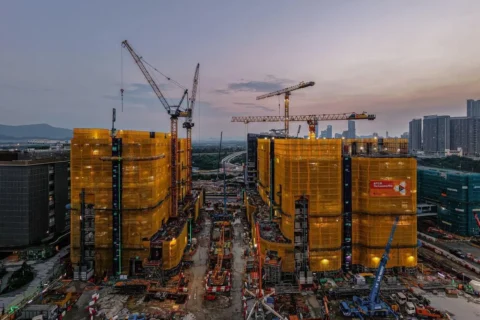
The project has already entered the construction stage. Authorities expect the facility to begin operations in 2029.
By 2032, the development could provide 180,000 petaFLOPS of computing power. That would equal about 36 times Hong Kong’s current computing capacity.
Infrastructure expansion around Sandy Ridge will also support the project. The University of Hong Kong is developing a new campus nearby.
Meanwhile, MTR plans underground rail infrastructure connecting the sparsely populated area. These investments could improve access and strengthen the Northern Metropolis development framework.
Hong Kong data center construction outlook
Hong Kong expects its live data center capacity to exceed 1,100MW by 2030. Structure Research estimates that this expansion requires at least $7 billion.
That investment covers data centers and associated infrastructure. The estimate highlights the capital requirements behind Hong Kong’s broader digital infrastructure ambitions.
The city also faces changing investment patterns within the international data center market. North American investors are increasingly favoring facilities operated by major US hyperscalers.
Consequently, Hong Kong is increasingly targeting demand from mainland Chinese technology companies. Alibaba, Tencent and ByteDance represent major potential sources of computing demand.
Hong Kong authorities continue supporting data center development through land, infrastructure and facilitation measures. The government also identifies Sandy Ridge as an important artificial intelligence infrastructure project.
The financing outcome therefore carries implications beyond one development. It could demonstrate whether large-scale data center construction can attract sufficient private capital in Hong Kong.
Hong Kong’s $3.2 billion Sandy Ridge data center project reflects the growing demand for high-density AI computing infrastructure. A related development in China demonstrates how new data center designs are adapting to rising power and cooling requirements. The Huawei 3D Data Center in Wuhu uses vertically stacked cooling, computing, power and backup systems to support clusters exceeding 100,000 Ascend cards.
Also read: $35 Billion DeepSeek Data Center: Construction Planned for 1GW AI Infrastructure in Inner Mongolia
Project Fact Sheet
Project: Sandy Ridge Data Facility Cluster.
Location: Sandy Ridge, North District, Hong Kong.
Development area: More than 110,000 square meters.
Planned gross floor area: 250,000 square meters.
Data center allocation: Nearly 90% of the gross floor area.
Investment pledge: HK$24 billion, approximately $3.2 billion.
Proposed financing: About HK$20 billion in loans.
Land premium: HK$581 million.
Land tenure: 50-year land grant.
Construction status: Project entered the construction stage in 2026.
Planned operations: 2029.
Target computing capacity: 180,000 petaFLOPS by 2032.
Economic output: About HK$4.6 billion during the first three years.
Wider development: Part of Hong Kong’s Northern Metropolis program.
Primary purpose: High-tier data centers and related digital infrastructure.
Strategic function: Supporting artificial intelligence development and computing demand.
Project Team
Developer: Hong Kong Range Intelligent Computing Technology Company.
Parent companies: Hong Kong Range Intelligent Computing Technology Development Company and Sengro Fusion Technology Hong Kong.
Ultimate holding company: Range Intelligent Computing Technology Group Company.
Government authority: Hong Kong Innovation, Technology and Industry Bureau.
Digital infrastructure support: Hong Kong Digital Policy Office.
Financing participants: Hong Kong and mainland Chinese banking institutions.
Transport infrastructure: MTR Corporation for planned Northern Metropolis rail connectivity.
Nearby institutional development: The University of Hong Kong.

Leave a Reply