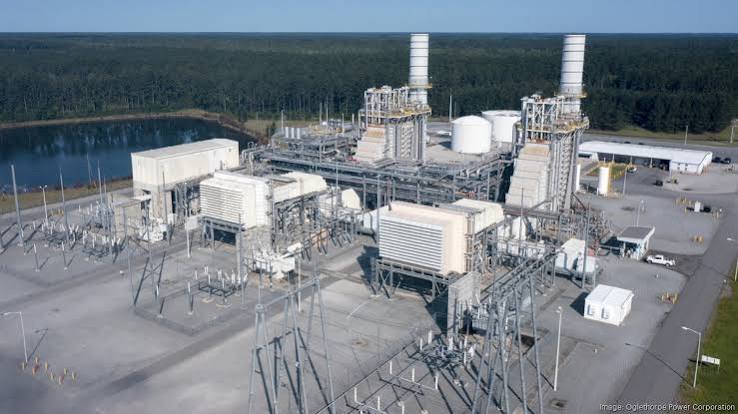
Is rural Georgia really getting a power plant, or is AI getting a power plant that happens to be in rural Georgia?
A $3.3 billion federal loan will help complete one of Georgia’s largest new power plants. The official purpose is rural reliability and affordable electricity. But the plant’s location—about half a mile from a major Google data-center project—has raised a harder question: is America’s rural power system now being expanded partly to serve the AI economy?
On October 14, U.S. Agriculture Secretary Brooke Rollins announced the loan to Oglethorpe Power Corporation to help finance its Smarr Combined-Cycle electric generating facility in unincorporated Smarr, Monroe County, Georgia. USDA described it as the largest loan in the history of its Rural Utilities Service.
The 1.4-gigawatt natural-gas plant is already under construction. Oglethorpe Power began building it in May, and the new federal financing is intended to help carry the project through to completion.
What the loan does
Oglethorpe Power is a nonprofit, member-owned generation cooperative. It sells electricity at wholesale prices to 38 electric distribution cooperatives that serve nearly 5 million people across Georgia.
The USDA loan carries an interest rate of roughly 6.3 percent—the Treasury rate plus one-eighth of a percentage point. Oglethorpe Power President and CEO Annalisa Bloodworth said the financing would save the member cooperatives about $25 million a year in interest as the debt is repaid over 30 years.
Those savings matter because the cost of the loan will ultimately be passed through to electricity customers. Lower financing costs can help limit the pressure on household and business bills as the utility pays for a major new power plant.
“This historic loan will allow us to build the reliable generation Georgia families, farms and businesses need at a lower cost,” Bloodworth said when the loan was announced.
Why a gas plant now
USDA framed the project as a response to rising electricity demand driven by rapid technological change. Rollins argued that American energy dominance requires more baseload generation—not less.
“American energy dominance is not going to be achieved through renewable sources alone,” Rollins said. “It requires increasing our generating capacity with more baseload power, not less.”
Combined-cycle natural-gas plants are attractive to utilities because they can produce large amounts of electricity reliably and can ramp up or down more easily than some other forms of generation. That makes them useful as demand grows and as utilities try to balance intermittent resources such as solar and wind.
But the project also adds fossil-fuel generation at a time when electricity demand is rising partly because of data centers, electric vehicles, manufacturing, and artificial intelligence. That creates a central tension: the same growth that makes new generation necessary also makes its climate consequences harder to ignore.
The data-center question
The Smarr plant is located in southern Monroe County, not far from a Google data-center project. That proximity has made the loan more than a routine utility-financing story.
Bloodworth was direct: the new 1.4 GW of generation is not being built for data centers. She said the plant will serve Oglethorpe’s 38 member cooperatives, each governed by locally elected boards and accountable to their members.
Still, she acknowledged that some member cooperatives have been approached by data-center developers in the past. And USDA itself connected the loan to the broader surge in electricity demand from technological advancement.
That does not prove the plant exists to serve AI. But it explains why the project has become a test case for a bigger issue: when rural utilities build new generation, how much of that capacity will ultimately support local communities—and how much will help accommodate large commercial customers such as data centers?
Who benefits—and who pays
The clearest beneficiaries are Oglethorpe’s member cooperatives and their customers. The low-cost federal loan reduces financing expenses, while the new plant adds generation capacity to a system serving millions of Georgians.
Monroe County also stands to gain from construction activity and a major long-term infrastructure investment. The project is already under construction, meaning some of the economic benefits are no longer hypothetical.
The costs are less visible. A natural-gas plant requires fuel, maintenance, transmission access, and eventual retirement or replacement. Its emissions also become part of Georgia’s broader energy and climate picture.
The central question is whether the benefits and burdens are being shared fairly. Rural customers may receive more affordable financing and reliable power, but they may also be helping build capacity that makes their communities more attractive to energy-intensive developments.
That is why FERC’s 60-day review matters beyond Washington. The agency is asking grid operators to clarify exactly the issues this Georgia project exposes: how large users connect to the grid, whether their costs are transparent, and whether ordinary customers are protected when new generation and transmission are built. As data centers continue to seek power across the country, the rules FERC is now reviewing could determine whether projects like Smarr remain primarily rural infrastructure—or become part of the backbone of the AI economy.
A bigger federal shift
The USDA loan is not an isolated case. Earlier this year, the Department of Energy provided Georgia Power with a loan of more than $22 billion for upgrades across its generation fleet.
Together, the two deals show that the federal government is becoming a major financier of new and upgraded electricity infrastructure in Georgia. That shift reflects a national reality: the United States needs more generation and transmission capacity, and utilities are turning to federal financing to pay for it.
But it also raises an accountability question. When public-backed loans support fossil-fuel generation, taxpayers and ratepayers deserve a clear explanation of the trade-offs: reliability and affordability on one side; emissions, fuel exposure, and long-term infrastructure costs on the other.
What happens next
The Smarr plant will continue construction, with the USDA loan helping finance its completion. Oglethorpe says the facility will provide dependable, affordable power for its member cooperatives.
The more important story may unfold over the next several years. If Georgia’s electricity demand keeps rising, the line between “rural reliability” and “data-center growth” may become harder to draw.
The Smarr plant was approved as a project for Georgia’s electric cooperatives. Whether it also becomes part of the infrastructure that enables AI expansion will depend on decisions made by local cooperatives, developers, regulators, and the technology companies seeking power.
What we know and what remains unclear
What we know
- USDA announced a $3.3 billion loan to Oglethorpe Power on October 14.
- The loan is the largest ever issued by USDA Rural Development’s Rural Utilities Service.
- It will help finance the 1.4 GW Smarr Combined-Cycle natural-gas plant in unincorporated Smarr, Monroe County.
- Oglethorpe Power is owned by 38 distribution cooperatives serving nearly 5 million people.
- The loan’s interest rate is about 6.3 percent, and Oglethorpe estimates savings of about $25 million annually over 30 years.
- The plant is under construction near a Google data-center project.
The remaining uncertainty
- How much of the plant’s future output may ultimately serve data centers or other large commercial customers.
- Whether additional data-center projects will seek power from Oglethorpe’s member cooperatives.
- How the plant’s emissions and fuel costs will affect long-term electricity prices.
- Whether federal financing at this scale will become a standard model for new gas generation.
Partners
Oglethorpe Power Corporation is developing the 1,425-MW Smarr combined-cycle natural gas plant in Monroe County, Georgia. The Industrial Company (TIC), a Kiewit subsidiary, is the engineering, procurement and construction contractor, while GE Vernova will supply 7HA.03 gas turbines and related equipment under a long-term service agreement. The project is backed by a record $3.3 billion USDA Rural Utilities Service loan and wholly owned by Oglethorpe Power, whose 38 member cooperatives include 29 subscribed to its output. Groundbreaking took place on May 7, 2026, following site preparation that began in late 2025. Commercial operations are expected in 2029.
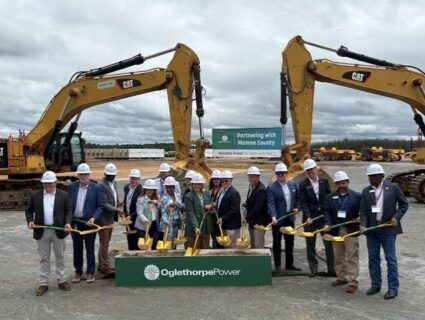
Factsheet: Smarr Combined-Cycle electric generating facility
- Location: Unincorporated Smarr, Monroe County, Georgia.
- Developer: Oglethorpe Power Corporation.
- Capacity: 1.4 gigawatts.
- Fuel: Natural gas.
- Status: Under construction; construction began in May.
- Loan amount: $3.3 billion.
- Loan provider: USDA Rural Development’s Rural Utilities Service.
- Loan significance: Largest loan in Rural Utilities Service history.
- Interest rate: About 6.3 percent.
- Estimated interest savings: About $25 million annually over 30 years.
- Owner structure: Oglethorpe is owned by 38 electric distribution cooperatives serving nearly 5 million Georgians.

Leave a Reply