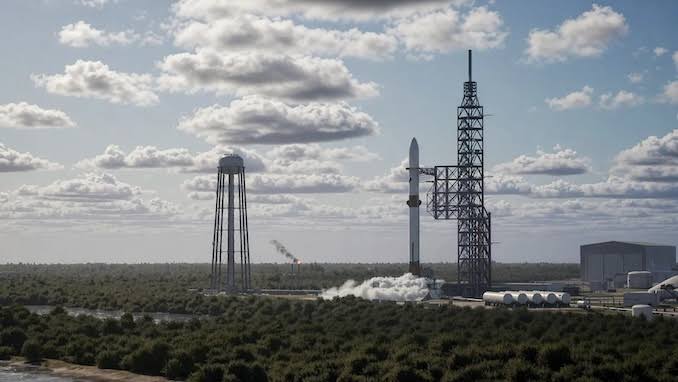
Jeff Bezos’ space company says a $330 million expansion of its Rocket Park campus in Cape Canaveral, Florida, is underway to build New Glenn upper stages at scale. Completion is expected in summer 2027, when the plant is designed to produce up to 150 upper stages a year for the larger New Glenn 9×4 rocket.
Operating across more than 20 sites in Brevard and Orange counties, Blue Origin has invested more than $3 billion in Florida facilities, employs more than 5,000 people and works with 500 Florida suppliers, according to Ian Richardson, the company’s senior vice president of operations. The company is targeting multiple New Glenn flights a week by the end of the decade and has filed an environmental assessment to raise the permitted launch rate at Launch Complex 36 from 12 to 50 a year. Blue Origin says its Florida footprint has more than doubled in the last couple of years.
Growth is also pushing Florida’s airports to add capacity quickly. At Jacksonville International Airport, the Concourse B project that Balfour Beatty started in 2024 is now scheduled for a ribbon cutting on January 27, 2027, with American Airlines flights from its six gates starting the next day, according to Jacksonville Aviation Authority chief operating officer Tony Cugno. That is later than the December 2026 completion targeted when construction began on the $344 million concourse. Cugno said the authority expects a certificate of occupancy from the city on December 30.
Blue Origin Rocket Park Expansion Targets 150 Upper Stages a Year for New Glenn 9×4
The Rocket Park expansion will support manufacturing of the New Glenn 9×4 second stage, according to a company post published on October 16. When complete in summer 2027, the new facility is designed to build up to 150 upper stages a year, or roughly one every two and a half days.
Furthermore, Blue Origin is investing in automated machining, welding, material handling and inspection tools to make production more consistent. Additional spending covers fairing preparation, chemical processing, tooling and storage, and the company said it is building the capability to manufacture nearly all components in house.
The 9×4 configuration carries nine BE-4 engines on the first stage and four BE-3U engines on the upper stage, compared with seven and two on the current 7×2 version. As a result, the 9×4 needs a more powerful upper stage. The 150 figure describes factory capacity, not a launch count.
The company statement does not say how the $330 million relates to the $600 million Project Horizon that the Florida Governor’s office announced in May 2026, according to a state announcement. That project covers an estimated 830,000 square foot upper stage facility at the same campus, with 500 aerospace jobs forecast and support from the Spaceport Improvement Program, a partnership between Space Florida and the Florida Department of Transportation.
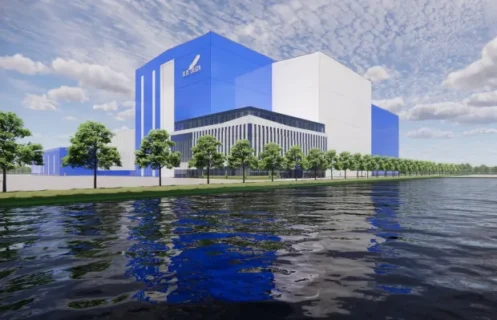
Blue Origin Rocket Park Expansion Connects to New Pads, Integration Facilities and Landing Platforms
Blue Origin is building a customer integration facility with the United States Space Force at Cape Canaveral Space Force Station. It is designed with four payload bays, two encapsulation bays and a multi-manifest processing area, and it will support both the 7×2 and 9×4 vehicles, including national security missions.
In addition, a new vertical integration facility is under construction to support 9×4 integration and to serve as a booster processing site. Launch Complex 36B is also under construction as the operational home for the 9×4, while Launch Complex 36A is being restored after the anomaly earlier this year.
Moreover, Blue Origin plans more New Glenn pads on the Space Coast, to be sited by replicating the approach used at Launch Complex 36B. Port Canaveral already hosts the landing platform Jacklyn, and work is underway on two more.
Reports differ on when New Glenn returns to flight, with estimates ranging from late 2026 to the first half of 2027.
Blue Origin Rocket Park Expansion Builds on a Space Coast Workforce of More Than 5,000
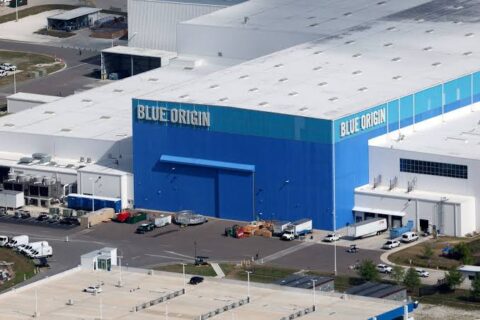
Blue Origin describes itself as the only company, and the largest employer, to manufacture, launch and refurbish rockets on the Space Coast. Rocket Park is a 1.37 million square foot campus near NASA’s Kennedy Space Center, and finished rockets travel about nine miles southeast to Launch Complex 36.
Col. Rob Long, president and CEO of Space Florida, said the state’s advantage is its ability to support “the full lifecycle of launch,” because a company can design, build and launch within one state.
Haskell designed and built the original Rocket Park complex, a facility of about 650,000 square feet. The contractor for the new upper stage facility has not been publicly disclosed.
Project Overview
- Project Name: Blue Origin Rocket Park upper stage manufacturing expansion
- Developer: Blue Origin
- Location: Rocket Park campus, Exploration Park, near Kennedy Space Center, Cape Canaveral spaceport, Brevard County, Florida
- Project Type: Upper stage manufacturing facility with automated machining, welding, material handling and inspection
- Project Value: $330 million per Blue Origin; the Florida Governor’s office announced a $600 million Project Horizon at the same campus in May 2026
- Capacity: Up to 150 New Glenn upper stages a year
- Facility Size: About 830,000 square feet per the state announcement, within a 1.37 million square foot campus
- Status: Under construction, per Blue Origin on October 16, 2026
- Target Completion: Summer 2027
- Vehicle Supported: New Glenn 9×4, with nine BE-4 engines on the first stage and four BE-3U engines on the upper stage
- Related Infrastructure: Customer integration facility with the Space Force, vertical integration facility, Launch Complex 36B and two more landing platforms
- Launch Rate Goal: Multiple flights a week by the end of the decade, with an environmental assessment seeking 12 to 50 launches a year at Launch Complex 36
- Jobs: 500 aerospace jobs with an average salary above $98,000, per the Florida Governor’s office for Project Horizon
- Public Support: Spaceport Improvement Program, per the state announcement
- Prior Investment: More than $3 billion in Florida facilities and more than 5,000 employees
Project Team
Owner and Developer
- Developer: Blue Origin
Public Partners
- State Spaceport Agency: Space Florida
- State Announcement: Office of Governor Ron DeSantis
- Spaceport Improvement Program Partner: Florida Department of Transportation
- Customer Integration Facility Partner: United States Space Force
- Launch Regulator: Federal Aviation Administration
Contractors and Financiers
- Original Rocket Park Builder: Haskell
- Upper Stage Facility Contractor: Not publicly disclosed
- Project Financiers: Not publicly disclosed
Related Project: Jacksonville International Airport Concourse B
- Owner and Operator: Jacksonville Aviation Authority
- Construction Manager at Risk: Balfour Beatty
- Lead Design Engineer: Jacobs
- Architectural Design: RS&H
- Anchor Airline: American Airlines
Source: constructionreviewonline.com All rights reserved. Unauthorized reproduction prohibited.

Leave a Reply