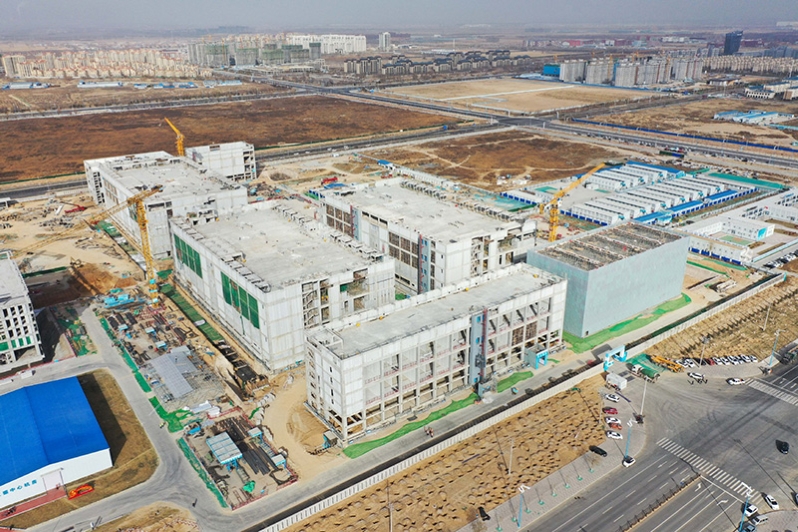
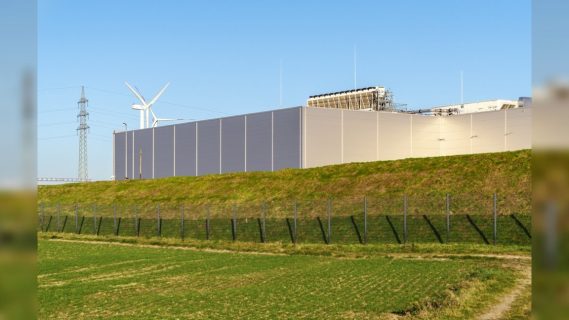
Further developments have emerged at Envision Group’s Galaxy AI Data Center Campus in Ulanqab, Inner Mongolia, with the company having moved beyond initial commissioning into live AI computing operations. On November 2, 2026, Envision announced the commercial deployment of an integrated 800V direct-current (DC) power system at the campus, which is already supporting live computing workloads. The system combines solid-state transformers, battery energy storage and AI-driven power management. These are structured to deliver electricity directly from medium-voltage input to server racks. What this does, is reduce conventional power-conversion stages and support higher-density computing infrastructure.
Meanwhile, a November 7 report by technology research firm SemiAnalysis provided further insight into the project’s construction progress. The report identified Galaxy Data Center as an approximately 800MW IT-capacity campus being developed in four phases for two unnamed internet companies. Its initial 120MW phase was delivered within a year. This is while two dedicated wind farms with a combined installed capacity of 420MW are expected to supply more than 60% of the electricity requirements of the first two phases. The campus will also feature four-hour battery storage to improve power reliability. The green-data center pivot is increasingly becoming an important anchor point in the roll-out of AI computing facilities in China.
This development also comes as Nvidia chief, Jensen Huang resigns from the company he helped establish in 1993 because of an affair with a businesswoman reportedly linked to Chinese intelligence. Huang’s exit from Nvidia has raised questions about the future of the billion-dollar AI company, and what comes next for the data center construction boom in China.
How 800V DC power system and solid-state transformers help solve Galaxy AI Data Center power challenges
As AI clusters scale up with massive multi-gigawatt power requirements and high-density GPU racks (such as NVIDIA GB200-class systems pulling anywhere from 100 kW to 1 MW per rack), traditional data center electrical grids are getting it rough. In what ways does the power challenge present itself?
-
The high-density amperage trap
Traditional data centers typically rely on alternating current (AC) distribution stepped down to low-voltage DC rails (about 12V or 54V) at the server rack.
The math problem: Electrical power is equal to voltage multiplied by current. To push 1 megawatt of power through a legacy 54V rack, the system requires a massive current of roughly 18,500 amperes.
The physical limit: Carrying that much current requires enormous, heavy copper busbars and thick cabling that can consume up to half of a rack’s physical space. This leaves little room for actual computing hardware. And all this while suffering severe resistive heat losses.
-
How 800V DC power distribution solves it
By shifting the facility distribution backbone to 800 volts direct current (800V DC), the dynamic changes entirely:
- Drastically lower current: Raising the voltage reduces the required current for a 1-megawatt load down to about 1,250-1,400 amperes.
- Savings on material cost: Lower current means relatively thinner cables and significantly less copper infrastructure. This cuts non-IT capital expenditures and eliminating undesired transmission challenges.
- Fewer conversion steps: Traditional setups convert and invert power multiple times (AC to DC, step-down to step-down), losing efficiency at every transition. An 800V DC power system streamlines this flow, delivering power straight to high-efficiency rack converters.
-
The role of solid-state transformers (SSTs)
Traditional iron-core transformers are bulky and slow to manufacture. They are also designed strictly for fixed-frequency AC grid transitions. Solid-state transformers (SSTs) replace massive magnetic coils with advanced high-frequency power electronics (utilizing wide-bandgap semiconductors like Silicon Carbide).
- Direct medium-voltage conversion: SSTs can take incoming medium-voltage grid electricity (such as 10 kV or 15 kV) and convert it directly into a stable 800V DC bus. And this is done in a single, compact step.
- Millisecond-level dynamic control: Because AI training workloads fluctuate wildly from second to second, SSTs pair with on-site battery energy storage and smart controllers (such as Envision’s Dubhe Controller) to balance load spikes in real time. They act as an intelligent buffer, matching volatile renewable energy supply (from wind and solar) with heavy computing demand.
3GW Galaxy AI Data Center Campus in China to be complete by 2028, Envision says
Reported October 30, 2026 – Chinese renewable energy and technology company Envision Group is targeting the completion of its massive Galaxy Data Center Campus in Ulanqab, Inner Mongolia, by the end of 2028. The development, which is expected to reach an eventual capacity of 3 gigawatts (GW), represents a major expansion of China’s artificial intelligence (AI). It is also a great push for China’s computing infrastructure and an ambitious move into the rapidly growing data center market.
Ricky Zheng, General Manager of Envision’s AI Data Center business, confirmed the completion target during an interview with Bloomberg TV. Zheng also disclosed that the company has already secured offtake agreements extending through 2029 or 2030, reflecting strong demand for AI computing infrastructure in China.
The Galaxy AI Data Center Campus is located in Ulanqab. This is approximately 350 kilometers northwest of Beijing. The location also offers access to substantial wind and solar energy resources. This makes it suitable for a development designed around the direct integration of renewable electricity.
Galaxy Data Center Campus to combine renewable energy and AI computing infrastructure
Envision initially announced the commissioning of the campus in August 2026, marking its entry into the data center industry. The initial phase comprised 120 megawatts (MW) of capacity, with the company initially outlining plans to scale the development beyond 2GW.
The latest 3GW target represents an expansion of those earlier ambitions and positions Galaxy Campus among the largest planned AI data center developments globally.
The campus also features a 120,000-square-metre AI supercomputing facility. This is designed to accommodate up to one million AI accelerators at full development. Envision’s approach also integrates renewable energy generation and dedicated transmission infrastructure. Envision’s data center in Inner Mongolia will also have battery storage and intelligent power management to support the electricity requirements of intensive AI workloads.
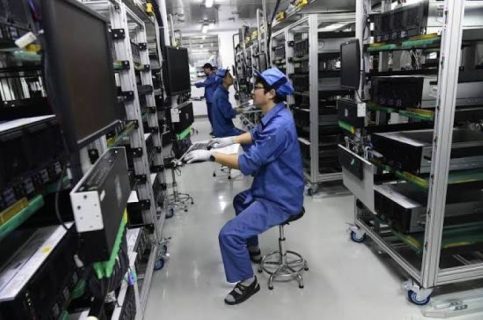
80% of Galaxy Data Center Campus electricity to come from wind power
Unlike conventional data center developments that depend primarily on electricity supplied through regional grids, Galaxy Campus is designed to receive power directly from dedicated renewable energy installations.
Additionally, the project will source approximately 80% of the campus’s electricity from its nearby wind farms through dedicated transmission connections. The battery storage (mentioned earlier) will provide additional support when renewable generation fluctuates.
Envision expands beyond renewable energy generation
The Galaxy Data Center Campus development also marks a strategic diversification for Envision. The Chinese company’s established business operations also include wind turbine manufacturing, battery production and renewable energy solutions.
Under its operating model, Envision will also develop and provide the data center’s power infrastructure and supporting systems. Technology companies can then lease the facilities and install their own AI chip clusters.
Zheng indicated that Envision is also discussing potential leasing arrangements with companies operating in autonomous driving and content generation, in addition to major technology companies. These industries are increasingly relying on AI applications that require substantial computing resources.
Beyond Galaxy AI Campus, Envision is considering additional data center developments in Inner Mongolia and other parts of northwest China. The company also has longer-term international ambitions, targeting as much as 10GW of data center capacity globally. Some of their potential markets include Latin America, Southeast Asia, Europe and Africa.
Galaxy Data Center Campus supports Envision’s global green computing ambitions
The development forms part of Envision’s wider strategy to connect renewable energy infrastructure with emerging industrial and digital technologies.
In June 2026, the company introduced its Mission Gobi initiative. Mission Gobi targets the development of 5GW of green AI computing capacity in desert and arid regions worldwide by 2030. The Galaxy AI Data Center Campus is positioned as the initiative’s flagship development.
The project also reflects a broader shift in data center development. Operators are increasingly consider electricity availability, renewable energy access and energy storage when selecting locations for new facilities. By combining power generation and computing infrastructure at a single site, Envision is seeking to address one of the major challenges facing the global AI industry.
Envision’s Galaxy AI Data Center Campus Project Fact Sheet
Location: Ulanqab, Inner Mongolia
Target completion date: End of 2028
Planned ultimate capacity: Up to 3GW
Initial commissioned phase: 120MW in August 2026
Main data center building: 120,000 square meters
Planned computing infrastructure: Up to one million AI accelerators
Power supply: Wind power and battery storage
Offtake agreements: Secured through 2029 or 2030
Associated initiative: Mission Gobi, targeting 5GW of green AI computing capacity globally by 2030
Who is involved in the project?
Envision Group – Project developer.
Envision AI Data Center division – Responsible for the data center infrastructure and supporting power systems.

Leave a Reply