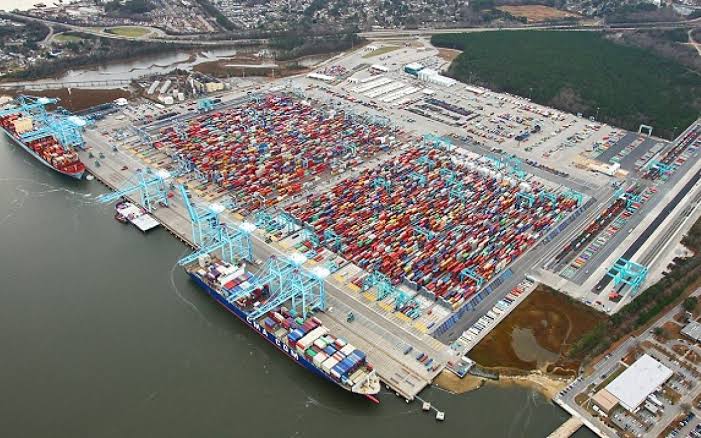
The Port of Virginia’s extensive expansion program has reached major milestones as part of its overarching $1.4 billion Gateway Investment Program. Most notably, the port celebrated the official inauguration of the deepest commercial shipping channel on the U.S. East Coast. Following the completion of dredging operations to deepen the harbor to 55 feet and widen channels for two-way ultra-large container vessel (ULCV) traffic, state officials formally presented the completed harbor, enabling fully laden post-Panamax vessels to navigate Norfolk Harbor without tide or draft restrictions.
Alongside the channel improvements, landside container handling operations at Norfolk International Terminals (NIT) are advancing rapidly. Construction on the $650 million North Berth optimization project at NIT is nearly 87% complete, progressing on schedule for a mid-2027 completion. The reconfiguration will introduce semi-automated container yard stacks, low-profile ship-to-shore cranes, and a fifth ULCV berth. The port also commissioned four new Suez-class ship-to-shore cranes at NIT South, expanding its current berth capacity to handle four ultra-large container ships simultaneously. Once the North Berth development finishes, the Port of Virginia’s total annual capacity will reach 5.8 million TEUs.
Similar Projects
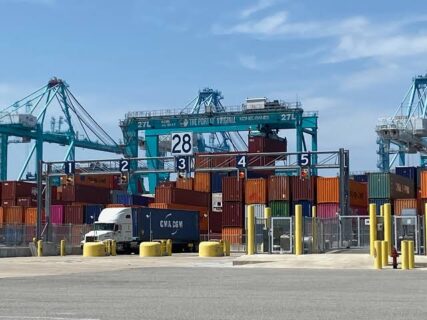
Another similar container terminal development in the US is the Louisiana International Terminal. The Louisiana International Terminal project has recently achieved a key milestone following the approval from United States Army Corps Engineers. Virginia Container Terminal Expansion and the $1.8 billion Louisiana International Terminal (LIT) project share core similarities as multi-billion-dollar port modernization efforts designed to capture the growing market share of ultra-large container vessels (ULCVs). Both projects center on deep-water infrastructure developments. The Port of Virginia deepening its harbor to 55 feet and LIT leveraging a naturally deep-water channel on the Mississippi River, to eliminate draft and height restrictions, allowing fully laden post-Panamax ships to call directly without tide dependencies. Additionally, both initiatives feature public-private operational frameworks aimed at significantly expanding regional throughput capacity into millions of TEUs while modernizing landside logistics through integrated rail, highway, and automated terminal infrastructure. Ultimately, both developments function as regional economic engines, strengthening supply chain resiliency and positioning their respective state gateways, the U.S. East Coast and Gulf Coast, as dominant hubs for international maritime trade.
July 27, 2026
Virginia container terminal expansion has entered its final construction stages at Norfolk International Terminals, marking another milestone in the Port of Virginia’s long-term modernization strategy. The $650 million project will expand capacity, improve cargo handling efficiency, and strengthen the port’s ability to accommodate the world’s largest container vessels. The investment also supports the broader $1.4 billion Gateway Investment Program, which aims to transform Virginia into one of North America’s most advanced maritime logistics hubs.
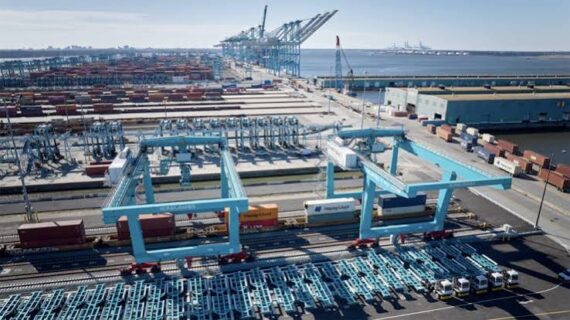
Construction crews continue to reconfigure and modernize the North Berth while installing advanced terminal infrastructure. The upgraded facility will introduce additional semi-automated container handling systems, expanded storage areas, and a fifth berth capable of serving ultra-large container vessels. As a result, the project will increase operational flexibility while supporting future cargo growth.
Virginia container terminal expansion strengthens East Coast capacity
The project forms the largest remaining construction package within the Gateway Investment Program. It follows the completion of several supporting infrastructure upgrades across the port network.
Earlier this year, Virginia completed the $450 million harbor deepening project, creating the deepest commercial shipping channel on the US East Coast. The channel now reaches 55 feet, allowing larger vessels to transit safely without tidal restrictions. Meanwhile, the port also completed the $83 million Central Rail Yard expansion and commissioned a fourth berth for ultra-large container vessels.
The North Berth redevelopment builds on these investments by increasing terminal productivity rather than simply adding quay space. Engineers have redesigned the terminal layout to improve truck circulation, automate container stacking operations, and reduce vessel turnaround times. Once complete, the upgraded terminal will integrate seamlessly with the port’s existing semi-automated operations.
According to the Port of Virginia, Norfolk International Terminals will eventually operate more than 90 semi-automated stacking cranes while handling approximately 3.6 million TEUs annually after the modernization program concludes.
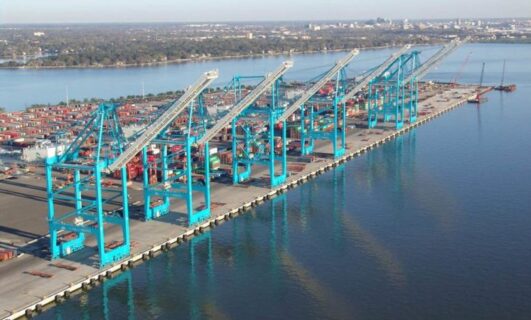
Virginia container terminal expansion supports future trade growth
The construction project arrives as East Coast ports compete for larger vessels and growing container volumes. Shipping lines increasingly deploy ultra-large container ships across Atlantic services, requiring deeper channels, larger berths, and faster cargo handling systems.
Virginia’s integrated investment strategy addresses each of these requirements simultaneously. Besides expanding terminal infrastructure, the state has invested in rail connectivity, channel deepening, heavy-lift facilities, and inland logistics improvements. Together, these projects create additional capacity throughout the supply chain instead of addressing individual bottlenecks.
Port officials believe the improvements will position Virginia for sustained cargo growth over the coming decades. The deeper harbor already enables unrestricted access for the largest vessels operating in Atlantic trade. Furthermore, the upgraded North Berth will allow the terminal to process higher cargo volumes with greater operational efficiency after construction finishes in 2027.
Virginia’s wider Gateway Investment Program continues to generate economic benefits across the Commonwealth. State officials estimate that port operations contribute more than $124 billion annually to Virginia’s economy while supporting over 565,000 jobs. The modernization program aims to strengthen that economic impact by improving supply chain resilience and attracting additional international shipping services.
Although construction remains underway, the North Berth redevelopment has passed its halfway point. Contractors continue structural works, equipment installation, and terminal reconfiguration ahead of scheduled completion in mid-2027. Once operational, the expanded facility will become a cornerstone of the Port of Virginia’s strategy to remain America’s most modern gateway for international container trade.
The Virginia container terminal expansion also reflects a broader wave of investment in strategic maritime infrastructure across the United States. Similar initiatives are underway to improve freight mobility, strengthen supply chain resilience, and accommodate growing cargo volumes. One notable example is the Phase 2 and 3 of the Soo Lock project in Michigan, which is advancing construction to modernize a critical shipping corridor that supports commercial navigation throughout the Great Lakes region.
Project fact sheet
Project: Virginia container terminal expansion at Norfolk International Terminals North Berth
Location: Norfolk, Virginia, United States
Project value: $650 million
Project type: Container terminal expansion and modernization
Focus: North Berth redevelopment and terminal optimization
Status: Construction underway, nearing major completion milestones
Expected completion: Mid-2027
Part of: $1.4 billion Gateway Investment Program
Key works: Berth reconfiguration, terminal expansion, automation systems, container yard improvements, crane infrastructure, operational optimization
Future capacity: Norfolk International Terminals to handle approximately 3.6 million TEUs annually after full expansion
Key benefit: Increased efficiency for ultra-large container vessels and improved cargo handling capacity
Project team
Project owner: Virginia Port Authority
Operating authority: The Port of Virginia
Project program: Gateway Investment Program
Terminal: Norfolk International Terminals (NIT)
Funding: Virginia Port Authority with state and federal infrastructure investments supporting the wider Gateway program
Associated stakeholder: U.S. Army Corps of Engineers (related harbor deepening works)
Supporting agencies: Commonwealth of Virginia and Virginia transportation authorities
End users: Global shipping lines, logistics companies, importers, exporters, rail operators, and trucking companies



Leave a Reply