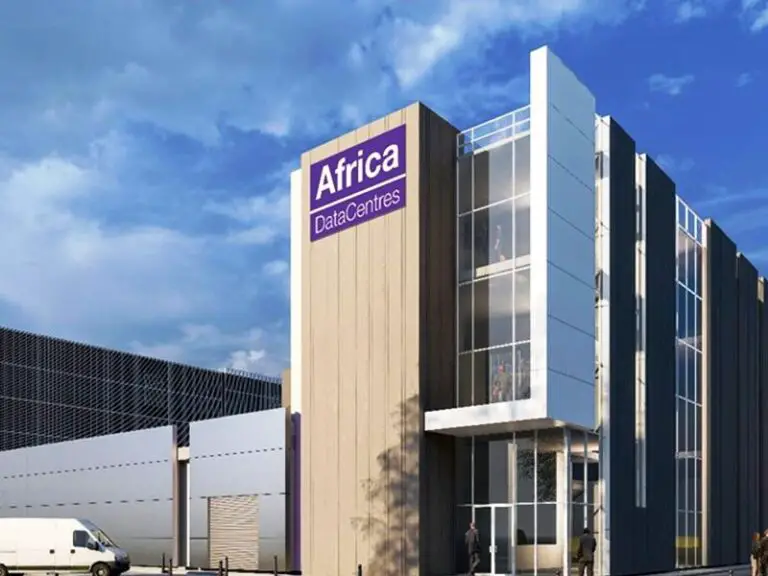
Africa Data Centres, a business unit of Cassava Technologies, has expanded its flagship NBO1 facility at Sameer Industrial Park along Mombasa Road in Nairobi to scale up to an additional 15 MW of IT load. Built on adjacent land secured specifically for campus growth, the multi-phase expansion increases the site’s total capacity fivefold to accommodate accelerating demand from hyperscalers, global cloud providers, and enterprise colocation clients across East Africa.
The development relied on a prefabricated modular construction approach where critical plant rooms and technical modules were engineered off-site to preserve build quality and speed up delivery times. To align with regional sustainability objectives, the expanded campus uses closed-loop, air-based cooling systems that completely avoid water consumption, operating within a local energy grid that draws predominantly from renewable geothermal and hydroelectric power sources.
As one of East Africa’s most interconnected digital hubs, the Tier III-certified Sameer Park campus houses direct connectivity to over 50 carrier networks, hosts the Kenya Internet Exchange Point (KIXP), and features a point-of-presence for the London Internet Exchange (LINX Nairobi). This positioning establishes the expanded NBO1 site as a primary gateway for enterprise cloud deployments, cross-border fiber routes, and low-latency digital service delivery in the region.

Nairobi Emerges As a Leading Computing Infrastructure Hub in East and Central Africa
Nairobi is cementing its position as East Africa’s central artificial intelligence and digital infrastructure hub, driven by a rapid convergence of hyperscale data center investments, local AI innovation, and high-density connectivity. Facilities like Digital Realty’s newly launched 6.4 MW Nairobi Two Data Center (NBO2) and Africa Data Centres’ 15 MW expansion at Sameer Business Park supply the critical computing power, ultra-low latency interconnections, and rack densities required to train and deploy complex machine learning models. Coupled with major investments across the metro area, such as iXAfrica’s hyperscale campuses and upcoming cloud regions Nairobi offers the scalable colocation footprint needed to host GPU clusters and energy-intensive AI workloads.
Beyond raw physical infrastructure, Kenya’s grid reliance on renewable geothermal and hydroelectric power provides a sustainable foundation for energy-demanding data halls. This green compute environment, combined with stringent local data sovereignty policies, encourages global tech giants, enterprises, and research institutions to localize their data processing within Nairobi rather than routing through overseas facilities. Paired with a vibrant ecosystem of tech talent, local startups, and direct subsea fiber routes, the capital’s expanding data center cluster is directly powering the next wave of regional AI research, sovereign cloud applications, and data-driven enterprise solutions.
June 23, 2023
Recently, Africa Data Centers (ADC) broke ground on a larger facility at Sameer Business Park, in Nairobi, which would expand its capacity, from 5 MW to 15 MW of IT load.
The expansion coincides with an increase in demand for colocation. This is a data center facility where companies may rent space for servers and other computing hardware. It’s also in line with a significant digital transformation of institution services including those provided by government corporations.
Also Read: Ruiru affordable housing project in Kiambu, Kenya, launched
Jane Marriott, the British High Commissioner to Kenya, commended the country’s data privacy regime. She labeled Kenya as one of the most exciting countries to be in IT on the continent and globally. This is due to its people’s drive, education, and intelligence.
She said that since 2018, the UK has provided such technologies with a total investment of $220 million in Africa.
Africa Data Centers’ future plans
With the support of the US Development Finance Corporation, ADC intends to invest an extra $500 million in the construction of hyper-scale data centers throughout Africa. The Sameer facility is currently the most connected data center in the Eastern African region.
According to Hardy Pemhiwa, group president and chief executive of Cassava Technologies, a pan-African technology group that owns Africa Data Centers, their investment into expanding their data center operations in Kenya is in line with the growing demand that they are experiencing due to the significantly increased use of digital services in the East African region.
Tesh Durvasula, CEO of Africa Data Centers, said that the expansion would enable ADC clients to scale and grow in accordance with their requirements.
According to Africa Data Centers, all important plant rooms in the facility will be prefabricated off-site. As a result, the highest quality is guaranteed. Also, local contractors will continue to profit from contracts to lay foundations, put the building together, and complete the building.
Reported earlier
Nov 2022
Nairobi Data Center to get an additional 1MW

Africa Data Centers, a pan-African data center, is expanding its Nairobi Data Center, which started construction in mid-June, by 1 MW. It is expected to be completed in 40 weeks, making it the first EDGE-certified data center in the region.
The International Finance Corporation (IFC), an organization that is a member of the World Bank Group, developed the EDGE certification system as a green building certification system for new markets.
It is a quantifiable method for developers to optimize designs. This makes a product more marketable and a better investment while simultaneously promoting sustainability.
The EDGE certification enables developers to certify projects for a relatively lower cost. It also helps keep certification localized, fast, and affordable to promote more green construction.
According to Africa Data Centers’ managing director, Dan Kwach, the East Africa region is one of the company’s key markets. This is due to the region’s rapid growth in the demand for data centers.
Given that Kenya is a critical African market for the demand for hyperscale data centers and digital transformation in East Africa, he continued, the immediate 1 MW facility is a significant part of this expansion.
How the Nairobi Data Center is going to impact the people
In all of the firm’s operational regions, the new facility will, according to the company, promote the creation of jobs, strengthen the local economy, partner with local companies to build facilities, and promote social growth.
The expansion is situated in the East Africa Data Center facility. It is an environment that has already received Tier III Certification.
The Sameer site is located in the country’s capital, the Sameer Business Park. This addition adds 717 square meters of additional white space or roughly 230 racks.
To maintain cooling efficiency, Kwach said, the cold aisle containment will be completed. He said that dedicated fresh air systems will manage the hall’s humidity control.
He said all critical security and infrastructure systems will also be managed and monitored constantly. For the best information security possible, the facility will also be PCI DSS and ISO27001 compliant.
The new facility seeks to make way for hyperscale customers of Africa Data Centers to deploy low-latency technology solutions in the region.
Africa Data Centres (ADC) NBO1 Expansion Factsheet
Facility Name: NBO1 Nairobi Data Centre (Sameer Industrial Park Expansion)
Operator: Africa Data Centres (a business unit of Cassava Technologies)
Location: Block A, Sameer Industrial/Business Park, Mombasa Road, Nairobi, Kenya
Initial Site Capacity: 7.5 Megawatts (MW)
Expansion Power Capacity: Additional 15 MW IT load (scaling overall campus power utility allocation up to 37.5 MW)
White Space: 2,000 square meters across 4 Tier III-certified data halls
Target Rack Density: Standard to high-density deployments (up to 15 kW–20 kW per rack)
Infrastructure and Ecosystem Features
- Tier and Quality Certification: Uptime Institute Tier III Certified design and operational status; PCI-DSS, ISO 27001, ISO 9001, and ISO 14001 compliant.
- Power Redundancy: 2N incoming utility supply topology with 2N electrical distribution at the rack level, supported by 30-minute full-load UPS battery autonomy and 96-hour on-site generator backup.
- Cooling Systems: Concurrently maintainable CRAC (Computer Room Air Conditioning) system using hot/cold aisle containment and a zero-water-consumption, eco-friendly cooling model.
- Interconnection and Connectivity: Hosts over 50 carrier networks, the Kenya Internet Exchange Point (KIXP), and a point-of-presence for the London Internet Exchange (LINX Nairobi). Provides direct dark fiber connectivity to landing stations in Mombasa and terrestrial routes into neighboring East African countries.
- Security and Operations: Multi-level security zone perimeter, 24/7 Security Operations Center (SOC), biometric access controls, and CCTV surveillance with 90-day video retention.
Project Team
Primary Developer and Parent Company
- Africa Data Centres (ADC): Owner and operator leading the site expansion.
- Cassava Technologies: Parent tech group funding and directing the $500 million pan-African infrastructure rollout.
Financial and Investment Partners
- U.S. International Development Finance Corporation (DFC): Key project finance partner providing long-term debt capital for ADC’s pan-African expansion program.
- STANLIB Infrastructure Fund: Equity/capital investment partner supporting ADC’s regional data center platform.
Technology, Equipment and Infrastructure Suppliers
- Schneider Electric: Primary technology partner supplying critical power infrastructure, uninterrupted power supply (UPS) architecture, and thermal cooling management solutions.
- Caterpillar / Local Dealers (Mantrac Kenya): Suppliers of high-capacity backup diesel generators.
Power and Grid Utility
- Kenya Power and Lighting Company (KPLC): State utility provider supplying the 37.5 MW grid connection via dual incoming feeder lines.
Telecommunications and Interconnection Partners
- Liquid Intelligent Technologies: Sister company providing core fiber backhaul and cross-border terrestrial fiber connectivity.
- Kenya Internet Exchange Point (KIXP): Regional IXP partner hosted on-site for direct local peering.
- Hyperscale Cloud On-Ramp Providers: Microsoft Azure, Amazon Web Services (AWS), and Google Cloud (providing direct cloud interconnects).
Standards and Certification Organizations
- Uptime Institute: Certifying body for Tier III Design and Facility compliance.
- International Finance Corporation (IFC / World Bank Group): Certification authority behind the EDGE green building framework applied to the site.


Leave a Reply