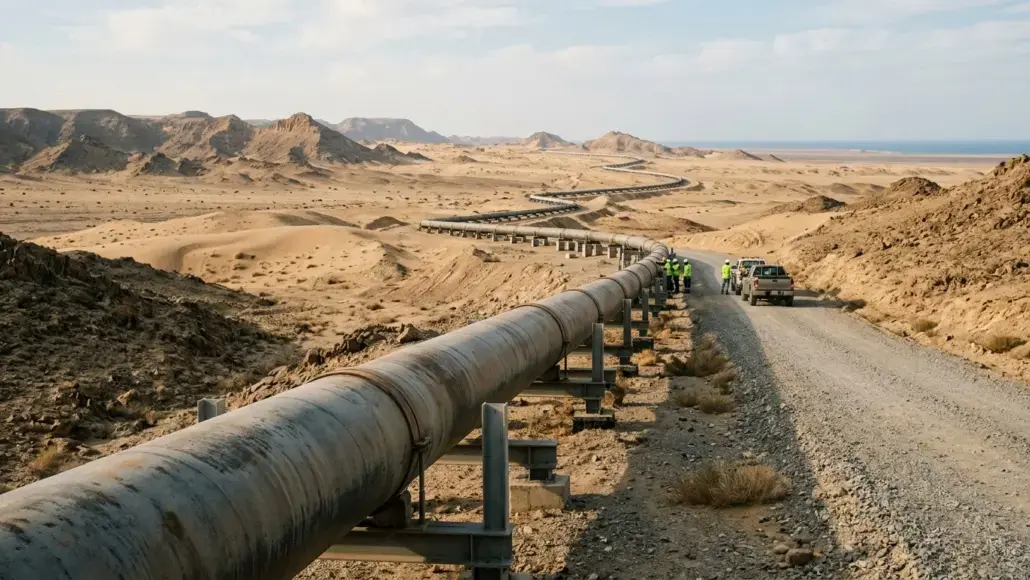
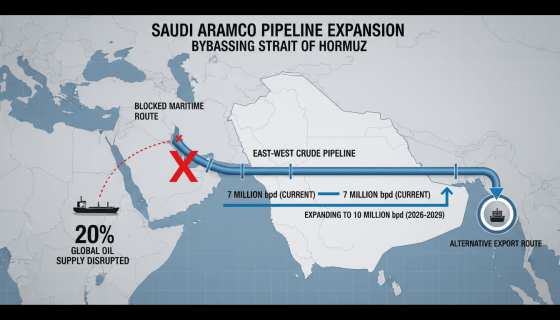
Saudi Aramco has started preliminary engineering on its East-West pipeline expansion, the crude artery that bypasses the Strait of Hormuz. CEO Amin Nasser confirmed the work on Tuesday during the analyst call after third-quarter results. The company plans to lift capacity from 7 million barrels per day to as much as 10 million.
The 1,200-kilometre Petroline system runs from Abqaiq in the Eastern Province to the Red Sea port of Yanbu. Nominal capacity stands at about 7 million bpd, of which roughly 5 million has been available for export. The remainder serves refineries on the west coast. A 10 million bpd rating therefore adds 43 percent throughput on the kingdom’s main Hormuz-free export route.
“With regard to the expansion to our East-West Pipeline and the additional networks that we are building, this work has already started,” Nasser said, per Al-Monitor. He added that Aramco is also engineering existing routes via Hormuz and the Suez Canal. Details will wait until final investment decisions. Aramco has disclosed no project cost at this preliminary stage.
Various oil projects across the Middle East are making headway such as the Bu Hasa EOR project in Abu Dhabi. ADNOC Onshore has invited contractors to bid for the Bu Hasa EOR Unit 1 (Phase 1) project tender. The Bu Hasa EOR project targets a 70 percent lift in output at its westernmost producing field. MEED reported the tender on 16 October.
Scope of implementation on the East-West pipeline expansion
The push responds to the US-Iran conflict, which has effectively choked transit through Hormuz. Nasser said the conflict has brought more than 130 reported attacks on tankers. Seaborne freight rates have also surged to more than 15 times year-earlier levels. Aramco’s VLCC fleet, roughly 540 vessels worldwide, has lost effective capacity to vessel restrictions.
Yanbu has already carried the burden. Loadings there surged toward 4 million bpd at peaks earlier in the crisis. Terminal infrastructure, tanker availability and insurance costs still capped sustained flows. Even so, Aramco restored western-region loadings quickly after quarterly disruptions, thanks to the pipeline’s multiline configuration.
Saudi Energy Minister Prince Abdulaziz bin Salman set the frame in October. He described plans to lift Hormuz-bypass capacity to 10 million bpd in two to three years. The route leans on upgrades and related investments. The East-West crude pipeline expansion sits at the centre of that plan.
Outlook for Aramco crude capacity and Zuluf
The quarter delivered a second milestone: Zuluf. Aramco commenced production at the offshore Zuluf crude increment in October after completing construction. The facility will process up to 600,000 bpd of Arab Medium crude through a central plant before the end of 2026. That restores the path to Aramco’s 12 million bpd capacity ceiling.
Nasser said Aramco could return to pre-conflict production of about 10.4 million bpd within days. Reaching 12 million would take under three weeks. He also argued the market needs more. Rebuilding inventories could absorb an extra 2 million bpd for two years. Countries expanding reserves could take another 1 million bpd. The conflict has removed more than 3 billion barrels of liquid fuels from global supplies. Hormuz-free exports through the East-West pipeline have already cut the cumulative shortfall to about 2 billion.
Moreover, Aramco is reviewing overseas storage expansion alongside the pipeline work. Final investment decisions will fix scope and cost. For now, preliminary engineering has started, Zuluf has started up, and the route around Hormuz is getting bigger.
Project Overview
- Project Value: Not disclosed, pre-FID
- Location: Abqaiq to Yanbu, Saudi Arabia
- Operator: Saudi Aramco
- Status: Preliminary engineering started
Scope
- 1,200-kilometre East-West pipeline
- Capacity rises from 7 million bpd
- Target up to 10 million bpd
- 43 percent throughput increase
Project Highlights
- Bypasses Strait of Hormuz entirely
- Feeds Red Sea port Yanbu
- Restores 12 million bpd MSC path
- Zuluf adds 600,000 bpd
Key Developments
- Engineering work already started
- Zuluf production began October
- Yanbu loadings peaked near 4 million
- Minister targets 10 million by 2029
Key Challenges
- Tanker attacks exceeded 130
- Freight rates up 15-fold
- FID and cost still pending
- Terminal and insurance constraints persist
Outlook
- FID will set final scope
- Zuluf processing before end 2026
- Global inventories need rebuilding
- Overseas storage under review



Leave a Reply