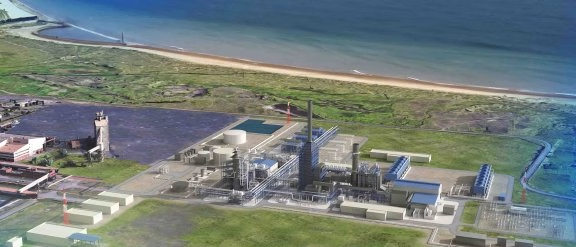
The Net Zero Teesside Power Plant has moved deeper into construction as major equipment deliveries support work at Teesside in northeast England. The £833 million construction contract awarded to Balfour Beatty remains central to the project’s delivery. However, construction has now progressed beyond the original 2025 mobilization plans.
The project aims to become the world’s first commercial-scale gas-fired power station equipped with carbon capture and storage. Once operational, it will generate up to 742MW of flexible, dispatchable low-carbon electricity.
Importantly, the development combines power generation, carbon capture and compression within one integrated facility. The Northern Endurance Partnership will then transport and permanently store captured carbon beneath the North Sea.
The project reached financial close in December 2024, enabling the delivery phase to move forward. Construction activity subsequently accelerated across the wider East Coast Cluster.
Net Zero Teesside Power Plant Construction Gains Momentum
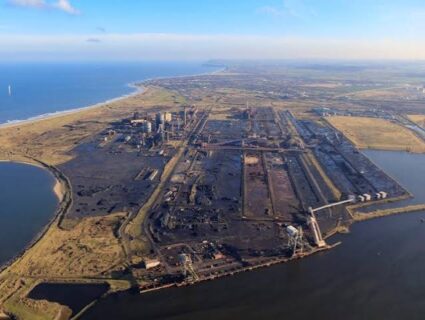
The construction programme received a major boost in April 2026 when the first significant equipment shipment arrived at Redcar Bulk Terminal. The shipment included modules for GE Vernova’s heat recovery steam generator and condenser.
The terminal underwent a multi-million-pound quay upgrade to handle equipment weighing up to 3,500 tonnes. Southbay Engineering delivered the upgrade, while Mott MacDonald supported engineering activities.
The upgraded facility now supports deliveries required for both Net Zero Teesside Power and the Northern Endurance Partnership. Further equipment deliveries will include the main gas turbine, steam turbine and generator.
Meanwhile, Balfour Beatty serves as the main construction partner alongside Technip Energies and GE Vernova. Its scope covers civil engineering, ground engineering and mechanical and electrical works.
Technip Energies leads the consortium delivering the power, capture and compression facilities. GE Vernova supplies the advanced 9HA.02 gas turbine for the combined-cycle power plant.
Shell Catalysts & Technologies supports the development through its carbon-capture technology. The system uses Shell’s CANSOLV technology within Technip Energies’ Canopy by T.EN solution.
At peak construction, Balfour Beatty expects to employ approximately 1,500 workers. The wider East Coast Cluster has already awarded more than 230 subcontracts worth over £1.5 billion to UK businesses.
Net Zero Teesside Power Plant Builds UK Carbon Capture Capacity
The plant will capture up to two million tonnes of carbon dioxide annually. The captured gas will undergo compression before entering infrastructure developed by the Northern Endurance Partnership.
NEP will transport the carbon through onshore and offshore infrastructure before storing it beneath the North Sea. Its Endurance saline aquifer provides access to up to one billion tones of potential carbon storage capacity.
The carbon capture system therefore connects the power station with a much larger regional decarbonization network. That network also intends to serve future carbon capture projects across Teesside and the Humber.
The project forms part of the UK’s East Coast Cluster, which targets industrial decarbonization across northeast England. Construction activity across the cluster has already generated substantial local supply-chain opportunities.
The development also provides a useful link to wider gas infrastructure investment. For example, the Gemini-1 gas well project offshore Sicily is moving through well-completion works within Eni’s Argo-Cassiopea development.
That project demonstrates another construction pathway for gas infrastructure, using subsea well completion and existing processing facilities to support future production.
Net Zero Teesside Power instead combines gas generation with carbon capture and permanent storage. Both developments therefore demonstrate different infrastructure approaches surrounding Europe’s evolving gas and energy systems.
Also Read UK Approves 140 MW Oaklands Farm Solar Park in South Derbyshire
Collaboration at Scale
In addition, this venture isn’t a solo act. Balfour Beatty will team up with Technip and GE Vernova, a major American energy equipment company. Together, they will deliver the combined cycle gas-turbine segment of the Net Zero Teesside Power plant, a joint effort involving BP and Equinor. Collectively, their goal is to produce up to 742 MW of flexible, low-carbon power, enough to supply over one million homes annually.
Policy-Driven Push for Clean Energy
Moreover, the UK government is fast-tracking initiatives to lower energy bills and cut carbon footprints. With an industry strategy unveiled just this week, the government is rolling out exemptions for heavy energy users and other incentives aimed at balancing costs and sustainability. Further, that broader backdrop underscores why Teesside matters, not just as a power plant, but as a catalyst in reviving local economies and supporting a national energy transformation.
Also Read £500 Million Investment Planned for UK’s First Regional Hydrogen Transport and Storage Network
Jobs, Emissions, and Economic Growth
Finally, Balfour Beatty CEO Leo Quinn summed it up: this is not merely an energy asset, it is a cornerstone for “net zero” targets and a major economic boon for North-East England. In fact, 3,000 construction jobs will be supported during the build, with 1,000 ongoing roles upon operation. What’s more, the plant is designed to capture and store around two million tones of CO₂ annually, underlining its role in the global push to tame climate change.
Balfour Beatty NetZero Teesside Power Overview
Name: Net Zero Teesside Power (NZT Power)
Location: Teesside, North‑East England
Joint Venture Partners: BP (75%) and Equinor (25%); Northern Endurance Partnership (NEP) also involved for CO₂ storage
Technology & Capacity
Type: Combined‑cycle gas turbine (CCGT), powered by GE Vernova 9HA.02 turbine
Carbon Capture: Shell’s CANSOLV® via Technip Energies’ Canopy by T.EN™ system, capturing 95% of CO₂
Output: Up to 742 MW, serving approximately 1 million UK homes annually
CO₂ Transport & Storage: 2 million tonnes per year piped and stored offshore by NEP (BP, Equinor, TotalEnergies)
Timeline & Economic Impact
Financial Close: December 2024; official engineering go‑ahead issued mid‑December 2024
Construction Phase: Begins mid‑2025; onshore civil works (Balfour Beatty, Technip Energies & GE Vernova)
Operational Target: Full commercial operations expected by 2028
Job Creation: 3,000 construction jobs; 1,500 on‑site at peak; up to 1,000 long‑term roles; minimum 5% apprenticeships via Balfour Beatty’s 5% Club
Strategic & Policy Context
UK Government Support: £21.7 billion CCUS funding boost in 2024, aligned with 2030 clean power goals
Net‑Zero Alignment: Gas‑with‑CCS seen as essential to UK’s 2035 and 2050 carbon budgets; supports 6% of future electricity mix with CCS
Regional Benefits: Revitalizes North‑East industrial skills base, retains legacy workforce; part of wider East Coast Cluster aiming to decarbonize heavy industry
Risk & Challenges
Legal & Environmental Concerns: Government promised compensation if court halts onshore development; some critics argue lifecycle emissions may still be substantial
Scale-Up Imperative: NZT is first of its kind, UK will need 10 GW of CCS gas plants by 2035. Success here is vital to technology rollout
Project Fact Sheet
Name: Net Zero Teesside Power
Type: Gas-fired power station with carbon capture and storage
Location: Teesside, northeast England, United Kingdom
Capacity: Up to 742MW
Generation technology: Combined-cycle gas turbine
Gas turbine: GE Vernova 9HA.02
Carbon capture: Post-combustion capture
Carbon capture technology: Shell CANSOLV through Technip Energies’ Canopy by T.EN
Annual CO₂ capture: Up to 2 million tonnes
Carbon transport: Offshore pipeline system
Carbon storage: Beneath the North Sea
Storage infrastructure: Northern Endurance Partnership
Construction partner: Balfour Beatty
Engineering and technology consortium: Technip Energies and GE Vernova
Project owners: bp and Equinor
Financial close: December 2024
Current status: Construction underway
First major equipment delivery: April 2026
Target start-up: 2028
Balfour Beatty contract: £833 million
Expected electricity supply: More than one million UK homes annually
Project Team
Owner: Net Zero Teesside Power Limited
Partners: bp and Equinor
Construction partner: Balfour Beatty
Engineering, procurement and technology partner: Technip Energies
Power generation technology supplier: GE Vernova
Carbon capture technology partner: Shell Catalysts & Technologies
Carbon transport and storage developer: Northern Endurance Partnership
NEP partners:
- bp
- Equinor
- TotalEnergies
Major equipment logistics facility: Redcar Bulk Terminal
Redcar Bulk Terminal upgrade contractor: Southbay Engineering
Engineering consultant for terminal upgrade: Mott MacDonald
Expected operational date: 2028



Leave a Reply