MTN Nigeria Data Centre has moved from a planned development into an operational digital infrastructure project. The facility now anchors MTN Nigeria’s strategy to expand cloud, computing and artificial intelligence capacity.
The Ikeja facility launched its first phase in July 2025. MTN Nigeria invested about $120 million in the initial phase, including cloud infrastructure.
The wider development carries an investment of more than $240 million. MTN Nigeria plans to deliver the 9MW facility through two construction phases.
The project initially targeted a 1,500-rack Tier IV data centre. However, the first operational phase opened with Tier III certification and 780 racks.
This progression gives the project a different significance than its original 2024 announcement. MTN has already converted part of the planned capacity into an operating digital platform.
MTN Nigeria Data Centre delivers first 4.5MW phase
The first phase provides 4.5MW of IT capacity and occupies three floors. It uses 96 prefabricated modules, making it Nigeria’s largest prefabricated modular data centre.
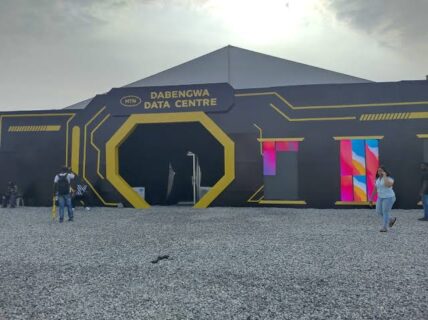
MTN named the facility the Sifiso Dabengwa Data Centre after its former Group CEO. The company officially unveiled the facility in Lagos on July 1, 2025.
The initial infrastructure cost about $100 million, while cloud infrastructure added another $20 million. Dell Technologies partnered with MTN on the cloud infrastructure.
Furthermore, MTN designed the facility to operate with modular power and cooling systems. The architecture allows the operator to add capacity as market demand increases.
The facility also operates as a carrier-neutral platform. Therefore, customers can connect through different fibre providers instead of relying on one network.
MTN Cloud forms another major component of the development. The platform gives businesses self-service control over computing and storage resources.
Consequently, enterprises can access locally hosted digital infrastructure without maintaining their own server facilities.
MTN Nigeria Data Centre targets AI and regional expansion
The second phase will increase the overall facility capacity to 9MW. However, MTN has indicated that demand could eventually push capacity toward 14MW or 20MW.
The operator also targets Tier IV certification for the second phase. That classification would provide higher redundancy and fault tolerance than the current Tier III facility.
AI represents another major growth opportunity for the development. MTN Nigeria has identified the facility as a potential foundation for future AI infrastructure.
Meanwhile, MTN Group continues exploring partnerships with US and European technology companies. The wider strategy seeks to develop AI-ready data centres across African markets.
The Nigerian facility therefore forms part of a broader shift toward local computing capacity. Africa still has limited AI data centre capacity compared with other global markets.
Nigeria is also attracting competing data centre investments. Airtel’s Eko Atlantic facility, for example, targets 38MW and could become Nigeria’s largest data centre.
Equinix has also expanded its Lagos footprint through the LG3 data centre. The $22 million facility forms part of a wider US$100 million African investment programme.
The regional competition highlights the growing demand for secure, high-capacity digital infrastructure. It also places MTN’s development within West Africa’s rapidly expanding data centre construction market.
The trend extends beyond Nigeria. Côte d’Ivoire is developing its first state-owned national data centre through a US-backed digital infrastructure programme. The project forms part of a $170 million programme supporting digital sovereignty and secure government data.
For a closer look at this parallel West African development, read our Ivory Coast Data Center project update. The project demonstrates how governments are increasingly prioritising locally controlled digital infrastructure.
Earlier Updates
MTN Nigeria has announced the construction of West Africa’s largest data centre as part of efforts to bolster Nigeria’s digital infrastructure. This state of the art facility, boasting 1,500 racks and Tier 4 classification is poised to meet the escalating data requirements of businesses and individuals across the country.
Mohammed Rufai, the Chief Technical Officer, at MTN Communications Nigeria emphasized the necessity for data processing capabilities due to the surge in data consumption and the introduction new services. He stressed that there is an uptick in data usage within the market and underscored the importance of expanding and modernizing their data centre capacity to cater to this growing demand effectively.
The data centre will play a crucial role in MTN’s infrastructure, providing vital support to businesses across Nigeria. Rufai explained that companies looking for data centre solutions now have an alternative to managing their own server rooms. MTN’s facility will offer the necessary space and services to help these businesses with their digitalization efforts and improve their operational efficiency.
Additionally; this advanced data centre will optimize content delivery from tech giants such as Meta and Google resulting in improved access speeds, for users. This local hosting of content will greatly enhance user experience and network efficiency. The initiative represents not an investment but also a driver, for economic development. By offering flexible infrastructure it will empower businesses, small and medium enterprises (SMEs) to take advantage of cloud services and other digital solutions. This in turn will stimulate innovation, productivity and competitiveness across sectors of the economy. Rufai highlighted MTN’s willingness to collaborate with startups and SMEs presenting partnership opportunities in cloud services.
Read also: Sh5 Billion set aside for new data center in Konza, Kenya

MTN’s Nigeria data centre is in line with its Ambition 2025 strategy
In line with MTN’s Ambition 2025 strategy the data centre signifies the company’s dedication to Environmental Social and Governance (ESG) objectives. The facility will eventually employ efficient cooling systems along with a mix of energy sources like gas and renewable energy. This move is set to decrease its carbon footprint. Rufai underscored the significance of these initiatives by stating that “up to 60 percent of the power consumption by a data centre, in our region goes towards cooling. Our effective systems are designed to help us achieve our sustainability goals.”
As Nigeria’s data centre progresses in its transformation journey the new data centre represents a major achievement.
Read also: IX Africa Data Centre in Nairobi, Kenya, the largest of its kind in Africa
There is an emphasis, on driving innovation maintaining quality and fostering growth to enhance living and deliver better services, economic advantages and a robust digital infrastructure for the future.
A Tier 4 data centre is constructed with fault tolerance redundancy in every component and an uptime expectation of 99.995 percent.
This indicates its ability to withstand disruptions and provide the most dependable infrastructure.
During his remarks Mr. Rufai underscored the requirement for data processing capabilities due to the substantial increase in data usage and the introduction of new services.
“We are observing a rise in demand in the market as data consumption continues to grow
“To meet this demand and prepare for expansion MTN is enhancing and updating its data centre capacity” stated the MTN representative.
He noted that the MTN West Africa’s largest data centre project in Nigeria is not merely an investment but also serves as a driver for development.
Project Fact Sheet
Name: Sifiso Dabengwa Data Centre.
Alternative name: MTN Nigeria Data Centre.
Location: Ikeja, Lagos, Nigeria.
Developer and operator: MTN Nigeria.
Overall investment: More than US$240 million.
Planned overall capacity: 9MW.
Phase One capacity: 4.5MW.
Phase One investment: Approximately $120 million.
Planned Phase Two certification: Tier IV.
Phase One infrastructure cost: Approximately $100 million.
Cloud infrastructure investment: Approximately US$20 million.
Phase One certification: Tier III.
Initial rack target: Approximately 1,500 racks.
Phase One rack capacity: 780 racks.
Expansion potential: 14MW to 20MW depending on demand.
Building configuration: Three floors.
Modular construction: 96 prefabricated modules.
Cloud platform: MTN Cloud.
Connectivity model: Carrier neutral.
Primary applications: Cloud computing, enterprise hosting and artificial intelligence.
Launch date: July 1, 2025.
Current development status: Phase One operational, with further capacity planned.
Project Team
Developer: MTN Nigeria.
Operator: MTN Nigeria.
Cloud technology partner: Dell Technologies.
Infrastructure technology partner: Huawei.
Enterprise cloud platform: MTN Cloud.
Chief Executive Officer: Karl Toriola.
Chief Technology Officer: Yahaya Ibrahim.
Chief Enterprise Business Officer: Lynda Saint-Nwafor.
General Manager, Infrastructure: Roger Shutte.
Construction approach: Prefabricated modular data centre.
Phase One delivery: MTN Nigeria and technology partners.
Phase Two objective: Expanded capacity and potential Tier IV certification.