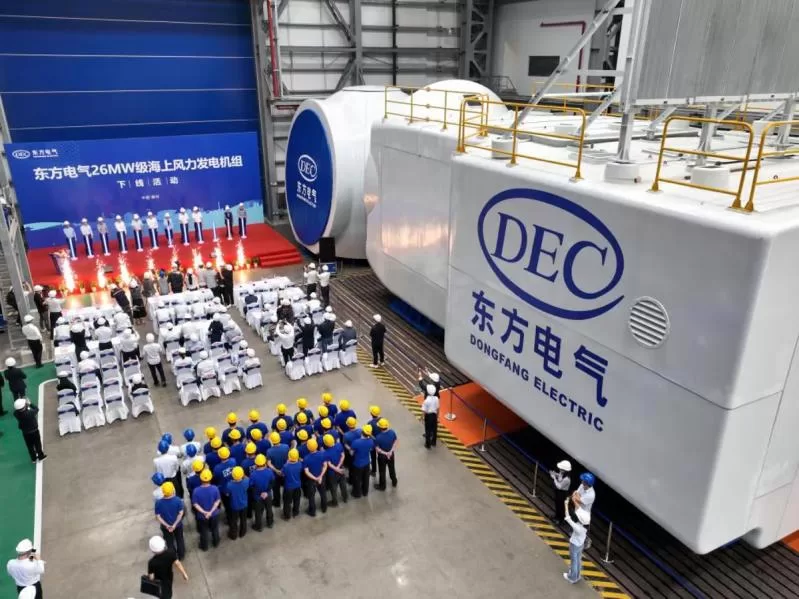
The 26 MW Dongfang offshore wind turbine has moved from factory production to grid-connected testing in China. The record-setting machine now represents a major construction milestone for offshore wind technology. Dongfang Electric developed the turbine and completed its installation at a testing base in Dongying, Shandong Province. The company says the machine holds world records for single-unit capacity and rotor diameter.
The turbine rolled off the production line in October 2024. Dongfang Electric then installed the prototype at the Dongying Wind Power Equipment Testing and Certification Innovation Base in August 2025.
The latest development moves the turbine beyond a manufacturing milestone. On October 31, 2025, the machine entered grid-connected power generation, according to Xinhua.
No reliable public source discloses a specific construction cost for the individual turbine. Therefore, no unsupported dollar figure has been assigned to the project.
26-MW Dongfang Offshore Wind Turbine Advances Construction Technology
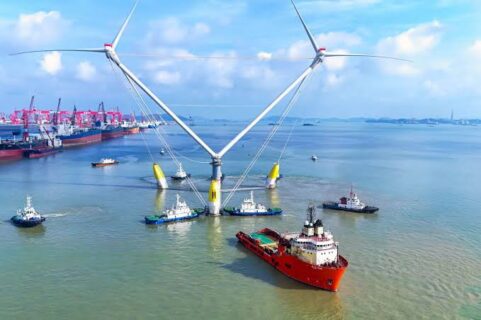
The turbine carries a rated capacity of 26 MW and features a rotor exceeding 310 meters. Its blades measure approximately 153 meters each, while the rotor sweeps about 77,000 square meters.
Furthermore, the turbine has a hub height of 185 meters. That height makes the nacelle comparable to a 63-storey building.
Dongfang Electric uses a third-generation semi-direct-drive integrated design. The system combines the shaft system, gearbox and generator within a compact structure.
The design also addresses offshore operating challenges. Its sealed body protects equipment from salt spray and corrosion. Meanwhile, dual typhoon-resistance technology supports operation during severe storms.
The turbine can withstand super typhoons reaching Level 17, according to Dongfang Electric. Its design also addresses aerodynamic and structural coupling challenges affecting ultra-long blades.
Moreover, the machine uses three-level full-power conversion technology. Dongfang says the optimized transmission chain improves overall power generation efficiency by more than 2%.
The turbine supports flexible ratings between 20 MW and 26 MW. This configuration allows developers to adapt output to different offshore wind conditions.
At a 10 meters-per-second wind speed, Dongfang estimates annual generation at 100 million kWh. That output could meet the annual electricity demand of approximately 55,000 households.
The same output could save more than 30,000 tonnes of standard coal annually. It could also reduce carbon dioxide emissions by more than 80,000 tonnes.
Offshore Wind Construction Moves towards Larger Turbines
The 26 MW machine has displaced earlier offshore turbine records. Siemens Gamesa’s 21.5 MW SG 21-276 DD previously held the capacity record.
Dongfang’s turbine also exceeds earlier machines in rotor diameter. It’s more than 310-metre rotor demonstrates the industry’s continuing shift toward larger generating units.
However, larger turbines create new engineering demands. Developers must manage greater blade loads, tower stresses, foundation requirements and installation challenges.
The machine contains more than 30,000 components. Dongfang says its supply chain remains fully domestically controlled, including key components such as generators, blades and bearings.
The turbine’s development also connects with China’s broader offshore wind construction program. China continues to expand renewable generation while increasing domestic manufacturing capacity. By July 2025, the country’s combined installed wind and solar capacity had reached 1.68 billion kW.
The technology could eventually reduce turbine numbers within large offshore wind projects. However, commercial deployment will depend on certification, project economics, installation logistics and long-term operational performance.
The development also provides a useful technology link to the Rudong Offshore Wind Farm. That 800 MW project has surpassed 10 TWh of generation after more than 1,600 operating days. Its performance demonstrates how China’s offshore wind sector is combining large-scale generation with advanced transmission infrastructure.
Overview on the World’s Largest Offshore Wind Turbine
Another step taken in China’s strides to achieving net zero is the Dongfang’s 26 MW offshore wind turbine. This turbine beats Mingyang’s record breaking wind turbine in both size and capacity. The 26 MW wind turbine is now the largest in the world.
Specs for the World’s Largest Offshore Wind Turbine
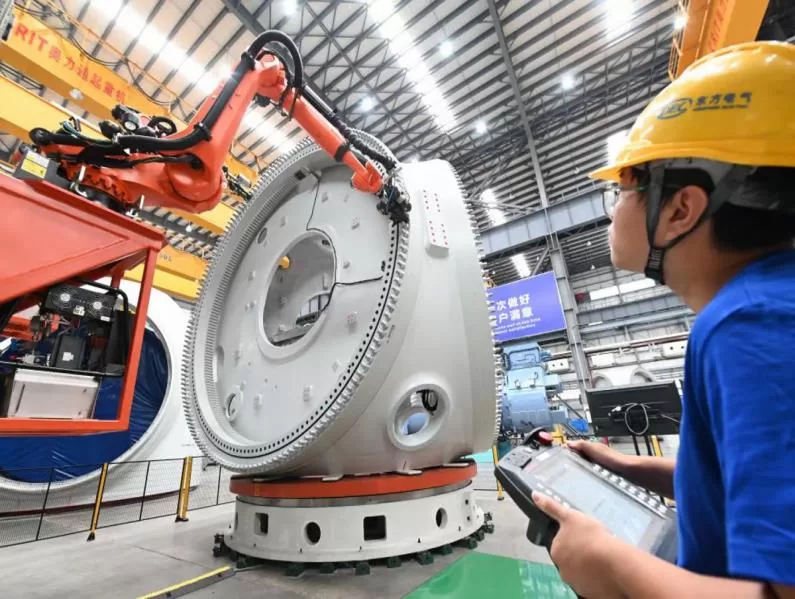
The giant turbines are being build in Fuzhou, Fujian Province in China. They will stand at 340 meters and will have the center of the hub sit at a height of 185 meters. The blades have an enormous diameter of 310 m and a wide sweep area of 75,477 square meters.
These wind energy harvesters also come with special features. These include:
1. A third generation fully integrated semi-direct drive technology which features a highly integrated generator, gearbox and shafting.
When compared to previous releases that were directly connected to the power grid, the third generation technology presents with 67% increase in torque, 36% reduced turbine vibration, and a 5 % reduction in components temperature rise.
The generator, which is the devil in the detail, will largely contribute to the characteristic pure torque, high load, and high reliability of the turbine.
2. Resistance to corrosion and the ability to withstand violent typhoons with winds speeds of up to 137mph (220 km/hr).
137 mph of wind speeds are equivalent to a category 17 typhoon or those of a category 4 hurricane. The “dual anti-typhoon design” that was incorporated in the engineering of the turbines is what makes these gigantic wind harvesters able to take their ground in the face of the destructive winds.
The 26 MW turbine will be able to generate up to 100GWh of electricity in a year which can power about 55,000 homes in China.
The 26 MW Dongfang turbine vs The 20 MW Mingyang turbine
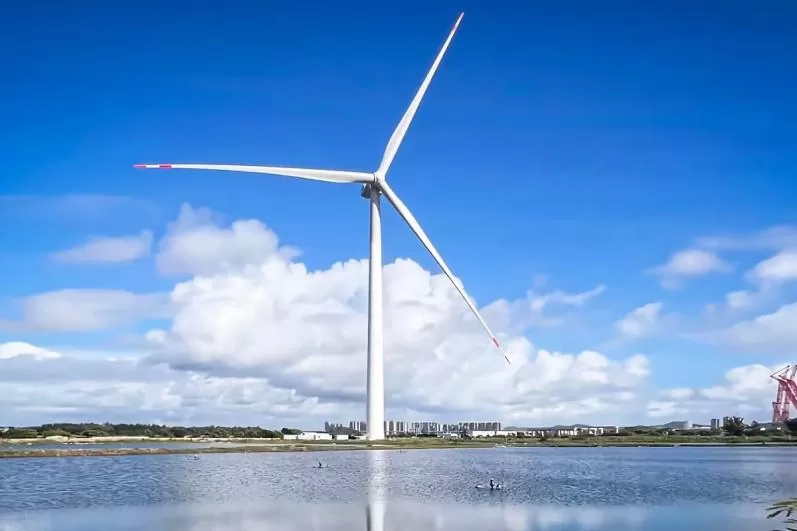
Mingyang Smart Energy announced the installation of their (now previous) world’s largest offshore wind turbines in September 2024.
Their turbines have a rotor diameter of a varying 260-292 meters, and cover a maximum sweep area of 66,966 square meters. This is a bit smaller compared to the 26 MW turbines by Dongfang Electric Corporation (DEC).
The 26 MW turbines have a power capacity of 100GWh while Mingyang’s turbines come close with only 80GWh in electricity generated in a year – this is still a lot of clean energy generated annually.
Surprisingly, the 20 MW turbines beats the 26 MW turbines in their ability to withstand violent wind storms. According to Mingyang, their turbines are able to face violent wind speeds of up to 79.8 m/s (178 mph / 287 km/hr), while the 26 MW turbines can stand unwavered to wind speeds of up to only 137 mph (220 km/hr). Mingyang is also developing the world’s largest floating offshore turbine rated at 50 MW.
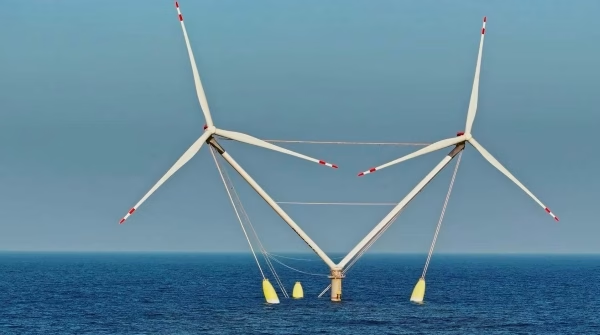
Also Read: 131 Meters of Wind Power: The World’s Largest Onshore Wind Turbine
How Reliable are the 26 MW Turbines?
According to DEC, the units are specifically made to suit medium to high speed winds. They will also have low operation and maintenance costs.
The 100 GWh of electricity annually will not only power households but also reduce coal usage. This will be by up to 30,000 tons, and cut down carbon emissions by up to 80,000 tons.
End-notes
DEC has a good track record in the innovation of sustainable energy solutions over the course of the decade.
They have achievements like building the first 10 MW offshore wind turbine in Asia. This was followed by an upgrade to 13 MW. Then the world’s first 18 MW offshore wind turbines, and more innovations that broke “world records” like the world’ s first ultra high turbines and the longest blades for a wind turbine.
They now have the largest turbine, both by size and capacity, in the world. More is surely set to come in the race to harness and make use of greener, cleaner, and sustainable energy for the planet.
Project Fact Sheet
Name: Dongfang Electric 26 MW Offshore Wind Turbine.
Type: Offshore wind turbine prototype and testing project.
Developer and manufacturer: Dongfang Electric Wind Power Co., Ltd.
Location: Dongying, Shandong Province, China.
Manufacturing location: Fujian Fuzhou Offshore Wind Power Industrial Park.
Rated capacity: 26 MW.
Flexible capacity range: 20 MW to 26 MW.
Rotor diameter: More than 310 meters.
Blade length: Approximately 153 meters.
Rotor swept area: Approximately 77,000 square meters.
Hub height: 185 meters.
Installation milestone: August 29, 2025.
Testing facility: Dongying Wind Power Equipment Testing and Certification Innovation Base.
Grid milestone: Commissioned for grid-connected generation in October 2025.
Estimated annual generation: Up to 100 million kWh at 10 meters per second.
Equivalent household supply: Approximately 55,000 households annually.
Estimated annual coal savings: More than 30,000 tones.
Estimated annual emissions reduction: More than 80,000 tones of CO₂.
Drive system: Third-generation fully integrated semi-direct drive.
Converter system: Three-level full-power conversion technology.
Typhoon resistance: Up to Level 17 super typhoons.
Components: More than 30,000 parts.
Project Team
Developer: Dongfang Electric Corporation.
Turbine manufacturer: Dongfang Electric Wind Power Co., Ltd.
Technology developer: Dongfang Electric Wind Power research and design teams.
Manufacturing facility: Fujian Fuzhou Offshore Wind Power Industrial Park.
Testing facility: Wind Power Equipment Testing and Certification Innovation Base, Dongying.
Key component supply: Dongfang Electric’s domestically controlled supply chain.
Generator technology: Dongfang Electric.
Blade technology: Dongfang Electric.
Bearing technology: Dongfang Electric supply chain.
Control system: Dongfang Electric’s domestically developed system.
Power conversion technology: Dongfang Electric.
Grid connection: Dongying testing and certification facility infrastructure.


Leave a Reply