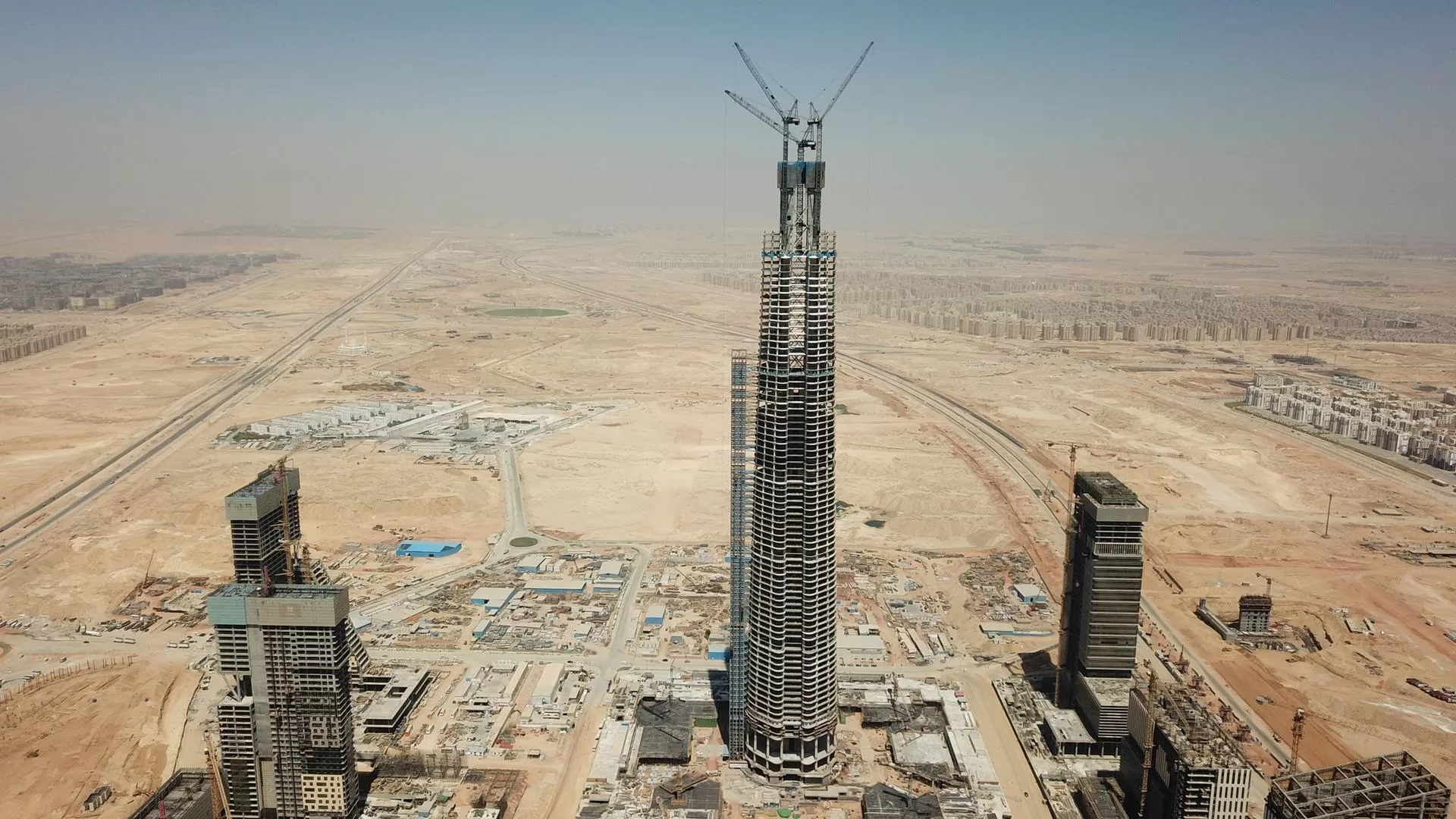
Iconic Tower in Egypt’s New Administrative Capital continues advancing through major construction milestones in 2026, reinforcing the country’s push to deliver a landmark CBD skyline east of Cairo. The Iconic Tower, valued at around $3 billion, remains the centerpiece of the Central Business District and forms part of a broader master-planned city development strategy. Construction teams have progressed steadily with structural, façade, and systems integration works, while the project continues to evolve into its final architectural form.
Moreover, the development reflects Egypt’s wider ambition to decentralize administrative functions from Cairo. Consequently, the New Capital has already begun hosting government institutions, residential communities, and commercial districts. The skyscraper stands as a defining vertical element within this expanding urban ecosystem.
Iconic Tower reaches advanced structural phase
Construction activity on Iconic Tower has reached advanced completion stages, with the structural frame largely established and exterior works progressing in coordination with internal systems installation. China State Construction Engineering Corporation (CSCEC) continues to lead delivery operations under the supervision of Egyptian authorities and engineering consultants.
Additionally, the project has transitioned from major concrete works into finishing and integration phases. Mechanical, electrical, and plumbing systems are being installed across multiple levels, while façade works continue to define the tower’s final external identity. Workforce deployment remains high, supporting parallel construction streams to maintain delivery momentum.
However, full operational readiness still depends on final systems testing, interior completion, and commissioning of building services. Therefore, the project remains under active construction in 2026 despite visible structural completion.
Iconic Tower linked to wider New Capital expansion
The skyscraper forms a central anchor within Egypt’s broader New Administrative Capital expansion program, which is increasingly operational in 2026. Government relocation, financial district activation, and residential occupation have already begun shaping the city’s functional identity.
Furthermore, the project links directly to surrounding mega developments, including commercial towers, government districts, and large-scale infrastructure corridors. Notably, it complements other landmark initiatives in the capital such as emerging business districts and integrated mixed-use zones, reinforcing a coordinated urban growth strategy across the New Capital landscape.
As a result, the skyscraper is not only a standalone structure but also part of a wider economic and urban transformation model intended to redistribute population density and investment flows away from central Cairo.
This skyscraper project aligns with Egypt’s broader megaproject pipeline in the New Administrative Capital, including the Citystars Park St Development in New Cairo. Both developments reflect a coordinated national strategy focused on large-scale mixed-use urban expansion, combining vertical landmark architecture with integrated live-work-play communities to reshape Greater Cairo’s metropolitan structure.
The Scope of Implementation on Africa’s Tallest Skyscraper

Implementing Africa’s tallest skyscraper and the New Administrative City is expected to be of unprecedented significance. Once implemented, the official aim of the 700-square kilometer is to relieve some pressure on Cairo. Egypt’s capital city holds around a fifth of the country’s population, with 111 million citizens residing there. Upon completion, the New Administrative City is expected to help relieve the pressure as some residents relocate to it. The city in the desert is expected to host up to six million individuals. The mega-city will also hold Egypt’s parliament and the presidential palace. Broken down into three phases over seven to 12 years, according to the press releases, the future capital will follow a functional zoning system and include a governmental district hosting a presidential palace, ministerial buildings, a parliament, a diplomatic quarter, and an international airport.
The Significance of the Iconic Tower Upon Completion
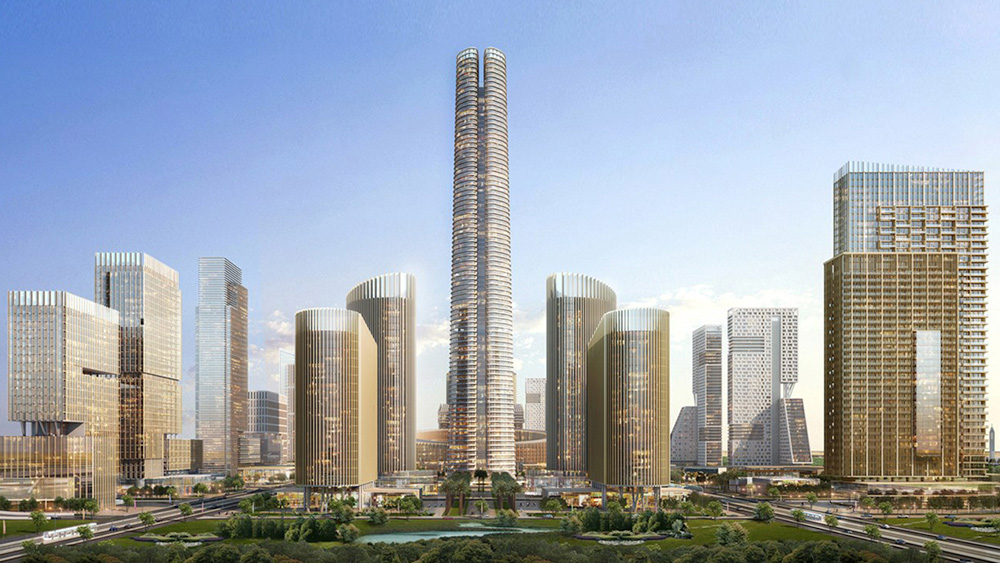
Once fully completed, Africa’s tallest skyscraper prides its heritage and status in its ability to capture the essence of Egypt’s history and future. Its design is inspired by the obelisks, which are highly regarded in Egypt. This enables the building to pay homage to the nation’s rich cultural heritage. Furthermore, the tower’s incorporation of modern architectural elements and eco-friendly features shows how the nation promotes modernity. It also shows its commitment to sustainability in its infrastructural designs. The Iconic Tower will promote tourism as visitors will come far and wide to see the magnificent building.
Egypt is already one of the leading tourist destinations in Africa and the world, and the Iconic Tower will solidify its position further. The Iconic Tower is not merely a construction but a symbol of Egypt’s desire for economic development and the effects of globalization. It will act as a landmark in the New Administrative Capital, where people, tourists, and investors will visit to transact business. Its construction is expected to continue the area’s growth and create more employment opportunities for the inhabitants. In addition, the tower is expected to emerge as a significant attraction for tourists from all parts of the world. Its size and location on the skyline will embody a combination of historical greatness and contemporary advancement.
Also read:
Construction of the World’s Tallest Bridge Underway as Expected Completion Time is Set in Focus
Construction Timeline and Funding
The Iconic Tower started in May 2018, and there are signs that the project has been going well. However, there are some challenges, like logistic difficulties and the COVID-19 pandemic; the project is nearing its conclusion. The tower’s construction should be completed and fully functional by the end of 2024. Thus, the Iconic Tower was designed by Dar Al-Handasah, an internationally recognized architectural firm that applies modern architectural and engineering concepts. It has a slender and contemporary style that looks attractive and possesses structures that can withstand earthquakes and strong gales common in its location.
The building is intended to be technologically complex, with a sleek outer shell, energy-saving equipment, and modern security systems, effectively meeting the requirements for constructing tall buildings worldwide. The construction of the Iconic Tower has been very costly, and the estimated project cost is approximately $3 billion. Such an investment would correlate with the project’s size and the engineering level needed to bring such a monumental edifice to fruition. This has been in combination with government grants and private financing, which underlines the integrated effort to achieve this dream.
The Contractors Involved in the Project
The implementation and construction of Africa’s tallest skyscraper bring various contractors on board, each with a specific and fundamental role. These include:
Architect
Design
Dar al-Handasah Shair & Partners; Perkins+Will
Architect of Record
Dar al-Handasah Shair & Partners
Structural Engineer
Design
Dar al-Handasah Shair & Partners
MEP Engineer
Design
Dar al-Handasah Shair & Partners
Contractor
Main Contractor
China State Construction Engineering Corporation
Also read:
Saudi Arabia Approves Designs for World’s Tallest Sprts Tower in Riyadh
Project Timeline
2007
Design for the Iconic Tower officially started in 2007. The building comprised a unique design that sees its twist from a triangular base into a rectangular skyscraper. It is founded on an area of roughly 240,000 square meters.
May 2018
The construction of the Iconic Tower was officially launched in May 2018. The construction of the project was launched by the country’s Prime Minister Mostafa Madbouly. The Iconic Tower is going up at a rate of one floor every six days or fewer with five thousand workers toiling on the project.
February 2019
In February 2019, a base of about 18,500 cubic concrete and 5000 tons of reinforced bars was poured.
Nov 2019
Egypt commence construction
Construction of the Iconic Tower in Egypt’s new administrative capital has begun. Housing Minister Asem al-Gazzar revealed the report and said that foundation works have commenced.
The Iconic Tower is one of several Dubai-style mega projects being built in the new administrative capital. The base of about 18,500 cubic concrete and 5000 tons of reinforced bars was poured in February.
December 2020
As of December 2020, 49 floors out of 80 (245 meters (804 ft) were reported to have already been completed.
Jun 2021
Iconic Tower Skyscraper-the tallest tower in Africa-topped off
The Iconic Tower Skyscraper that is being built in the New Administrative Capital (NAC) east of Cairo, Egypt, since May 2, 2018, has been topped off.
Speaking during the ceremony, the Egyptian Minister of Housing, Utilities, and Urban Communities, Essam el-Gazzar said that this is the most important building in modern Egypt, which marks the latest achievement of the North African country.
The construction of the Tower was officially launched in May 2018 by the North African country’s Prime Minister Mostafa Madbouly with CSCEC as the project’s main contractor.
Following the civil works, construction of the tower’s core tube started in April 2019. Wei Jianxun, the general manager of the Iconic Tower project said that the core tube was constructed at the fastest speed of one floor every four days.
In late February this year, the Iconic Tower’s base, built with approximately 18,500 cubic meters of concrete and 5,000 tons of reinforced iron bars, was completed with a 38-hour non-stop operation, which was hailed by Mostafa Madbouly as “a miracle by all means.”
According to Ahmed Al-Banna, the project manager from Dar al-Handasah Shair & Partners, the construction of the tower to the top-off point took approximately 800 non-stop working days. On the other hand, Hossam Berry, the structural manager of the Dar supervision company, thanked the workers and engineers for working around the clock to reach this milestone.
Egypt completes phase 1 construction
The government of Egypt has announced the completion of phase one construction of the Iconic Tower the tallest tower in Africa. Egyptian Ministry of Housing said the CSCEC completed the concrete work at the 400-meter Iconic Tower.
June 2021
The lift supplier
The Iconic Tower has selected KONE Corporation to equip the tallest building in Africa. Thomas Hinnerskov, Executive Vice President for KONE South Europe, Middle East, and Africa confirmed the report and said the company won the tender to deliver and install 60 custom-made elevators and escalators for the Iconic Tower.
KONE’s delivery includes 36 KONE MiniSpace™ elevators, 13 KONE MonoSpace® elevators, seven KONE TranSys™ freight elevators, and four KONE TransitMaster™ 120 escalators, all with finishes specially designed for this building.
Smart technologies
In addition, the KONE Destination Control System will help reduce waiting and travel times and the KONE E-Link™ service will enable monitoring equipment performance in real-time, from a single location onsite. The contract also includes maintenance services.
“Iconic Tower will become a significant landmark not only in the New Administrative Capital but across Egypt and Africa. We are truly honored to provide our high-rise expertise and our people flow solutions for this development and together with our customers help the city set new standards for smart and sustainable buildings,” said Mr. Hinnerskov.

Project Fact Sheet
Project Name: Iconic Tower (Africa’s Tallest Skyscraper Project)
Location: Central Business District, New Administrative Capital, Egypt
Country: Egypt
Project Type: Supertall skyscraper / mixed-use commercial tower
Height: ~393–400 meters (design specification range)
Estimated Cost: ~US$3 billion
Developer: New Urban Communities Authority (NUCA)
Main Contractor: China State Construction Engineering Corporation (CSCEC)
Status (2026): Advanced construction phase / finishing and systems integration ongoing
Function: Landmark tower for government, commercial, and mixed-use office functions
Key Purpose: Anchor the CBD skyline and support New Capital identity
Project Team
Client / Owner: New Urban Communities Authority (NUCA), Egypt
Main Contractor: China State Construction Engineering Corporation (CSCEC)
Project Engineer / Structural Delivery: CSCEC engineering divisions
Government Oversight: Egyptian Ministry of Housing, Utilities and Urban Communities
Urban Development Authority: Administrative oversight under New Capital development bodies
Architecture & Design Consultant: International and Egyptian consortium led through New Capital CBD design framework
Mechanical, Electrical & Plumbing Contractors: International subcontracting packages under CSCEC coordination
Façade Engineering Contractors: Specialist façade system suppliers and installers under EPC structure
Project Management: Central Business District (CBD) project management unit



Leave a Reply