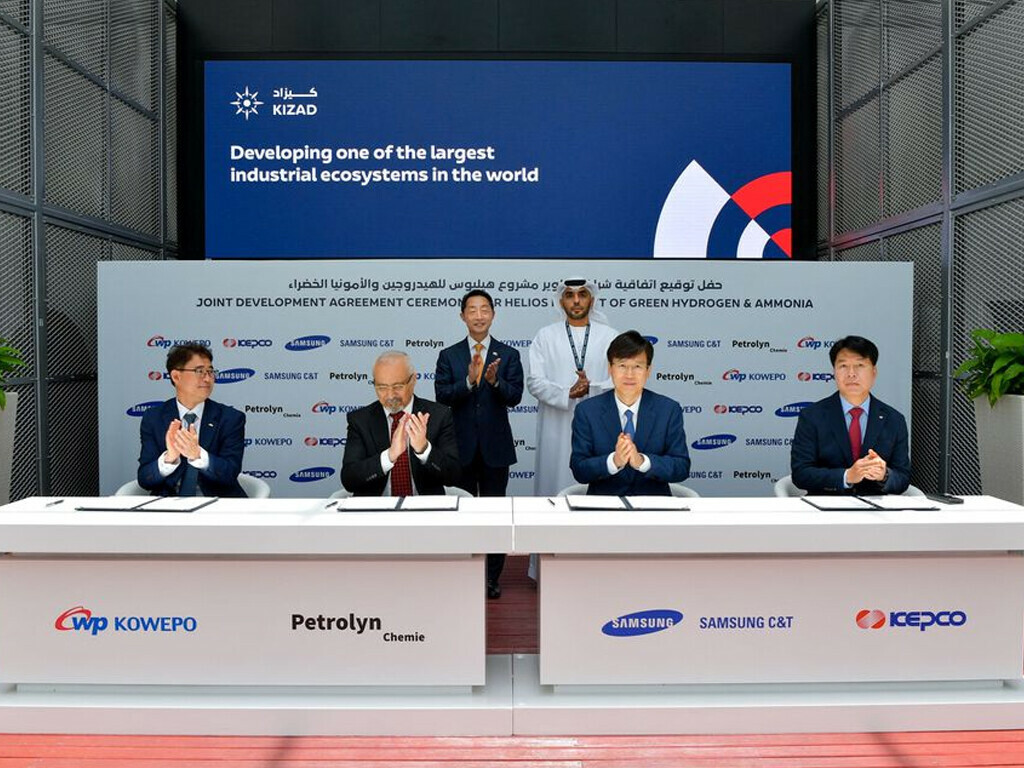
The KIZAD ammonia production facility project remains part of Abu Dhabi’s earlier ambitions to develop large-scale green hydrogen and ammonia manufacturing capacity. Announced on June 9, 2022, the development brought together South Korean energy and construction companies with UAE-based Petrolyn Chemie. The proposed facility would combine solar photovoltaic infrastructure with hydrogen-to-ammonia production technology.
Its development strategy envisaged two phases, beginning with a 300MW solar power plant and approximately 35,000 tonnes of annual ammonia production. The wider scheme targeted an 800MW solar photovoltaic installation and more than 200,000 tonnes of green ammonia exports annually. However, publicly available information does not establish whether the original project has progressed into construction or reached commercial operation.
KIZAD Ammonia Production Facility Targets Green Ammonia Exports
The original development involved a consortium of Samsung C&T, Korea Electric Power Corporation (KEPCO), Korea Western Power and Petrolyn Chemie.
Petrolyn Chemie operates as a joint venture between Chemie Tech and Petrolyn. The consortium signed the implementation contract following a land lease agreement and completion of a technical study.
German engineering company ThyssenKrupp AG undertook the technical study. The proposed development would use renewable electricity to support hydrogen production and subsequent ammonia manufacturing.
Phase One initially proposed a 300MW solar photovoltaic installation. It also targeted approximately 35,000 tonnes of annual ammonia production capacity.
However, the developers had not finalized the initial phase’s specifications and production capacity when Construction Review published its original report.
The wider development envisaged an 800MW solar photovoltaic installation. Once fully implemented, the facility targeted more than 200,000 tonnes of green ammonia exports annually.
Green ammonia offers an alternative pathway for producing and transporting hydrogen. Industries can also use ammonia in fertiliser manufacturing, shipping and other industrial applications.
Consequently, the proposed KIZAD development sought to establish Abu Dhabi as a supplier of renewable hydrogen derivatives. Its solar-powered production model also aligned with the UAE’s longer-term decarbonisation ambitions.
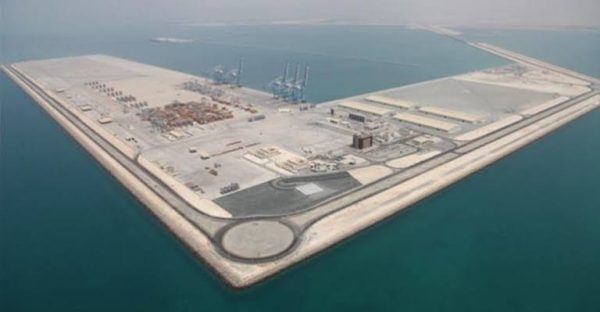
KIZAD Ammonia Production Facility Faces a Changing Industrial Landscape
Abu Dhabi has subsequently advanced other ammonia manufacturing developments, particularly through its TA’ZIZ Industrial Chemicals Zone in Al Ruwais.
In May 2024, Fertiglobe and its partners awarded Tecnimont the engineering, procurement and construction contract for a 1-million-tonne-per-year low-carbon ammonia facility. The development targets approximately 50% lower carbon intensity during its initial phase. Its partners include TA’ZIZ, Mitsui & Co. and GS Energy Corporation.
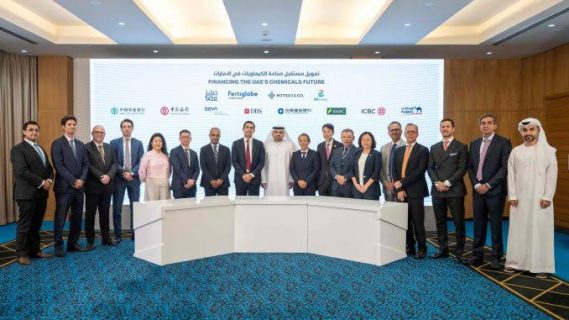
On November 4, 2026, TA’ZIZ announced $1.39 billion in financing for its Ruwais terminal and ammonia projects.
The financing includes more than $928 million for the terminal and over $460 million for ammonia production. The ammonia facility’s EPC works have exceeded 90% completion, while terminal construction stands at approximately 70%.
The ammonia facility targets annual production of one million tonnes. Meanwhile, the terminal will provide chemical storage and export infrastructure for the wider industrial zone.
The Ruwais development represents a separate project from the earlier KIZAD proposal. Nevertheless, both illustrate Abu Dhabi’s strategy of expanding industrial chemical production and associated export infrastructure.
The latest financing milestone also demonstrates the growing scale of investment supporting the emirate’s ammonia manufacturing ambitions.
As of November 2026, no sufficiently reliable public announcement confirms the KIZAD project’s construction status, revised capacity or commissioning schedule. Therefore, its original development targets should not be interpreted as completed infrastructure or confirmed current construction activities.
Implementation of the Ammonia production facility project in the Kizad industrial area
The Ammonia production facility project in the Kizad industrial area will be constructed in two phases – the first of which entails a 300MW solar PV plant and an estimated 35,000 tonnes-a-year ammonia production capacity. While the final specifications and capacity for phase one are still under discussion, the overall project will include an 800MW solar photovoltaic (PV) plant to power hydrogen-to-ammonia production. The facility is expected to produce over 200,000 tonnes of green ammonia for export annually once completed.
Also Read: World’s largest green hydrogen facility to be constructed in Saudi Arabia
Green hydrogen is considered to be an important fuel for reducing greenhouse gas emissions. Petrolyn stated that the project will enable the participating companies to achieve their Net-Zero vision. The firm further added that they are expected to expand the driver of future growth in the market for green hydrogen through their expanded reproduction of their future business model.
According to the Korea Times, this project is said to be South Korea’s first overseas green hydrogen and ammonia project. While just last month, The Abu Dhabi National Oil Company (ADNOC), the British petroleum and Masdar signed a partnership to study clean hydrogen projects in the country, further proving their commitment to achieving Net-Zero emissions by 2050.
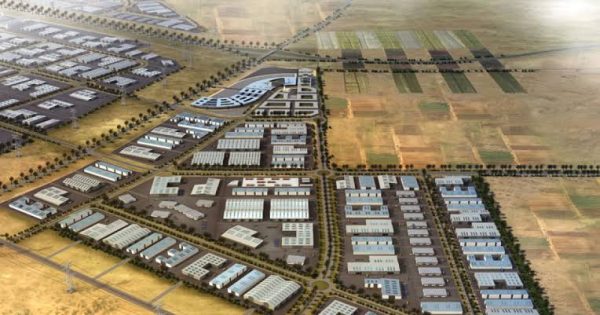
Project Fact Sheet
Name: KIZAD Ammonia Production Facility.
Location: Khalifa Industrial Zone Abu Dhabi (KIZAD), Abu Dhabi, UAE.
Project category: Green hydrogen and ammonia manufacturing.
Original announcement: June 9, 2022.
Development structure: Two proposed phases.
Initial solar power capacity: 300MW.
Initial proposed ammonia production: Approximately 35,000 tonnes annually.
Overall proposed solar power capacity: 800MW.
Overall proposed green ammonia exports: More than 200,000 tonnes annually.
Main energy source: Solar photovoltaic power.
Production process: Hydrogen-to-ammonia manufacturing.
Technical study: ThyssenKrupp AG.
Construction status: Not independently confirmed as of November 2026.
Operational date: No verified commissioning date available.
Cost: No verified project cost publicly established in the cited sources.
Project Team
Project consortium: Samsung C&T, Korea Electric Power Corporation, Korea Western Power and Petrolyn Chemie.
UAE project partner: Petrolyn Chemie.
Petrolyn Chemie joint venture partners: Chemie Tech and Petrolyn.
South Korean construction and engineering participant: Samsung C&T.
Electricity sector partner: Korea Electric Power Corporation (KEPCO).
Power supply and trading partner: Korea Western Power (KOWEPO).
Technical study consultant: ThyssenKrupp AG.
Project development location: Khalifa Industrial Zone Abu Dhabi (KIZAD).

Leave a Reply