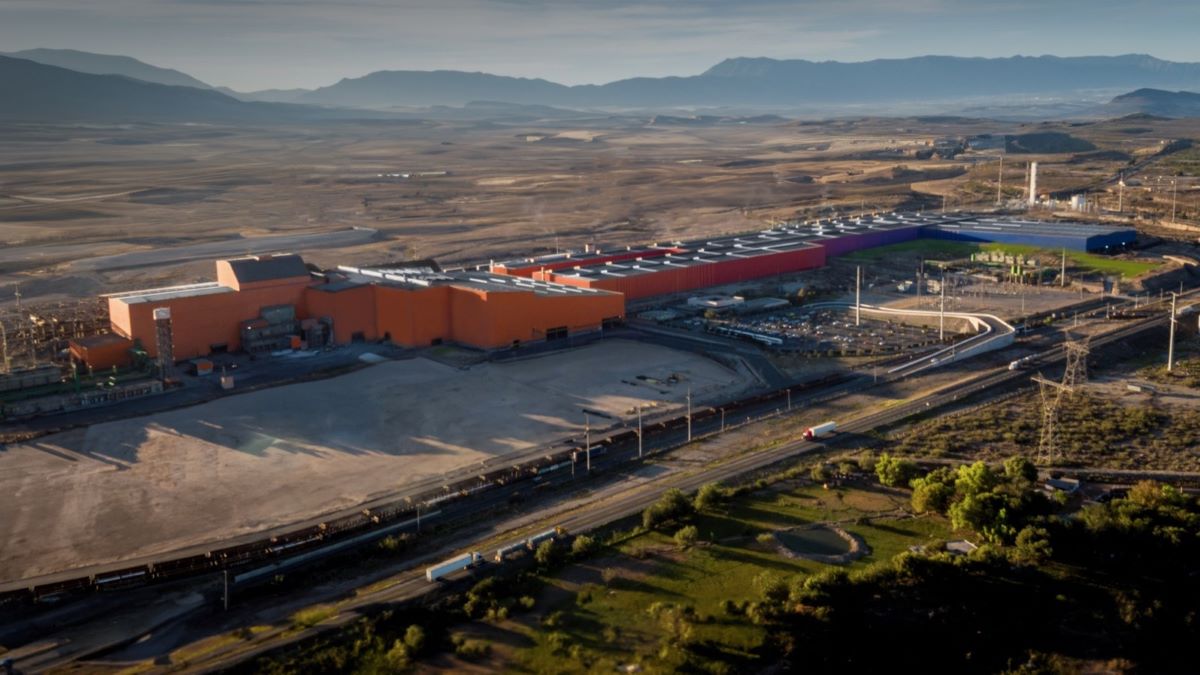
Deacero has produced the first steel billet at Ramos II, its $600 million electric arc furnace minimill and structural section rolling mill in Ramos Arizpe, Coahuila, Mexico. Danieli, the plant’s Italian equipment supplier, reported the milestone on November 2, 2026. The plant is in commissioning, about nine months behind the February 2026 start date set in 2024.
The milestone is not new capital. Several outlets reported a fresh $600 million commitment in late November, but the figure is the same Ramos II budget Deacero announced in June 2024, when Coahuila governor Manolo Jiménez Salinas joined company executives at the launch. What changed this month is that the plant has started making steel. Once Ramos II is complete, Deacero’s cumulative investment at the Ramos Arizpe complex will reach about $1.3 billion, a total that includes the mill the company built there in 2011 and 2012.
How the First Billet Was Made
The startup sequence explains why the plant is producing steel before its own furnace is running. According to Danieli’s commissioning statement, the new continuous casting complex was fed with liquid steel from the existing electric arc furnace at Steelmaking Plant No. 1, while commissioning continued on the new furnace at Steelmaking Plant No. 2. The layout lets Deacero test the caster without waiting for the new melt shop.
Beam blanks come next. Danieli said beam blank production would start in the weeks after the first billet. Beam blanks are the semifinished shapes the new rolling mill will turn into large structural beams and sections up to 27 inches deep.
Commercial output is a separate question. Cluster Industrial reported on November 24 that the first billet is a commissioning test rather than the start of full commercial operation, and that no date has been confirmed for reaching full capacity.
The core equipment is a 150-tonne electric arc furnace with Danieli’s “Zero-Man-Around” automation and automatic raw material feeding, as SteelOrbis described the order. Ramos II is the fifth Danieli minimill Deacero has ordered.

The Capacity Figure Has Changed Three Times
Published capacity for Ramos II has shifted with each announcement. In September 2023, Deacero described its planned fourth steel mill in Ramos Arizpe as a 1.2 million tonne plant. Two months later, SteelOrbis reported that Danieli had been contracted for a 1.5 million tonne minimill at the same site, with startup in the first quarter of 2026. The June 2024 launch statement then put the addition at 1 million tonnes a year, the figure Deacero still uses.
A Deacero spokesperson told Reforma in October 2024 that the project would raise the company’s production capacity by 1.2 million tonnes a year. Deacero has not reconciled the figures. A plausible reading is that 1.5 million tonnes describes the melt shop’s design rating and 1 million tonnes the finished section output, but the company has not confirmed this.
Employment estimates have moved as well. In earlier comments reported by BNamericas, Deacero chairman Raúl Gutiérrez Muguerza said construction would employ about 2,000 people and operations about 700. The 2024 launch projected about 1,000 direct jobs, 2,500 indirect jobs, and up to 1,500 workers a day during construction. These remain projections, and Deacero has not reported how many operating positions have been filled.
Where Ramos II Fits in Mexican Steel
The plant targets a gap in domestic supply. Deacero’s stated aim is to replace imports of large structural sections used in industrial buildings, bridges, airports, and ports. Its existing Ramos Arizpe mill, operating since 2013, makes smaller sections, so Ramos II takes the company into heavier products it has not made before.
Scale is easier to read against a peer. Ternium’s expansion at Pesquería, in neighboring Nuevo León, is a $4 billion program built around a 2.6 million tonne slab plant, a 2.1 million tonne direct reduced iron plant, and new cold rolling and galvanizing lines. Spread over its steelmaking capacity, that works out at roughly $1,540 per tonne. Ramos II, at $600 million for 1 million tonnes, comes in at about $600 per tonne. The gap mostly reflects scope: Ternium is building ironmaking and flat product finishing lines for automotive steel, while Deacero is melting scrap in a plant next to an existing melt shop, which allows equipment to be shared during startup.
Coahuila’s steel identity is shifting with it. For decades, the state’s steel output rested on Altos Hornos de México in Monclova, the country’s largest integrated blast furnace plant, which stopped operating at the end of 2022 after the Federal Electricity Commission cut its power. The mayor of Ramos Arizpe has said Deacero’s investment could bring the municipality toward the production levels AHMSA once reached. Ramos II will run on scrap rather than iron ore and coke.
The wider industrial base in southeast Coahuila is also growing. Tetakawi, the shelter manufacturing operator, runs industrial parks in Saltillo, next to Ramos Arizpe, alongside sites in Sonora, Querétaro, and a manufacturing community in Mazatlán that broke ground in 2023. Demand from industrial building construction of this kind is the market Deacero expects its new beams to serve.
Water, Scrap, and Open Questions
Two resource choices shape the plant’s footprint. Deacero said in 2024 that Ramos II would use treated wastewater from the municipalities of Ramos Arizpe and Saltillo rather than draw on local aquifers, a material point in a water-stressed region. The company also said electric arc furnace production on recycled scrap would cut carbon dioxide emissions by a factor of seven compared with blast furnace steelmaking.
Several questions remain open. Deacero has not published a date for full commercial production, a reconciled capacity figure, or the final cost of the project after a startup roughly nine months later than planned. The company has also not named the civil works or erection contractors that built the plant.



Leave a Reply