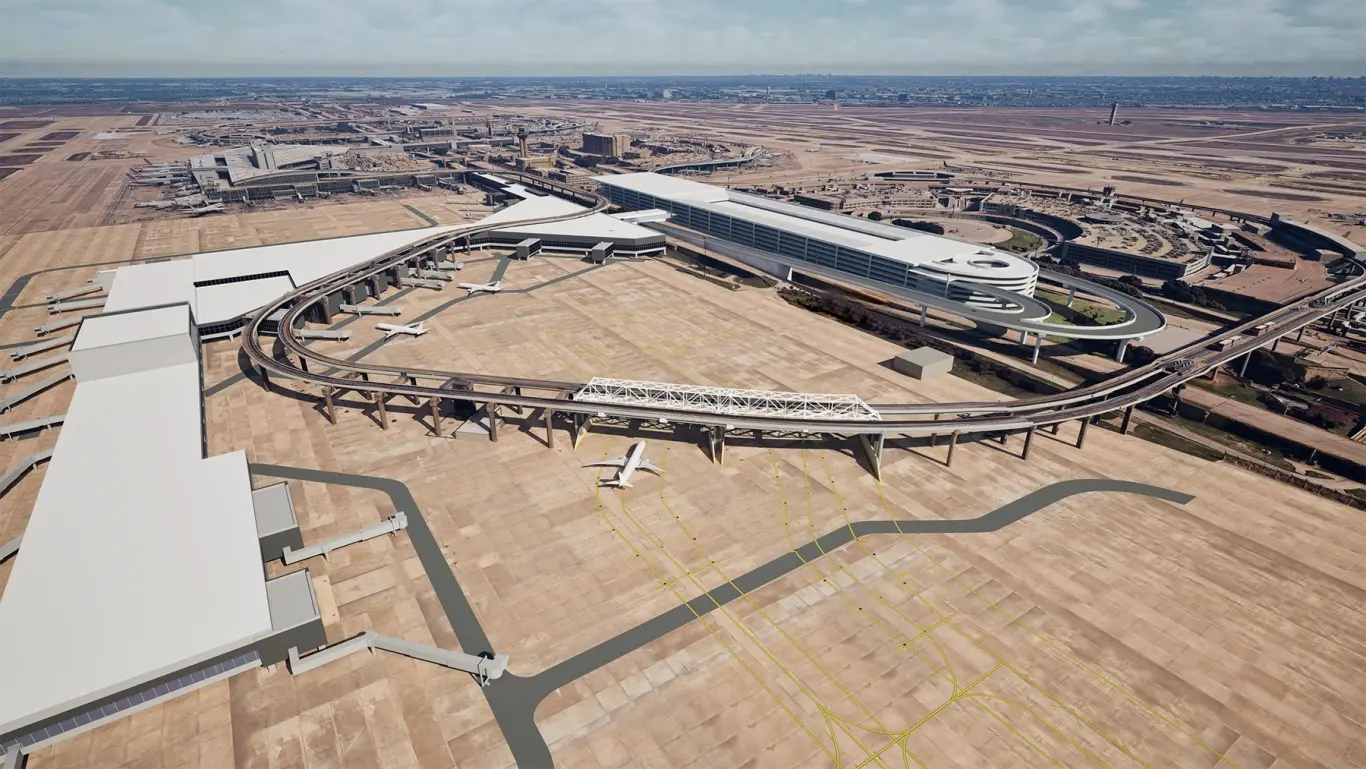
Dallas Fort Worth International Airport (DFW) will cut new openings into its elevated Skylink train line to bring aircraft traffic to its sixth terminal, and Jacobs will design the work.
The airport has selected Jacobs to lead design of modifications to existing Skylink guideway bridge spans. The changes will make room for dual parallel taxi lanes beneath the light rail. These lanes will connect the future Terminal F to DFW’s established taxiway network. The work will enable up to 16 additional gates at Terminal F. Skylink must keep running through every construction phase.
Jacobs will work with the Innovation Next+ construction joint venture, which is already building the first phase of Terminal F. Jacobs’ role is to optimize construction sequencing, operational requirements and safety considerations. The Executive Vice President Tom Meinhart said keeping Skylink running throughout construction is “no small task.” That is the central challenge of the job.
An aging system with little slack
Skylink is a core part of how the airport functions. The automated people mover began service in 2005 and has been maintained by Alstom since opening. It now runs 10 stations along 4.81 miles of elevated track. Alstom reports availability above 99% each year and more than 20 million passengers annually before the pandemic. Any bridge alteration therefore has to avoid disrupting a system that connects every terminal airside.
Part of a program that has grown sharply
The Skylink work sits inside a larger and fast-changing program. The $4 billion Terminal F expansion doubled in scope in May 2025 to 31 gates, and American Airlines will occupy all of them. The first phase is expected to open in 2027 with 15 of the planned 31 gates. The expansion is part of DFW’s $12 billion transformation plan.
The Skylink changes have also been gathering money and approvals. In April 2026, the airport board approved design of Skylink structural column modifications to support early construction, at a cost for design, code and construction not to exceed $300 million. That approval came alongside a revised execution plan for the change in gate capacity from 15 to 31. Last year, the board raised the Innovation Next+ contract ceiling by $31.2 million to $1.12 billion. A separate $164 million amendment covered relocating and expanding the Skylink Station, plus apron paving. Alstom Transport USA received a contract of up to $22.6 million for the new Terminal F station.
Station progress
Construction on the new station is already visible. On Nov. 3, all six prefabricated modules of the new Terminal F Skylink station were placed in an eight-hour operation that tied the station into the existing system. The terminal itself is billed as the largest modular airport project ever.
Who is involved
Innovation Next+ is a joint venture of Archer Western Construction, Turner Construction, Phillips May, H.J. Russell & Co. and CARCON Industries. Its design team members include PGAL, Gensler and Muller2.
Dallas Fort Worth is not the only major US hub reworking its terminals while passengers keep moving. In Colorado, Denver International Airport is bringing a $1.3 billion renovation of its main terminal toward completion and is also planning a new terminal expansion. Both airports are adding capacity inside facilities that must stay open and fully operational throughout construction.

Leave a Reply