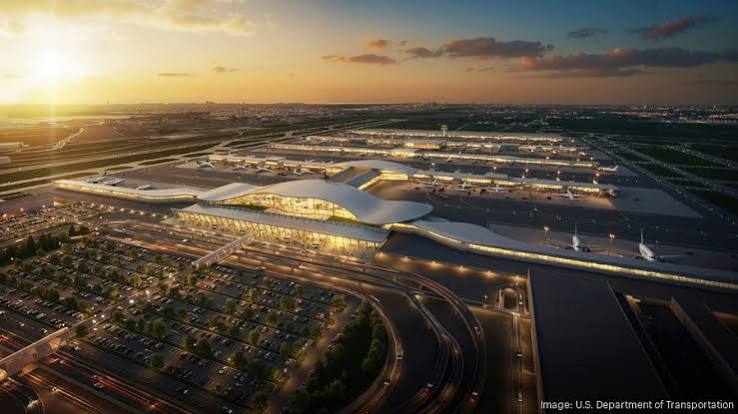
The vision for a sweeping revitalization of Washington Dulles International Airport is beginning to take the form of an actual construction program.
Less than a month after the White House unveiled plans for a major redevelopment of Dulles, the Metropolitan Washington Airports Authority has unanimously approved $15.5 billion in additional capital spending, taking a decisive step toward turning the proposal into a funded, long-term infrastructure program.
The Aug. 19 vote adds the new funding to $4.4 billion already included in MWAA’s capital budget, creating a $19.9 billion program of terminal, concourse and transportation improvements planned through approximately 2039.
The distinction is significant.
The July announcement, championed by President Donald Trump, MWAA and United Airlines, outlined a vision for a larger and more modern Dulles, with new and renovated terminals, expanded concourses and upgraded passenger infrastructure.
A $19.9 billion construction program takes shape
MWAA has divided the program into five major packages, together covering the airport’s terminals, concourses, passenger transportation and supporting infrastructure.
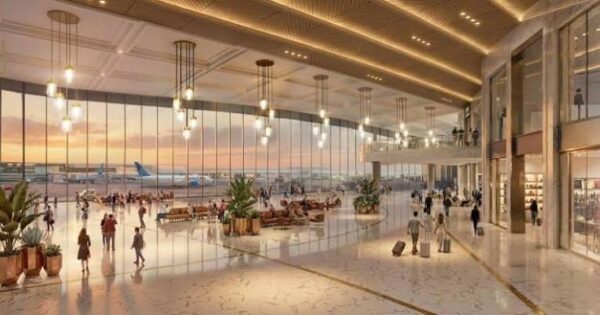
The largest, Package A, carries a $6.2 billion price tag and forms the core of MWAA’s Dulles Revitalization effort. It will expand and renovate the Main Terminal, extend the building approximately 300 feet east and west, upgrade ticketing and baggage systems and renovate Concourses A and B.
The work will also require MWAA to relocate several existing support facilities, including maintenance operations, a warehouse, flight kitchen and central utility plant. MWAA expects to award contracts in late 2026, with construction starting in late 2027 and continuing into the mid-2030s.
A second major phase, Package T, will invest $3.75 billion in expanding the AeroTrain system westward toward future concourses. The package also includes a central underground passenger and baggage spine designed to improve connections across the airport.
AeroTrain package
Construction on the AeroTrain package is expected to begin in early 2029 and continue until 2034. The new system will eventually support the phaseout of Dulles’ decades-old people mover shuttle vehicles.
MWAA has allocated another $2.3 billion for Package B, which will demolish the existing Concourses C and D in stages beginning around 2031. The authority plans to replace them with a modern 33-gate regional concourse by the late 2030s.
Package C will receive $4 billion to fully build out Concourses E and F and provide the utility infrastructure needed to support those facilities and future expansion.
The final major phase, Package D, carries a $3.7 billion budget for a new Concourse G/H. MWAA plans to time its development around future passenger demand, with the final phases extending toward 2039.
Together, the program will add and renovate approximately 5 million square feet of airport space while preserving Dulles’ historic Main Terminal, designed by Finnish-American architect Eero Saarinen.
MWAA authorizes first $48 million to get work underway
While most of the construction remains years away, MWAA has already approved up to $48 million in spending through the end of 2026 to begin moving the program forward.
The early funding includes $8 million for AeroTrain tunnel planning, $16 million for Concourse E/F and $24 million for Concourse G/H.
That authorization represents one of the first tangible steps following the broader redevelopment announcement. Allowing MWAA to begin planning and advancing the projects before the largest construction contracts reach the market.
Bonds will finance most of the expansion
The redevelopment will rely heavily on future borrowing.
MWAA expects to finance $14.2 billion of the program through future airport revenue bond sales. Another $1.23 billion would come from future Passenger Facility Charges, while $150 million is currently included as anticipated federal grant funding.
MWAA Chief Financial Officer Andrew Rountree said the grant amount serves largely as a placeholder, with the authority expected to pursue additional funding opportunities to reduce its borrowing needs.
MWAA has said the program will not rely on local taxpayer funding outside direct federal grants.
The cost of rebuilding and expanding Dulles
The massive capital investment will also substantially increase costs for airlines operating at Dulles.
The airport’s cost-per-enplanement currently stands at $12.77. MWAA projects the measure could rise to between $60 and $65 by 2040 as the authority takes on debt to finance the redevelopment.
MWAA leaders argue the projected figure would remain competitive with other major U.S. airports undertaking large modernization programs. They have pointed to projected cost-per-enplanement figures at Los Angeles International Airport and San Francisco International Airport as examples of the financial pressures facing large airport expansion projects.
MWAA officials have also stressed that the charge is paid by airlines and does not directly represent an additional fee added to passenger ticket prices.
Still, the financial scale of the program has drawn scrutiny.
Supporters argue that Northern Virginia’s economy and demographics can support Dulles’ long-term growth and the investment needed to accommodate it. They also expect the redevelopment to create thousands of direct and indirect jobs across engineering, construction and aviation services.
Critics, meanwhile, have questioned whether future passenger growth will justify nearly $20 billion in capital spending. They have also raised concerns that higher airline operating costs could make Dulles less attractive to some carriers and increase competition from Baltimore-Washington International Airport.
Dulles is not alone in pursuing major airport infrastructure investment as aging terminals face growing demands for capacity, passenger amenities and modern operations. San Antonio International Airport, for example, is moving ahead with a $220.5 million renovation of Terminals A and B, adding another major U.S. airport project focused on upgrading existing passenger facilities while larger terminal construction continues elsewhere on the campus.
From announcement to action
The debate over the project’s cost and long-term economics is unlikely to disappear. But MWAA’s Aug. 19 vote marks a clear transition for the redevelopment.
The White House event put forward a vision for a transformed Dulles. The MWAA board has now backed that vision with $15.5 billion in new capital authorization, bringing the total program to $19.9 billion and setting the stage for years of planning, procurement and construction.
With early planning money authorized, contracts for the first major package expected in late 2026 and construction on the initial phase targeted for late 2027, the redevelopment has moved beyond a conceptual announcement.
The work of turning that vision into a new Dulles has begun.
Project Facts: Washington Dulles expansion
- Project: Washington Dulles International Airport redevelopment
- Location: Dulles, Virginia
- Owner: Metropolitan Washington Airports Authority
- Total capital program: $19.9 billion
- New capital authorization: $15.5 billion
- Existing capital funding: $4.4 billion
- Program timeline: Approximately 2026 to 2039
- New and renovated space: Approximately 5 million square feet
- Package A: $6.2 billion for Main Terminal expansion and Concourses A/B
- Package T: $3.75 billion for AeroTrain expansion and underground passenger and baggage infrastructure
- Package B: $2.3 billion for replacement of Concourses C/D
- Package C: $4 billion for Concourses E/F and supporting utilities
- Package D: $3.7 billion for a future Concourse G/H
- Early planning authorization: Up to $48 million through the end of 2026
- Primary funding: Future airport revenue bonds, Passenger Facility Charges and grants
- First major contracts expected: Late 2026
- Initial major construction expected: Late 2027

Leave a Reply