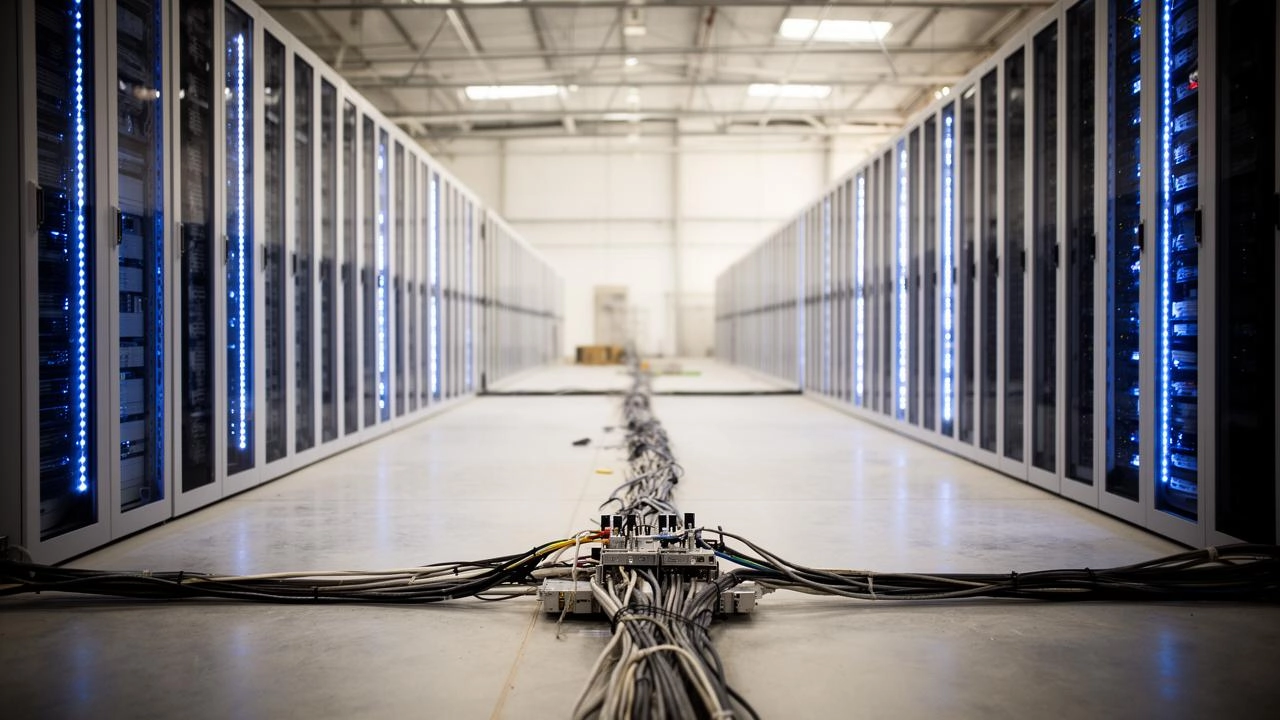
Huawei has bid to build AI data centres for the Egyptian government. However, in a move to counter this, the US State Department is now trying to assemble a rival consortium from Nvidia, AMD and Microsoft. This project of data centers will add on to the growing AI infrastructure in Africa as the continent struggles to catch up in the global data center race. African nations such as South Africa, Nigeria, Morocco, and Kenya have been recently actively developing data centers.
The tender offer proposes the exhortation of 1,408 of Huawei’s top-end Ascend 950-series chips for an AI training cloud. A further 600, either the same chips or the older 910B, would run two inference clusters. Huawei set out a 12-month build.
Mackenzie Hawkins reported the bid for Bloomberg, from people familiar with the matter and documents she reviewed. Gao Yuan and Matt Day contributed.
Huawei Struggles to Sell the Chips
Huawei has spent more than a year trying to sell these chips abroad without a completed deal. Last year it approached buyers in the Gulf and Southeast Asia with a couple of thousand processors. It offered only its second-best model, because production of the better 910C was too low.
This time it is offering the 950DT, which sits above the 910C. Huawei touted those chips at an event in South Korea last year, and the head of its Latin American cloud business told the South China Morning Post it is studying whether to sell them there too.
Huawei declined to comment. Egypt’s foreign ministry did not respond to Bloomberg’s questions.
The full order comes to 2,008 chips. Under typical training parameters that is roughly the capability of a few hundred top Nvidia processors, orders of magnitude below what Western companies deploy routinely.
How Would the Sale Matter to Huawei
For Huawei, a completed sale would prove two things at once: that foreign demand exists, and that it can now supply as US restrictions on chipmaking tools have held its volumes down for years.
Small first shipments into non-traditional markets are also the playbook that made Huawei the world’s largest telecoms equipment supplier.
The proposal is a partnership with iFlytek, the Chinese speech and surveillance company. Both firms have been on a US blacklist since 2019.
Their joint offering includes vehicle and individual recognition, run against a national population database. It also covers what the documents call situation awareness, packaged as a “one screen panoramic view of the city”.
The presentation runs to 102 pages. On one slide, the examples given for “basic video applications” carry the insignia of China’s Ministry of Public Security.
iFlytek did not respond. Bloomberg reports it is unclear what the American proposal would offer, or whether Washington would restrict any uses of the technology it supplied.

US Counters Huawei’s Proposal
When the Trump administration learned of the pitch, the State Department contacted Nvidia, AMD and Microsoft about a counter-bid. Microsoft declined to comment and the other two did not respond.
“Egypt is one of dozens of countries with whom we are speaking about US technology leadership on artificial intelligence,” a State Department spokesperson said. American AI “benefits the world”, they added, and the US “stands ready to partner with countries on AI development and deployment in ways that respect sovereignty and expand capabilities”.
Washington Issues Warning on Huawei Accelerators
Washington has also told the world that using certain Huawei accelerators without its approval can carry a legal penalty. Whether officials have raised that with Cairo is not known.
AI chip shipments to Egypt have needed American permission since 2023, which gives the administration leverage through the licensing process. Egypt is one of about 40 countries in that category.
Project Factsheet
Project Name: Egypt Government AI Data Center Project
Client: Egyptian Government (Public Sector, Military & Smart City Infrastructure)
Bidding Consortium (China): Huawei Technologies Co. & iFlytek Co.
Rival Consortium (US): Proposed coalition led by US State Department featuring Nvidia, AMD, and Microsoft
Project Timeline: 12-month build and deployment plan
Proposal Length: 102-page detailed pitch presentation
Hardware Specs
- Total Processor Order: 2,008 Chinese AI accelerators
- AI Training Cloud: 1,408 Ascend 950-series (950DT) top-end chips
- Inference Clusters: 600 chips (either Ascend 950-series or 910B models) split across 2 dedicated inference clusters
- Performance Benchmark: Compute capability roughly equivalent to a few hundred top-tier Nvidia processors
Core Features and Software
- Surveillance Systems: Vehicle and individual recognition tied directly into Egypt’s national population database
- Situational Awareness: Smart city monitoring packaged as a “one screen panoramic view of the city”
- Public Security Integrations: Basic video applications referencing software patterns used by China’s Ministry of Public Security
Geopolitical Context and Sanctions
- Both Huawei and iFlytek have been on the US Commerce Department blacklist (Entity List) since 2019.
- Advanced AI chip shipments to Egypt require official US export approval under 2023 license regulations.
- If completed, this marks the first confirmed international export of Huawei’s flagship Ascend accelerators.
Project Team
Chinese Consortium
- Huawei Technologies Co.: Lead hardware and cloud infrastructure supplier proposing its Ascend 950-series (950DT) and 910B AI chips.
- iFlytek Co.: Partner company specializing in speech, facial, and vehicle recognition surveillance software tied to national database systems.
US Counter-Bidding Consortium (Proposed)
- Nvidia Corporation: Approached by the US State Department for hardware accelerator supply.
- Advanced Micro Devices (AMD): Approached for complementary hardware and chip architectures.
- Microsoft Corporation: Approached to provide cloud ecosystem, platform integration, and enterprise software capabilities.

Leave a Reply