The EuroAfrica Interconnector project remains under development in 2026 as Egypt, Cyprus, and Greece continue pursuing one of the Mediterranean’s largest electricity transmission schemes. The planned high-voltage subsea interconnector aims to link the three countries’ power grids, enabling renewable electricity trade between Africa and Europe. While the project has not entered full construction, planning, financing, and regional energy cooperation efforts continue to support its long-term delivery.
Current status update (2026) of EuroAfrica Interconnector Project
As of 2026, the EuroAfrica Interconnector remains in the planning and development phase. Industry reports indicate that technical preparation and financing activities continue, although construction has not yet begun. Egypt is simultaneously advancing its wider ambition to become an electricity exporter to Europe through multiple interconnection projects, including EuroAfrica and the separate GREGY Egypt-Greece Interconnector.
The project also benefits from continued European support for strategic cross-border electricity infrastructure. In April 2026, the European Commission added 235 cross-border energy projects to its latest Projects of Common and Mutual Interest list, making eligible schemes able to seek Connecting Europe Facility (CEF) funding and streamlined permitting where applicable.
The broader Africa-Europe electricity interconnection agenda has gained further momentum following renewed discussions between Portugal and Morocco on another proposed subsea power link. These initiatives reflect Europe’s continued interest in strengthening grid resilience and increasing renewable electricity imports from North Africa.
The EuroAfrica Interconnector is one of several ambitious projects designed to connect Africa’s renewable energy resources with European electricity markets. Another major proposal is the $30 billion Morocco-Germany Power Cable Project, which recently encountered a diplomatic hurdle after negotiations on an intergovernmental agreement slowed progress.
EuroAfrica Interconnector Project Overview
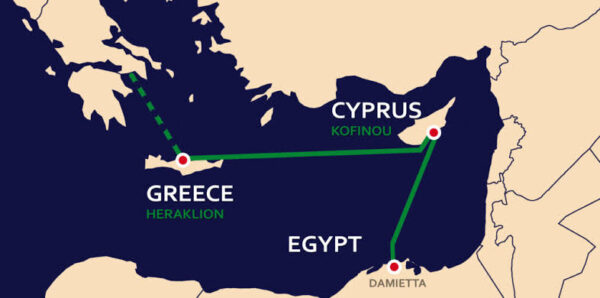
The EuroAfrica (Egypt-Greece) Interconnector, which is also known as the Egypt-Greece Interconnector is a 1,396-kilometre high-voltage direct current (HVDC) subsea power cable that is being developed to link Egypt with Cypriot and Greek power grids through the island of Crete.
Also Read: El Dabaa nuclear power plant (NPP) project timeline and all you need to know
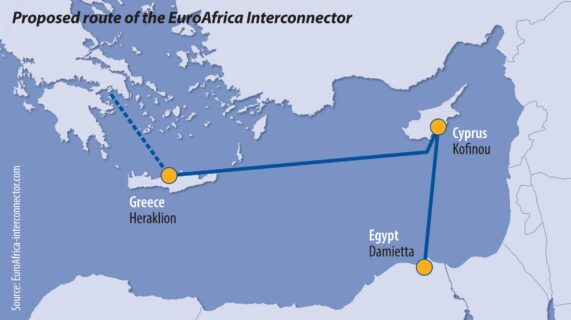
The project is being implemented in two phases. In the first phase, the cable will start from Kafresh-Sheikh in Egypt, and run for approximately 498 kilometers across the sea to Kofinou in Cyprus while in the second phase, it will run westwards from Kofinou, and take a subsea route to Korakia in Crete, the largest of the Greek islands. The distance from Kofinou to Korakia is approximately 898 kilometers or its thereabouts.

The lowest laying point for the subsea cable will be 3,000m below sea level in the Mediterranean Sea, making it the world’s deepest undersea cable.
It (the cable) will be connected to three HVDC onshore converter stations with multi-terminal operations, which will be constructed as part of the project at Kafresh-Sheikh, Kofinou, and Korakia. Incorporating voltage source converters (VSC) technology, the converter stations are mainly meant to convert electricity from direct current (DC) to alternating current (AC) and vice versa.
Noteworthy, the converter stations are bipolar and could run bi-directionally, this means electricity can be imported or exported depending on demand in the beneficiary countries.
When fully operational expectedly by 2024, the EuroAfrica Interconnector will have the capacity to transmit (in either direction) 2,000 megawatts of electricity, which is enough to power up to two million households. Upon the completion of its first phase (in 2023), it will transmit 1,000 megawatts of electricity.
EuroAfrica Interconnector Project Timeline
2017
In February, EuroAfrica Interconnector and the Egypt Electricity Company signed a Memorandum of Understanding (MoU) for the execution of the project studies.
2018
In February, the landing points, the exact route of the EuroAfrica interconnector cable, and the sites of the HVDC converter stations were approved.
In March, a strategic alliance agreement was signed between Elia Grid International (EGI), a subsidiary of Belgium’s Elia Group, and EuroAfrica Interconnector for the development and implementation of the project.
2019
In May, a framework agreement to implement the cable system’s construction was signed.
In June, a 33-year land lease agreement for the HVDC converter station in Cyprus was signed.
2020
In April, engineering, procurement, construction, and installation (EPCI) contractor for the HVDC converter station in Egypt was selected.
2021
At the end of July, the Council of the European Union approved a grant of close to US$ 117M for the project as part of the Recovery and Resilience Plan (RES), to lift the energy isolation of Cyprus, the last non-interconnected EU member state and to help the development of a sustainable and green economy.
On 7 September, the European Commission announced a tender that will allow companies to get funding from the Connecting Europe Facility (CEF). Reportedly, following this development, the project implementer will be able to apply and receive part of the required amount for the construction costs of the project.
The application for funding will concern, at this stage, the part of the project that connects Cyprus with Crete. The total amount of funding can be up to 50 percent of the total cost.
Egypt, Copelouzos meet over EuroAfrica (Egypt-Greece) Interconnector
The Copelouzos Group, which is in charge of the EuroAfrica (Egypt-Greece) Interconnector project, met with the Egyptian government’s top officials last week to expedite the project.
The EU’s main supplier of oil and gas, Russia, has recently seen its electricity prices rise throughout the continent. As a result of sanctions imposed in reaction to its invasion of Ukraine. As winter approaches, nations are looking for alternate energy sources.
Ioannis Karydas, CEO of Renewables, Copelouzos Group, said, “We are assisting Europe in weaning itself off of Russia’s fossil fuels and natural gas. We will be bringing 3,000 MW of clean energy, enough to power 45,000 households, to Europe via Greece. Additionally, compared to current energy pricing, the green energy we will convey will be substantially cheaper. You are aware that this will benefit consumers in both Greece and Europe.”
The European Union has designated the €3.5 billion GREGY interconnection project as a Project of Common Interest (PCI). The undersea power cable will transport clean electricity generated in Egypt or other African nations through solar or wind farms.
Ioannis Karydas added, “Greek industries will utilize one-third of the power that will be imported from Egypt. Another third will be exported to nearby European nations, and one-third will be used in Greece to create green hydrogen. However, the majority of this hydrogen will be exported to nearby European nations.”
Egypt has finished connecting to Libya, Sudan, and Saudi Arabia, and it hopes to develop into a significant energy hub for Southeast Europe. The GREGY interconnection is anticipated to be operational in seven to eight years.
Project fact sheet
Name: EuroAfrica Interconnector
Type: High-voltage direct current (HVDC) subsea electricity interconnector
Estimated investment: Approximately €3.5 billion (about US$4 billion)
Route: Egypt – Cyprus – Crete (Greece)
Total cable length: Approximately 1,396 km
Transmission capacity: 2,000 MW
Technology: Bipolar HVDC submarine cable
Converter stations: Egypt, Cyprus and Crete
Main objective: Connect African and European electricity grids
Electricity source: Conventional and renewable generation, including solar and wind
Current status (2026): Planning and project development continue; financing, technical studies and stakeholder engagement remain ongoing before full construction.
Project team
Developer: EuroAfrica Interconnector Ltd.
Host governments:
- Government of Egypt
- Government of Cyprus
- Government of Greece
Egyptian transmission partner: Egyptian Electricity Transmission Company (EETC)
Egyptian utility: Egyptian Electricity Holding Company (EEHC)
Greek transmission stakeholders: Independent Power Transmission Operator (IPTO/ADMIE)
European funding stakeholder: European Commission
Funding program: Connecting Europe Facility (CEF)
Regulatory stakeholders: National energy regulators of Egypt, Cyprus and Greece
Technical stakeholders: Transmission system operators across the three participating countries
Strategic objective: Strengthen Africa-Europe electricity integration and support renewable energy exports.
Leave a Reply