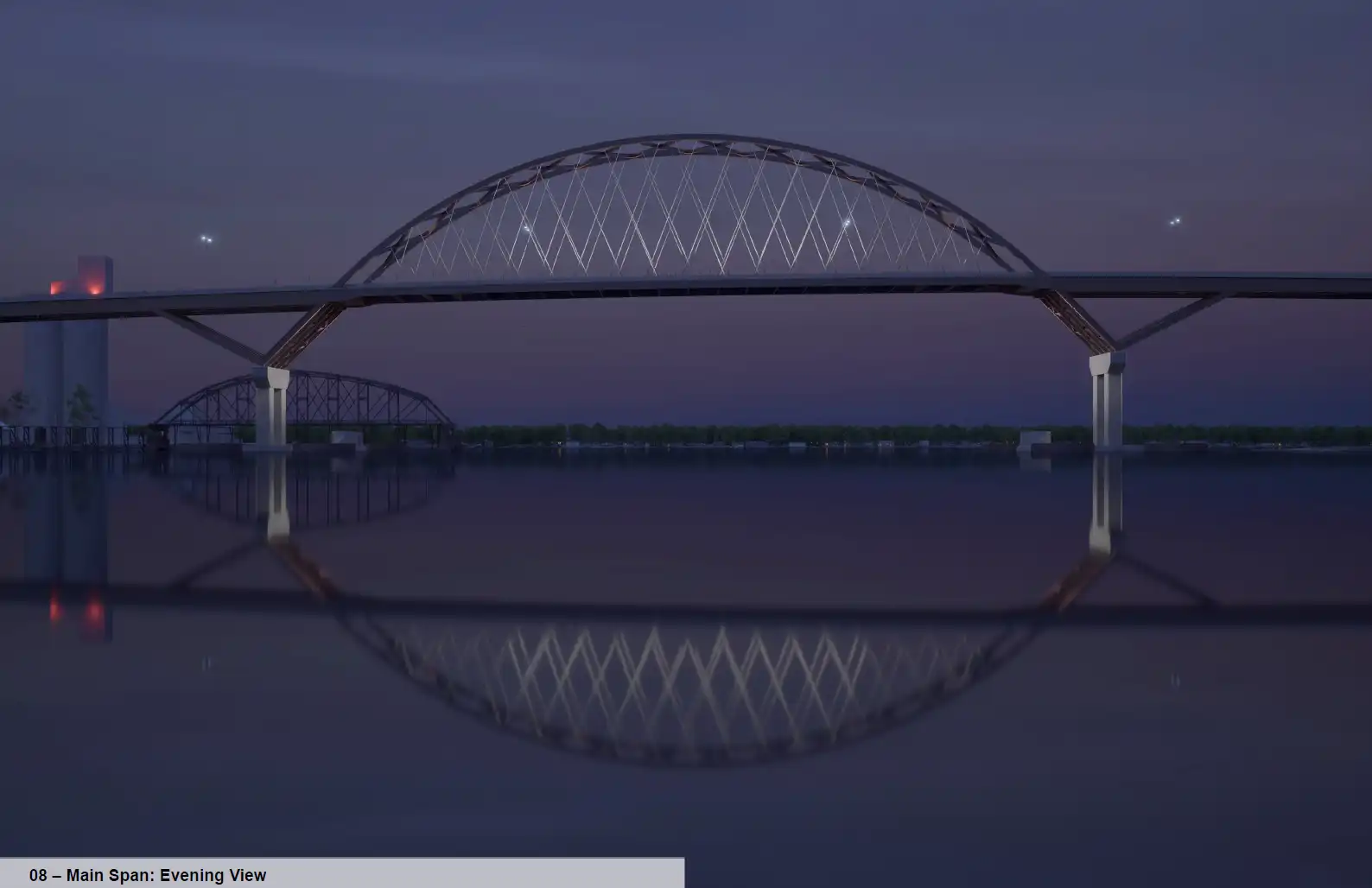
The Blatnik Bridge replacement project has officially broken ground, launching construction on a new $1.8 billion I-535 crossing between Duluth, Minnesota, and Superior, Wisconsin, over St. Louis Bay.
U.S. Transportation Secretary Sean P. Duffy joined federal and local officials on August 31 to mark the start of the long-awaited replacement of the existing 65-year-old bridge. The U.S. Department of Transportation committed $1.058 billion to the project in March 2026, providing the largest share of funding for the replacement.
The project will replace the approximately 1.5-mile-long bridge, which carries about 33,000 vehicles each day between the Twin Ports. The new crossing will improve safety, strengthen the regional transportation network and maintain an important route for freight moving through the Upper Midwest.

New bridge will feature tied-arch design
The replacement bridge will use a tied-arch design supported by raised piers, with the roadway positioned about 120 feet above the St. Louis River.
The structure will provide four lanes for vehicle traffic and add a 12-foot pedestrian and bicycle path along one side. The path will also include alcoves that provide viewpoints over the surrounding waterway.
Project officials designed the new structure to provide a longer service life and stronger safety features than the existing bridge. The design also accounts for the commercial shipping traffic that passes beneath the crossing, including vessels carrying iron ore pellets, grain and other commodities through the Great Lakes.
The new bridge will follow the existing alignment. Officials previously determined that this approach would accelerate construction by about one year, reduce project costs by as much as $100 million and avoid the risks associated with building a major new structure immediately beside live traffic.
Project partners
The Ames-Kraemer Joint Venture II, a partnership between Ames Construction and Kraemer North America, serves as the primary design-build contractor for the Blatnik Bridge replacement, bringing massive heavy-civil infrastructure expertise to the $1.8 billion project. Collaborating closely with them is HNTB Corporation, a premier engineering firm acting as the lead designer responsible for the bridge’s signature tied-arch “delta frame” aesthetic. Supporting the state transportation departments, Parsons Corporation provides critical owner’s representative services, delivering rigorous design and construction oversight to ensure the massive multi-year project meets all safety, budget, and engineering standards. Together, this powerful consortium of contractors and engineers is transforming a vital Midwestern transit corridor with modern, resilient infrastructure.
$1.05 billion federal commitment
The federal government committed $1,058,398,200 to the bridge replacement in March 2026 after completing the work required to obligate the funding.
The overall project carries an estimated cost of about $1.8 billion, with Minnesota and Wisconsin also contributing substantial funding toward the replacement.
Congressman Pete Stauber has pushed for federal support for the project and helped secure Project Labor Agreements for the construction work. Those agreements establish the use of union labor on the project.
The federal funding follows years of planning and advocacy for replacing the aging bridge. Federal officials had previously set aside funding for the project in January 2024, but the Transportation Department said it had not completed the work necessary to release the funds at that time.
Construction will continue through 2032
The project will take several years to complete. Construction and preliminary work have already progressed through the planning phase, while major work will now advance following the groundbreaking.
Crews are scheduled to begin demolishing the existing Blatnik Bridge in March 2027. The main span will come down during 2027 and 2028, followed by installation of the new bridge.
The replacement is scheduled to open to traffic no later than October 31, 2031. Additional landscaping, cleanup and other work will continue after the bridge opens, with final project activities expected to extend through June 2032.
During the bridge closure and demolition period, traffic will use the Bong Bridge, located roughly five miles southwest of the Blatnik Bridge, as the primary detour between Duluth and Superior.
Bridge replacement targets long-term reliability
The existing bridge opened in 1961 and has reached an age where corrosion, structural concerns and increasing transportation demands have driven the need for replacement.
The new structure will incorporate wider and more robust elements, updated safety features and a design intended to provide at least a century of service.
Beyond serving local commuters, the bridge plays an important role in the Twin Ports’ freight network. Commercial vessels pass beneath the crossing to reach Duluth-Superior-area terminals, while trucks use I-535 to move goods between Minnesota, Wisconsin and the wider Upper Midwest.
The groundbreaking therefore marks more than the replacement of an aging bridge. It starts a multiyear infrastructure project intended to maintain a critical connection between the two states and support freight and passenger movement across the region for decades.
The Blatnik Bridge is among several aging interstate bridges undergoing major replacement across the U.S. In Kentucky and Ohio, the Brent Spence Bridge Corridor project is also advancing, with the new Companion Bridge designed to expand capacity and improve the critical connection between Cincinnati and Northern Kentucky.

Blatnik Bridge Replacement Project — Factsheet
- Project: Blatnik Bridge Replacement
- Location: Duluth, Minnesota, and Superior, Wisconsin
- Route: I-535
- Project cost: Approximately $1.8 billion
- Federal funding: $1,058,398,200
- Existing bridge: Opened in 1961
- Bridge length: Approximately 1.5 miles
- Daily traffic: Approximately 33,000 vehicles
- New bridge design: Tied arch
- Vehicle lanes: Four
- Pedestrian/bicycle facility: 12-foot shared path
- Demolition of existing bridge: Scheduled for March 2027
- Main span demolition: 2027–2028
- New bridge opening: No later than October 31, 2031
- Final project work: Expected through June 2032
- Primary federal agency: U.S. Department of Transportation
- States involved: Minnesota and Wisconsin
- Labor agreement: Project Labor Agreement

Leave a Reply