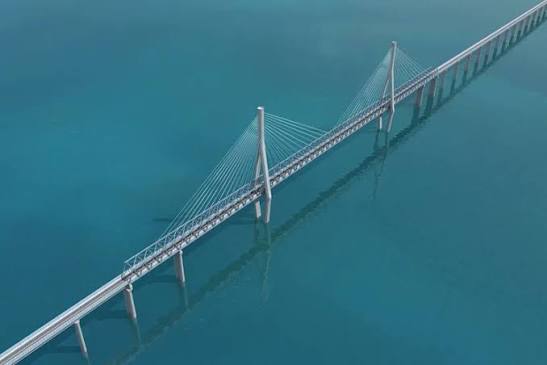
Crews in China’s Zhejiang Province capped the final three main towers of the Hangzhou Bay Cross-Sea Railway Bridge on September 2, 2026, completing all seven towers on what will become the world’s longest sea-crossing high-speed railway bridge. The 29.2-kilometer, double-track structure is the control project of the Tongsujiayong high-speed railway and now moves into superstructure work, installing steel girders and stay cables ahead of a targeted 2027 opening.
From Towers to Superstructure
The tower-capping milestone, reported by CCTV Plus, marks the end of substructure work on a bridge designed for trains running at 350 kilometers per hour on a double-track ballastless system. Construction began in November 2022, when crews first tackled the geological and tidal challenges of Hangzhou Bay, one of the world’s three most powerful tidal bays. With all seven towers now standing, the project shifts to erecting steel girders and stringing stay cables across the bay’s three navigation channels, the phase most visible to onlookers on the shore.
Engineering for a Bay That Doesn’t Sit Still
The bridge is built in three navigation channel bridges connected by long approach spans across embankment, open sea, and tidal shoal. The North Channel Bridge carries a 450-meter main span that project engineers describe as the world’s largest for a ballastless-track cable-stayed bridge, while the Middle Channel Bridge uses twin 448-meter spans across three towers, described as the largest ballastless-track, three-tower cable-stayed span arrangement anywhere. Ballastless track, which anchors rails directly to a concrete slab rather than crushed stone, demands far tighter alignment tolerances than conventional track, a requirement made harder by a bridge this long crossing open water. China Railway Major Bridge Engineering Group is building the structure to a 100-year design life, with CREC Bridge Institute serving as lead designer.
The Line It’s Built to Serve
The bridge is the signature crossing of the Tongsujiayong high-speed railway, a roughly 330-kilometer line connecting Nantong, Suzhou, Jiaxing, and Ningbo. Once open, the line is expected to connect with the Yancheng-Nantong, Beijing-Shanghai, Shanghai-Kunming, Nanjingnan-Taicang, and Ningbo-Taizhou-Wenzhou high-speed lines, cutting travel time between Ningbo and Shanghai to roughly an hour and reshaping the rail network across the Yangtze River Delta. The full line, including this bridge, is targeted to open by the end of 2027.
Not to Be Confused With Its Older Neighbor
The new railway bridge crosses Hangzhou Bay a short distance from the original Hangzhou Bay Bridge, a six-lane highway crossing that opened in 2008 after roughly $1.5 billion in construction costs and was, at the time, the world’s longest sea-crossing bridge. That 35.7-kilometer structure carries cars and trucks; the new bridge is purpose-built for high-speed rail and roughly six kilometers shorter, reflecting a more direct alignment. The pairing illustrates how quickly Hangzhou Bay has gone from a single crossing to a growing network of sea-spanning infrastructure in under two decades.
Part of a Broader Run of Chinese Bridge Superlatives
The Hangzhou Bay bridge joins a string of recent Chinese projects claiming world records in bridge engineering. We tracked the Shituo Yangtze River Bridge in Chongqing, billed as the world’s largest rail cable-stayed bridge, and the Huajiang Grand Canyon Bridge in Guizhou Province, which opened in September 2025 as the world’s tallest bridge. Those projects sit alongside China’s other high-speed rail ambitions, including the 1,000 km/h maglev research program in Hubei, which aims to push intercity rail speeds well beyond what even the Hangzhou Bay bridge’s 350 km/h design supports. Taken together, the projects show a national rail construction program pursuing records in span length, height, and speed simultaneously rather than one at a time. Our own roundup of China’s longest bridges offers a wider view of how the Hangzhou Bay crossings fit into that broader list.
What’s Left Before Trains Run
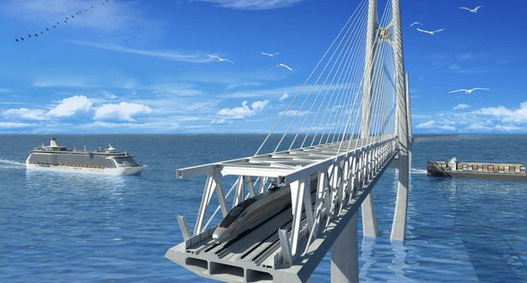
Superstructure work, girder erection and cable stringing across three navigation channels, remains the most demanding phase ahead. No updated cost figure for the bridge or the broader Tongsujiayong line has been published alongside the tower-capping milestone, and neither Chinese state media nor the railway’s operator has detailed a month-by-month schedule for completing the superstructure before the line’s targeted 2027 opening. Given the bay’s tidal conditions, the pace of that work will likely shape whether the full Tongsujiayong line opens on schedule.
Project Fact Sheet
- Project Name: Hangzhou Bay Cross-Sea Railway Bridge (control project of the Tongsujiayong high-speed railway)
- Location: Crossing Hangzhou Bay between Haiyan County (Jiaxing) and Cixi (Ningbo), Zhejiang Province, China
- Project Value: Not publicly disclosed for the bridge alone
- Owner/Project Management: Tongsujiayong Railway Co., under China Railway Shanghai Group
- Design Institute: CREC Bridge Institute
- Main Contractor: China Railway Major Bridge Engineering Group
- Key Components: 29.2 km double-track, ballastless-track railway bridge with three navigation channel bridges and long approach viaducts; North Channel Bridge main span of 450 meters; Middle Channel Bridge with twin 448-meter spans across three towers
- Design Speed: 350 kilometers per hour
- Design Life: 100 years
- Construction Start: November 2022
- Recent Milestone: All seven main towers capped, September 2, 2026, shifting work to superstructure erection
- Expected Completion: End of 2027, alongside the full Tongsujiayong line
Project Team
- Owner/Project Management: Tongsujiayong Railway Co. / China Railway Shanghai Group
- Design Institute: CREC Bridge Institute
- Main Contractor: China Railway Major Bridge Engineering Group
- Additional Construction Management: CCCC (reported)


Leave a Reply