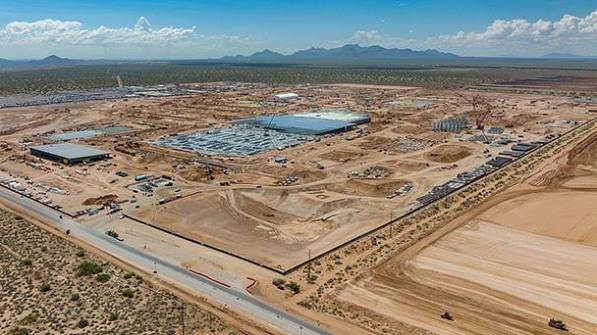
Oracle’s massive AI data center campus in Doña Ana County, New Mexico — known as Project Jupiter — is now 26% complete, up from 17% in July, according to Mahesh Thiagarajan, Oracle’s executive vice president of cloud infrastructure.
Construction began at the roughly 1,400-acre Santa Teresa site in September 2025, following Doña Ana County’s approval of an industrial revenue bond structure supporting up to $165 billion in investment.
The latest construction update comes as the project moves through a series of regulatory and infrastructure challenges. The New Mexico Supreme Court has also cleared the way for key permitting processes to resume after rejecting environmental groups’ legal challenges in mid-September.
Why is 26% completion significant?
The increase from 17% to 26% in roughly two months indicates that construction is advancing despite months of controversy over water use, air quality and the project’s reliance on natural gas.
However, Thiagarajan also said the fuel-cell microgrid intended to power the campus is only about 10% complete. That gap underscores how the project’s energy infrastructure remains a critical part of the construction schedule.
Oracle shifted its power strategy toward Bloom Energy fuel cells during 2026. The system is expected to provide the campus with large amounts of electricity while relying on natural gas as its fuel source.
That change made the project’s gas supply infrastructure another important milestone for the development.
What about the gas pipeline that Project Jupiter depends on?
The dedicated Green Chile Natural Gas Pipeline, a roughly 17- to 18-mile line designed to deliver up to 400 million cubic feet per day to the campus, has been delayed to Feb. 1, 2027.
New Mexico rejected proposed routes across state trust lands twice during 2026. The first rejection came in March, followed by another in July that forced the project to pursue a reroute.
The federal Bureau of Land Management approved the pipeline’s crossing of federal land in May 2026 under an accelerated 14-day emergency review. However, the state-level route disputes pushed the planned in-service date from Aug. 15, 2026, to Feb. 1, 2027.
The delay does not necessarily stop construction at Project Jupiter, but it adds another major infrastructure dependency as Oracle works toward its planned computing capacity.
What did the state Supreme Court decide, and why does it matter?
The pipeline dispute is not the only regulatory challenge surrounding Project Jupiter.
In orders issued around Sept. 17, 2026, the New Mexico Supreme Court unanimously rejected emergency petitions from New Energy Economy and the Center for Biological Diversity that had frozen the project’s air-quality permit hearing and emergency water withdrawal permit.
The court had imposed the stays in August, temporarily preventing the related state proceedings from moving forward.
With those stays lifted, the state Environment Department can resume the air-quality permit hearing process, while Oracle can resume drawing water from the Santa Teresa well after a more-than-three-week pause.
The ruling does not eliminate the underlying permitting requirements, but it removes a significant legal obstacle to the project’s next stages.
The challenges facing Project Jupiter are not unique to New Mexico. Texas, another major hub for data center development, is also confronting growing concerns over the power, water and permitting demands of large AI facilities. The developments there show how rapidly expanding data center construction is forcing states to reassess the infrastructure and regulatory pressures that come with the AI boom.
If construction is moving forward, why are investors nervous?
Despite the physical progress, financial markets are signaling concerns about the project.
As of mid-September 2026, roughly $18 billion in loans tied to the Oracle-leased data center were trading at 89–91 cents on the dollar, according to reports citing syndicate banks including Santander and Jefferies.
The discounted debt reflects concerns surrounding permitting delays, local opposition and the scale of Oracle’s broader AI infrastructure buildout.
The financing situation adds another layer of scrutiny as Oracle continues to commit substantial capital to AI data center infrastructure.
Additionally, on September 24, 2026, Oracle Corporation issued a force majeure notice to developer Blue Owl Capital. The legal filing was triggered by power delivery setbacks, including a six-month slip in a key natural gas pipeline and pending state air-quality permits for back-up fuel cells. While the notice allows Oracle to extend lower construction-stage rent and mitigate contractual liabilities, the news rattled markets—causing project-backed financing debt to trade below par and putting downward pressure on Oracle’s stock amid investor anxiety over AI infrastructure bottlenecks. Despite invoking the clause, Oracle maintains that Project Jupiter remains on its planned schedule and that it remains committed to the campus.
What is Doña Ana County doing to oversee the project?
On Sept. 22, 2026, county commissioners were expected to decide whether to appoint community members to a newly formed Project Jupiter oversight committee.
The body is intended to monitor construction, water use and air-quality impacts as the development advances.
The committee gives local residents a formal channel to follow the project’s progress as construction expands and the campus moves closer to operation.
Project Jupiter is not the only major AI data-center development raising questions about the balance between investment and community benefits. In Alabama, Applied Digital’s Delta Forge 2 has brought similar scrutiny over public incentives, permanent jobs, infrastructure demands and the long-term tax value of the project.
How is Oracle responding to criticism about power and emissions?
Oracle says it is “meeting applicable permitting requirements” and “standing ready to proceed with the department’s public hearing process” now that the court stays have been lifted.
The company has also highlighted its shift to Bloom Energy fuel cells, its plan to procure 2 GW of renewables to match Project Jupiter’s emissions, and a $1 million research effort focused on carbon capture and storage in New Mexico.
These measures form part of Oracle’s response to concerns over the project’s energy use and emissions as it moves toward operation.
What’s next for Project Jupiter?
Several milestones will determine how the project progresses from here.
The first is the scheduling and completion of the air-quality permit hearing for the proposed fuel-cell system. The Green Chile pipeline must also advance toward its revised February 2027 in-service target.
Oracle will also need to continue building the microgrid, which remains substantially less advanced than the overall campus.
At the same time, the project’s debt market performance will remain an important indicator of how lenders view the risks surrounding the development.
Oracle has stated that it expects Project Jupiter to begin delivering computing capacity in the first half of 2027. Whether the project can maintain that target will depend on the progress of its construction, power infrastructure, pipeline and remaining permits.
What Oracle’s $165 Billion Project Means for Doña Ana County
Project Jupiter is set to become a major piece of the infrastructure landscape around Santa Teresa.
Its scale places significant demands on the region’s power, natural gas and water systems, while its construction brings a large industrial development into a community that has become increasingly important to the Southwest’s logistics and technology infrastructure.
The project also illustrates the challenges that can emerge when large AI data centers require power and water infrastructure to be developed alongside the computing facilities themselves.
For Doña Ana County, the next stage will therefore extend beyond construction progress. Local officials will be watching how the project’s infrastructure develops, how its environmental requirements are addressed and how the newly established oversight process functions as Project Jupiter moves toward operation.

Fact sheet: Oracle’s $165B Project Jupiter
- Project name: Project Jupiter
- Location: Santa Teresa, Doña Ana County, New Mexico
- Developers: Oracle, OpenAI; part of Stargate initiative
- Total investment: ~$165 billion
- Site size: ~1,400 acres
- Primary power: Bloom Energy fuel cells (natural gas)
- Fuel supply: Green Chile Natural Gas Pipeline
- Pipeline capacity: Up to 400 million cubic feet per day
- Pipeline length: ~17–18 miles
- Renewables pledge: Up to 2 GW to match emissions
- Construction status (Sept. 22, 2026): 26% complete (site); 10% (microgrid)
- Target compute delivery: First half of 2027
- Pipeline in-service date: Feb. 1, 2027 (delayed from Aug. 15, 2026)
- Key permits: Air-quality permit; emergency water withdrawal permit
- Financing: ~$18 billion in syndicated loans (trading at 89–91 cents)
- Local oversight: Project Jupiter oversight committee (Doña Ana County)
- Key opponents: New Energy Economy; Center for Biological Diversity

Leave a Reply