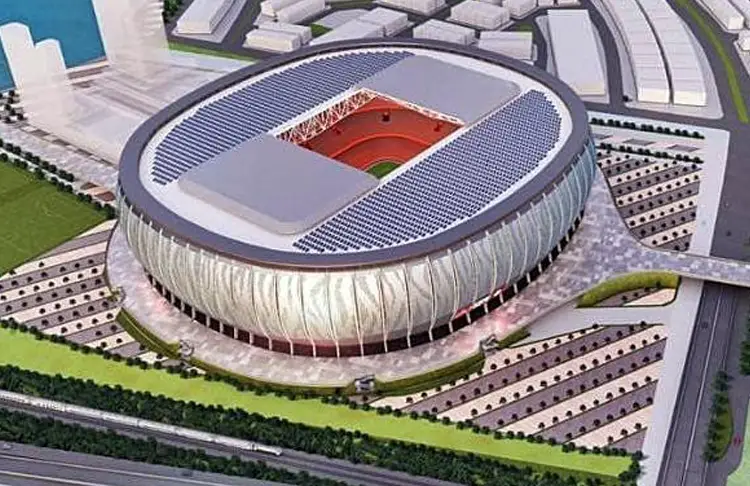
Jakarta International Stadium project has entered a new phase focused on sports tourism, venue management and improved urban connectivity. The 82,000-seat stadium in North Jakarta completed construction in 2022.
However, authorities continue developing infrastructure and partnerships around the major sports venue. The latest initiatives position the stadium as more than a football facility. They also support Jakarta’s broader strategy to strengthen sports tourism and event infrastructure.
Jakarta International Stadium project strengthens sports infrastructure
The Jakarta International Stadium project began construction in September 2019 after years of planning and land-related delays. The completed stadium opened in 2022 following the construction phase.
The venue occupies about 22 hectares and accommodates up to 82,000 spectators. Its retractable roof allows the facility to host football matches, concerts and other major events.
The stadium also features a hybrid playing surface and three seating tiers. Its roof uses an ETFE membrane and provides protection during events.
PT Jakarta Propertindo operates the facility for the Jakarta provincial government. Persija Jakarta uses the stadium as its home venue, while Indonesia’s national team has also staged selected matches there.
The construction consortium included PT WIKA Gedung, PT PP and PT Jaya Konstruksi. The reported construction cost reached about $312 million.
The project therefore established one of Indonesia’s largest football-specific stadiums. Its 82,000-seat capacity also makes it one of Asia’s major stadium facilities.
Jakarta International Stadium project targets sports tourism growth
Jakarta has now shifted attention from construction toward long-term venue utilization and sports tourism.
In May 2026, Jakarta launched a collaboration initiative involving JIS and Milan’s San Siro. The initiative examines international stadium management, sports tourism and event development.
The collaboration seeks to strengthen Jakarta’s ability to attract international sporting and entertainment events. It also provides opportunities to exchange knowledge on venue operations and visitor experiences.
The initiative reflects a wider trend among major stadium projects. Modern venues increasingly combine sporting functions with tourism, entertainment and commercial activities.
Bahrain is pursuing a similar approach through its planned Bahrain International Sports City development. The proposed facility will combine stadium and arena configurations within one venue.
The comparison demonstrates how stadium developments increasingly prioritize flexible event infrastructure. Bahrain’s project has now reached contractor prequalification, with 20 firms qualifying for Phase 1A construction.
The Bahrain development also includes a lifting pitch that can support different venue configurations. This approach aims to accommodate football, concerts and other major events.
The Bahrain International Sports City project therefore provides a useful comparison with Jakarta’s completed venue and its continuing sports-tourism strategy.
Jakarta International Stadium project improves connectivity
Jakarta has also continued investing in infrastructure around the stadium.
The city has developed transport links designed to improve access to JIS and surrounding destinations. These improvements support the stadium’s role within Jakarta’s wider urban infrastructure network.
The facility already connects with TransJakarta services through the Jakarta International Stadium bus rapid transit station. The station forms part of the city’s public transport system serving the stadium area.
The focus on connectivity remains important because large venues generate significant visitor movements during major events.
Improved public transport can help reduce pressure on surrounding roads while supporting easier access for spectators.
Meanwhile, the stadium’s design continues to provide flexibility for large-scale events. Its retractable roof allows operators to host events under varying weather conditions.
The venue’s scale also gives Jakarta a major platform for international football and entertainment events.
As a result, the Jakarta International Stadium project has moved beyond its original construction objective. The focus now centers on utilization, connectivity and international sports-tourism partnerships.
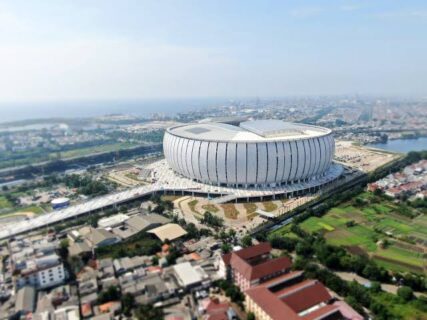
An overview of the Jakarta International Stadium
The stadium, whose shape is inspired by traditional Betawi clothing, has a three-tiered stand design and it is 73 meters tall, making it one of the tallest stadiums in the world. It will also have a tiger striped-style facade and seating mosaic themed after the aforementioned team’s color and mascot.

Its playing field is of FIFA regulation size i.e. (105 x 68 meters), featuring a hybrid grass surface (a combination of zoysia matrella grass and LIMONTA MIXTO artificial turf imported from Italy). The retractable roof of the stadium is made of an ETFE membrane and is 100 meters long.
Jakarta International Stadium will be the first football stadium to have a retractable roof in Indonesia, the second football stadium in Southeast Asia to feature a retractable roof after Singapore National Stadium, and more importantly the largest capacity retractable roof stadium in Asia and the second-largest retractable-roof stadium by capacity in the world, after AT&T Stadium in Arlington, Texas.
In addition to the pitch and stand/seats that include 200 units for people with disabilities, the project also includes the construction of VIP special rooms, modern and luxurious changing room’s, outdoor training fields fitted with LIMONTA MIXTO artificial turf, and parking lots spacious enough to accommodate a total of 900 vehicles (800 cars and 100 buses).
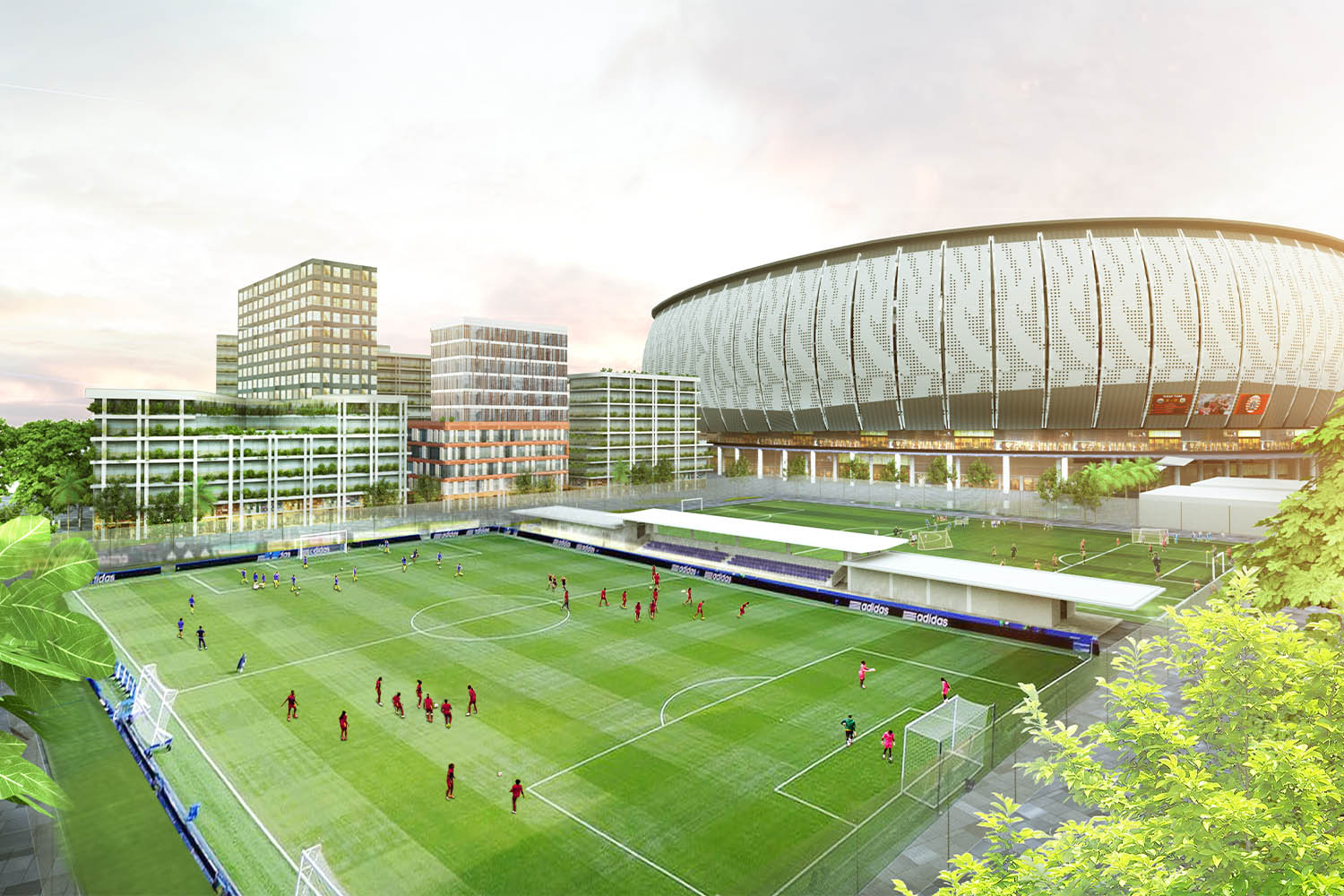
The Jakarta International Stadium will be integrated with public transportation modes such as MRT, LRT, KRL Commuter Line, and toll access.
Project timeline
Plans emerged between the late 2000s and early 2010s that a new home stadium for Persija Jakarta would be built near the BMW Park. The stadium, dubbed BMW Stadium after the aforementioned neighboring park, was scheduled to be constructed between 2013 and 2015. It had a planned capacity of 50, 000 seats and it would feature a running track.
2014
A year to the scheduled completion date, the construction of the BMW Stadium had not commenced because “the owner of the land was still disputed by the former squatters and the city government”.
New plans had been discussed to build the stadium with a new design which would help increase the capacity of the stadium by 30 000 seats, for the 2018 Asian Games. However, these plans were canceled and the government opted to renovate the Gelora Bung Karno Stadium later in 2016.
2017
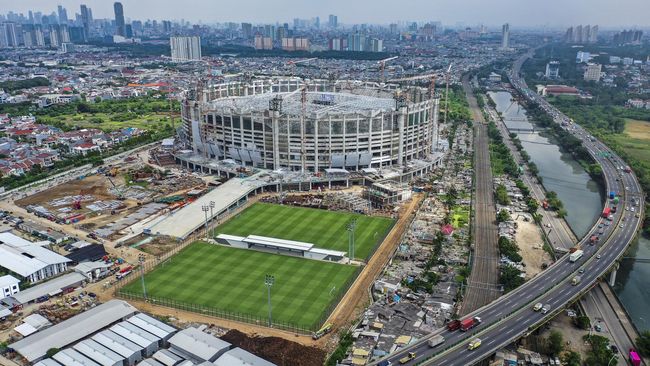
After numerous series of failed planning and construction, the land dispute was over and the land was ready to be cleared for construction.
2019
Two years after the land was cleared, an official tender was released for a stadium of 82,000 capacity with a retractable roof and without a running track, contrary to the previous project. The newly designed stadium was named Jakarta International Stadium.
In March 2019, the project was launched in a ceremony graced by Governor Anies Baswedan, however, the actual construction works begun 6 months later in September 2019.
2021
As of 15 March 2021, in the 80th week of construction, the project was reportedly 50.5% complete, which conflicts with the projected 52% according to the plan.
In October, in its 112th week of construction, the stadium reportedly reached 78.12 percent completion. In the same month, JIS and Ancol signed a memorandum of understanding (MoU) to connect the stadium to Ancol Carnival Beach in North Jakarta.
Project Fact Sheet
Project: Jakarta International Stadium
Location: Tanjung Priok, North Jakarta, Indonesia
Development area: Approximately 22 hectares
Construction period: 2019–2022
Opening: 2022
Capacity: 82,000 spectators
Construction cost: Approximately $312 million
Roof: Retractable ETFE-clad roof
Playing surface: Hybrid grass system
Primary use: Football and major sporting events
Additional uses: Concerts, entertainment and other large-scale events
Current focus: Sports tourism, venue utilisation and urban connectivity
Main tenant: Persija Jakarta
Public-sector owner: Jakarta provincial government
Operator: PT Jakarta Propertindo
Latest development: Sports-tourism collaboration involving JIS and San Siro
Transport integration: TransJakarta public transport connection
Project status: Operational
Project Team
Owner: Government of Jakarta
Developer and operator: PT Jakarta Propertindo (Perseroda)
Architect: Pandega Desain Weharima (PDW)
Construction contractor: PT WIKA Gedung
Joint contractor: PT PP (Pembangunan Perumahan)
Construction partner: PT Jaya Konstruksi
Engineering consultant: Buro Happold
Stadium tenant: Persija Jakarta
Transport authority: TransJakarta
Sports-tourism partner: San Siro/Milan sports stakeholders

Leave a Reply