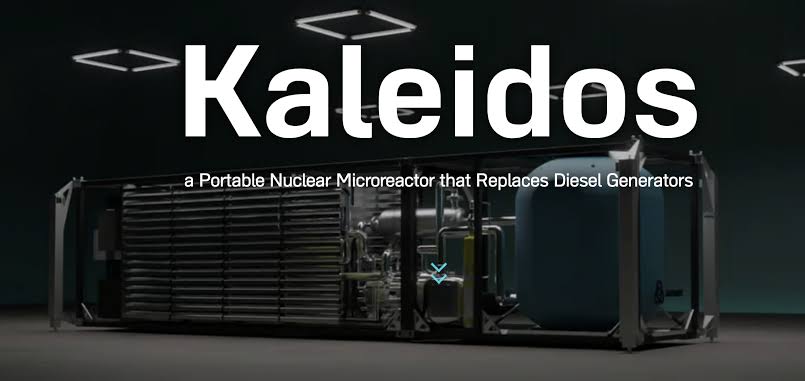
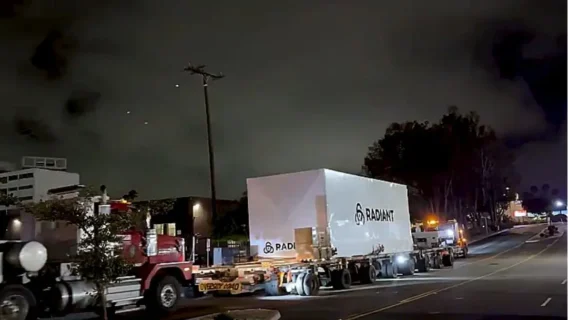
The Kaleidos portable nuclear reactor project has entered a major construction and deployment phase in the United States. The project involves transporting Radiant’s portable nuclear reactor over 1,000 miles to Idaho. The journey will demonstrate whether the factory-built reactor can withstand transportation before nuclear testing begins.
Radiant developed the Kaleidos reactor as a transportable high-temperature gas-cooled microreactor. The company aims to deliver reliable power to remote and critical infrastructure sites. Therefore, the transportation milestone tests an important part of the reactor’s deployment strategy.
The reactor will travel to Idaho National Laboratory, where it will undergo testing at the DOME facility. The demonstration will provide operational data before Radiant advances toward commercial deployment.
Kaleidos Portable Nuclear Reactor Project Advances Construction
The project began its latest milestone after Radiant completed construction of its Development Unit. The company built the reactor to support testing and validate its commercial design.
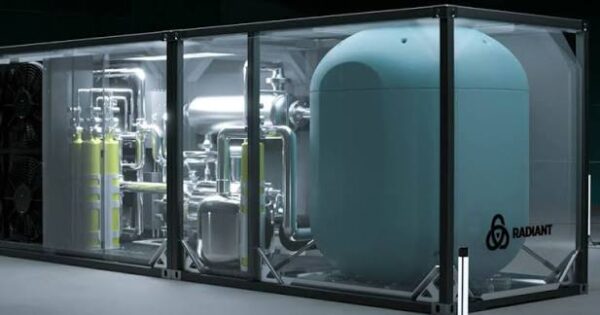
According to Radiant, the Development Unit represents a full-scale version of the planned Kaleidos system. The reactor incorporates high-temperature gas-cooled technology and TRISO fuel.
Furthermore, the design uses helium coolant to transfer heat from the reactor core. The system also incorporates passive safety features designed to manage heat without external electrical power.
The reactor produces approximately 1 MW of electrical power. It can also provide roughly 3 MW of thermal energy for industrial applications.
Radiant designed the system around a compact transportable package. The reactor measures approximately 35 feet long and weighs about 70 tons.
Consequently, the 1,000-mile road journey represents more than conventional equipment transportation. It provides a practical test of the project’s modular construction philosophy.
The company wants future units to leave manufacturing facilities and travel directly toward deployment locations. That approach could reduce extensive site construction and shorten installation timelines.
Meanwhile, the EAGL-1 nuclear reactor project is on a different route toward advanced nuclear construction in the United States. The $4 billion Indiana development combines 240-MW reactors with manufacturing and integrated fuel facilities. Unlike Kaleidos, EAGL-1 is progressing through NRC pre-application engagement before construction. The contrasting approaches highlight how developers are testing different models for deploying next-generation nuclear infrastructure.
Kaleidos Portable Nuclear Reactor Project Heads to Idaho
The reactor’s destination, Idaho National Laboratory, hosts the DOME test facility. DOME provides infrastructure for demonstrating advanced microreactor technologies under controlled conditions.
Radiant plans to use the facility for a full-power demonstration of the Kaleidos reactor. The testing will examine reactor performance, safety systems and operational characteristics.
Meanwhile, the U.S. Department of Energy supports the DOME demonstration programme. The National Reactor Innovation Center manages access to the facility.
Radiant has also progressed through several regulatory and engineering milestones. The company completed its Conceptual Design Review for Kaleidos in 2024.
Additionally, the DOE approved Radiant’s Preliminary Documented Safety Analysis for the DOME experiment. That milestone supports preparations for the planned reactor demonstration.
The Nuclear Regulatory Commission continues pre-application engagement for the commercial Kaleidos design. The NRC identifies Kaleidos as a transportable high-temperature gas-cooled reactor.
Radiant’s commercial strategy extends beyond the Idaho demonstration. The company targets commercial deployments beginning in 2028.
The company also plans to establish its R-50 manufacturing facility in Oak Ridge, Tennessee. The proposed facility could eventually produce up to 50 reactors annually.
Radiant expects the manufacturing plant to support wider deployment of portable nuclear generation. The company targets applications including defence facilities, data centers and remote industrial operations.
The project’s latest financing also strengthens its commercialization program. Radiant raised more than $300 million through its Series D financing round.
That investment supports reactor development, manufacturing infrastructure and commercialization activities. It also provides capital for advancing Kaleidos toward market deployment.
The Idaho demonstration will therefore represent a critical construction and engineering checkpoint. Successful testing could strengthen the case for factory-built nuclear power systems.
More importantly, the road journey tests whether Radiant can translate modular reactor construction into practical deployment. The outcome could influence how future microreactors reach remote power markets.
Project Fact Sheet
Name: Kaleidos Portable Nuclear Reactor Project.
Developer: Radiant Industries.
Technology: High-temperature gas-cooled microreactor.
Reactor type: Transportable advanced nuclear microreactor.
Electrical capacity: Approximately 1 MW.
Thermal capacity: Approximately 3 MW.
Reactor coolant: Helium.
Fuel technology: TRISO fuel.
Fuel enrichment: High-assay low-enriched uranium.
Reactor dimensions: Approximately 35 feet long.
Reactor weight: Approximately 70 tons.
Current milestone: 1,000-mile road transportation journey.
Destination: Idaho National Laboratory.
Testing facility: DOME.
Demonstration objective: Validate reactor performance and deployment readiness.
Planned demonstration period: 2026.
Commercial deployment target: 2028.
Planned manufacturing facility: R-50 factory in Oak Ridge, Tennessee.
Planned manufacturing capacity: Up to 50 reactors annually.
Latest financing: More than $300 million Series D funding.
Planned factory investment: Approximately $280 million.
Primary applications: Data centers, defence, remote communities and industrial facilities.
Key construction concept: Factory-built reactor transported to deployment sites.
Project Team
Developer: Radiant Industries
Testing facility: Idaho National Laboratory (INL)
Federal program partner: U.S. Department of Energy (DOE)
Demonstration program manager: National Reactor Innovation Center (NRIC)
Nuclear regulator: U.S. Nuclear Regulatory Commission (NRC)
Fuel partner: Standard Nuclear
HALEU supply partner: Centrus Energy
Enrichment partner: Urenco
Manufacturing program: Radiant’s R-50 facility


Leave a Reply