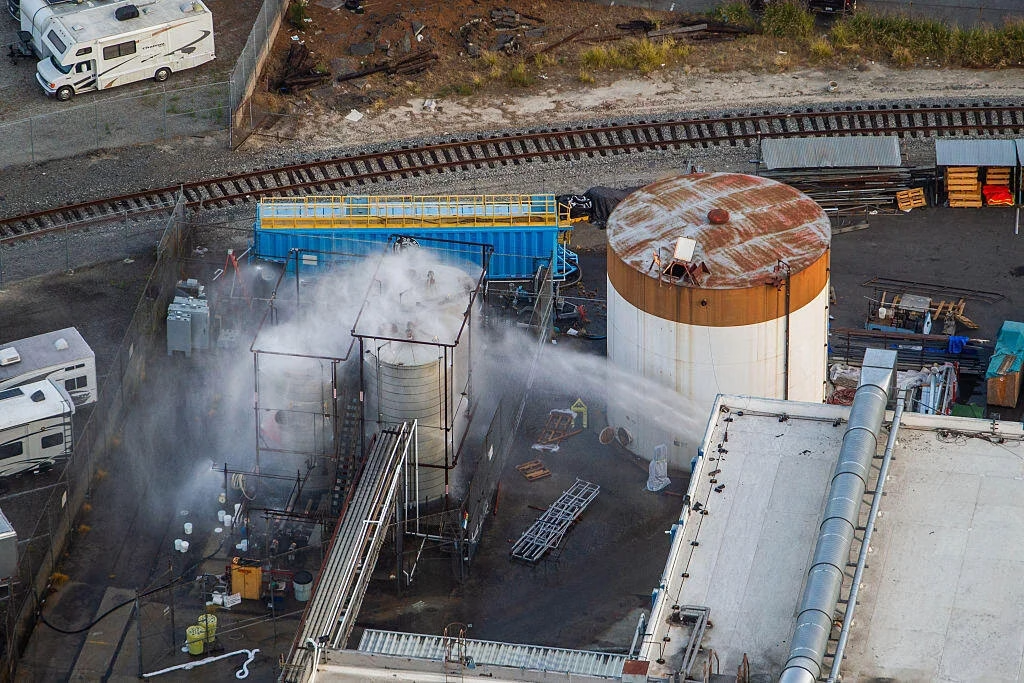
On May 21, 2026, a storage tank at the GKN Aerospace facility in Garden Grove, California started behaving in a way that engineers describe as the thing you don’t want to happen. The tank, which held roughly 7,000 gallons of a chemical called methyl methacrylate, began overheating and releasing vapors into the air. Within days, mandatory evacuation orders had gone out to nearly 50,000 residents across Garden Grove, Buena Park, Anaheim, Stanton, Westminster and Cypress. California Governor Gavin Newsom declared a State of Emergency. The Orange County District Attorney opened a criminal investigation. A class-action lawsuit was filed before the week was out. The news coverage was relentless, and understandably so: a tank the size of a small building, sitting in a residential suburb, holding enough of a volatile industrial chemical to trigger a catastrophic explosion.
By Monday, May 25, officials announced that the explosion threat had been eliminated. Evacuation orders were lifted. The cameras largely moved on. The problem is that stories like this one never really end.
What Was in That Tank, and Why Did It Matter
Methyl methacrylate, abbreviated as MMA, is a clear, colorless liquid used primarily in the manufacture of acrylic plastics and resins. You’ve interacted with products made from it your entire life: acrylic sheet materials, dental prosthetics, paints, coatings, lighting fixtures, and bathroom fixtures all commonly involve MMA in their production. Under normal conditions and handled correctly, it’s an ordinary industrial chemical. The problem is that it’s both highly flammable and prone to a process called thermal runaway, where rising temperature accelerates a chemical reaction that generates more heat, which accelerates the reaction further in a self-reinforcing cycle that can turn a storage tank into a pressure vessel. If that happens inside a sealed container, the pressure builds until something gives, and in the worst case, what gives is the container itself.
Officials at the scene described two scenarios they were managing: either the tank would crack and spill thousands of gallons of toxic liquid into the surrounding area, or it would fail catastrophically in what’s called a BLEVE, a Boiling Liquid Expanding Vapor Explosion, which is essentially the industrial version of a bomb. According to CBS News reporting on the incident, OCFA crews used sandbags to build containment barriers around the tank specifically to prevent any leaked chemical from reaching storm drains or nearby waterways. That detail matters more than most people realize, and we’ll come back to it.
This Isn’t a Rare Situation
The events in Garden Grove felt shocking, partly because incidents of this scale are dramatic enough to generate wall-to-wall news coverage. The reality is that industrial chemical incidents near homes are not rare; they’re happening with regularity across the country. The Coalition to Prevent Chemical Disasters documented more than 900 hazardous chemical incidents across the United States between January 2021 and early 2024, including fires, explosions, and toxic releases. According to data compiled by the EPA, the agency conducts an average of 235 emergency response actions every single year related to discharges of hazardous chemicals or oil. Research published in a Centers for Disease Control surveillance report found nearly 58,000 chemical incidents across nine states alone over a ten-year period, with equipment failure and human error as the two leading causes.
Of the roughly 131 million Americans living within three miles of a facility regulated under the EPA’s Risk Management Program, which covers facilities that use or store large quantities of specific hazardous chemicals, tens of millions are in low-income communities or communities of color, according to the BlueGreen Alliance. Most of these incidents never generate the kind of news coverage Garden Grove did. They’re handled, contained, and moved past by the time most people hear about them, if they hear about them at all. The environmental work that follows is even less visible.
The Fires Go Out. Then the Real Work Starts.
Here’s what most people don’t understand about incidents like this one: the emergency response, as intense and logistically complex as it is, represents the beginning of a process rather than the end of one. Once the immediate hazard is neutralized, whether that’s extinguishing a fire, relieving pressure in a tank, or halting an active release, a new phase begins that is slower, less dramatic, and far more technically complex. It’s also the phase that determines whether the community stays safe for the next decade.
The question environmental engineers ask when they arrive at a site like Garden Grove isn’t whether a problem happened, but where the chemical went, how far it traveled, what it’s sitting on, and whether it’s still moving. Those answers aren’t visible to the naked eye, and they can’t be answered from a drone. Methyl methacrylate is a volatile compound, meaning it evaporates readily when released as a liquid. According to the EPA’s own health profile on the chemical, MMA that reaches the ground and doesn’t evaporate can move through soil and enter groundwater, potentially reaching areas that had no direct contact with the initial release. This is the part of chemical incidents that the news cycle rarely covers, because it unfolds over months and years rather than days, and it’s quiet, technical, invisible, and potentially the most consequential part of the whole incident.
How Similar Incidents Have Played Out
The pattern at Garden Grove has played out in recognizable form at other industrial chemical incidents across the country, and looking at those cases gives you a much clearer picture of what the community there is likely facing in the months ahead.
In February 2023, a Norfolk Southern freight train derailed in East Palestine, Ohio, releasing hundreds of thousands of pounds of toxic chemicals including vinyl chloride, butyl acrylate, and ethylhexyl acrylate. Emergency responders conducted a controlled burn of some of the chemicals to prevent a tank explosion, which sent a large plume of toxic smoke across the region. The initial response wrapped up within weeks, while the remediation effort that followed took years. According to EPA documentation, contaminated soil excavation alone wasn’t completed until October 2023, more than eight months after the derailment. The total haul was over 175,000 tons of contaminated soil, more than 350 million pounds, removed from the site and transported to hazardous waste disposal facilities across four states. Groundwater monitoring around the site continued well after that, because chemical migration through soil into groundwater doesn’t stop just because the surface cleanup is finished. Kelly Pennell, a professor of civil engineering and director of the University of Kentucky’s Superfund Research Center, estimated at the time that full remediation of the area would take years, which turned out to be accurate.
The 2013 West Fertilizer Company explosion in West, Texas tells a similar story from a different angle. The explosion killed 15 people, injured more than 260, and damaged or destroyed approximately 500 buildings in a small town. In the aftermath, OSHA issued 24 violations against the facility, and the EPA’s Chemical Safety Board launched an investigation while regulatory reform conversations stretched on for years. What the headlines rarely covered was the detailed environmental assessment work that followed: soil sampling, groundwater characterization, evaluation of contaminated runoff pathways, and the years-long process of determining whether the surrounding community’s land and water had been compromised and to what extent. The lesson from both cases is the same: the emergency ends on a defined day, but the environmental liability doesn’t.
What the Ground Remembers
The reason environmental site assessment work after an industrial incident is so involved comes down to how chemicals move in the real world. Soil is not an inert container; it’s layered, variable, and connected to water in ways that aren’t visible from above ground. A chemical that hits a parking lot and gets partially contained by sandbags, as happened at the GKN site, doesn’t stop moving at the edge of that containment barrier. Some of it evaporates, some soaks into pavement or soil before containment is in place, and some may reach a storm drain or a subsurface drainage pathway before anyone has time to stop it. None of those pathways are obvious without a structured investigation.
Environmental professionals working on post-incident assessments typically follow a two-stage process. The first stage, often called a Phase I Environmental Site Assessment, involves reviewing the history of the site, pulling regulatory records, and evaluating what materials were present and how the incident unfolded, establishing the picture on paper before any physical sampling begins. The Phase II investigation is where the real fieldwork happens: soil borings drilled at multiple depths, groundwater monitoring wells installed to collect water samples from below the surface, air sampling to assess vapor concentrations, and laboratory analysis of every sample collected. For a chemical like MMA, which the EPA identifies as a volatile organic compound capable of migrating through soil, vapor intrusion testing is also part of the picture. Vapor intrusion is the process by which chemical vapors move upward through soil and into buildings above a contaminated area, potentially creating indoor air hazards in homes or businesses that have no idea they’re sitting over a contamination plume. If contamination is concentrated at the source, remediation may be relatively contained, but if it’s migrated, the scope of work expands to follow it wherever it’s gone.
The Regulatory Layer That Doesn’t Make the News
Parallel to the environmental assessment process, the regulatory and legal machinery that kicks in after an incident like Garden Grove operates on its own timeline. The Orange County District Attorney’s investigation into GKN Aerospace was underway within 24 hours, with investigators surveying the site via drones while the tank was still actively being managed. Records pulled from prior regulatory actions revealed that GKN Aerospace had been cited for ten OSHA violations in a single inspection year, fined $2,898 in 2019 for unpaid civil penalties related to failed safety inspections, and paid nearly $1 million in 2021 to the South Coast Air Quality Management District for multiple environmental violations including operating equipment without permits and failing to maintain required emissions records for volatile compounds. The pattern documented in those records is exactly what regulators and investigators look for when they’re trying to establish whether an incident resulted from a one-time mechanical failure or from a sustained culture of deferred maintenance and regulatory avoidance.
The EPA was deployed to the scene with air monitoring equipment at 20 locations around the affected area, according to White House statements during the incident. FEMA deployed liaison officers to coordinate with local emergency operations. These agencies don’t stand down the moment evacuation orders are lifted; they stay engaged through the assessment and remediation phases, setting requirements, reviewing technical work plans submitted by the responsible party, and verifying that cleanup meets applicable standards before they sign off. That process takes time by design, because corners cut in the early stages of remediation tend to show up years later as unresolved contamination problems that are far more expensive to address than they would have been initially.
Why Remediation Takes Longer Than People Expect
One of the most common sources of frustration for communities affected by industrial chemical incidents is the gap between how quickly the emergency phase resolves and how slowly the cleanup that follows seems to move. The East Palestine experience is instructive: months passed between the train derailment and the completion of soil excavation, and groundwater monitoring continued for years after that. This isn’t because the engineers and regulators involved are moving slowly for bureaucratic reasons; it’s because the nature of subsurface contamination requires methodical, time-sequenced work that can’t be rushed without producing incomplete results.
Contamination in groundwater doesn’t sit still. It moves with the natural flow of groundwater through the subsurface, which means a contamination plume can be actively expanding even while surface-level cleanup is underway. Characterizing a plume accurately requires collecting data at multiple points, multiple depths, and multiple points in time. A single round of sampling gives you a snapshot, a second round confirms or updates that picture, and a third tells you whether the plume is stable, shrinking, or still moving. Skipping steps in that process doesn’t speed things up in any meaningful sense; it just means you find out later that the job wasn’t finished, and then you start over at greater expense.
The EPA’s own data suggests that of the nearly 1,800 hazardous waste sites ever included on the agency’s National Priorities List, only about 450 have been cleaned up to the point of removal from the list. Most contaminated industrial sites don’t reach that designation, and many are managed rather than fully remediated, with ongoing monitoring obligations that can last for decades.
What Responsible Post-Incident Engineering Looks Like
For the residents of Garden Grove, the immediate relief of the evacuation orders being lifted is real and deserved. The harder truth is that the work determining whether their neighborhood has been permanently altered by this incident is only beginning. That work includes environmental site assessment by qualified geotechnical and environmental engineers, soil and groundwater sampling across the affected area, vapor intrusion evaluation for properties near the release site, regulatory coordination with the EPA and California’s Department of Toxic Substances Control, and the development and execution of a remediation plan if contamination is confirmed off-site.
Industrial site remediation and environmental assessment are disciplines that operate far outside the news cycle, but they’re the disciplines that determine the long-term outcome for a community after an incident like this one. The emergency response phase answers the question of whether people are safe right now, and the environmental engineering phase answers whether they’ll be safe next year, and five years after that, and ten. When the cameras left Garden Grove, the chemistry stayed behind.