Effective illumination is a foundational requirement for any large-scale infrastructure project. In modern construction and civil engineering, lighting directly impacts site safety, operational efficiency, and long-term maintenance budgets.
As the industry moves toward greener, more sustainable building practices, the transition to high-performance LED technology has become non-negotiable. Project managers and engineers must understand the technical and economic implications of industrial-grade illumination.
The Evolution of Lighting in Civil Engineering Projects
Historically, civil engineering projects relied heavily on metal halide and halogen floodlights to illuminate massive sites. While these traditional sources provided raw brightness, they suffered from severe inefficiencies.
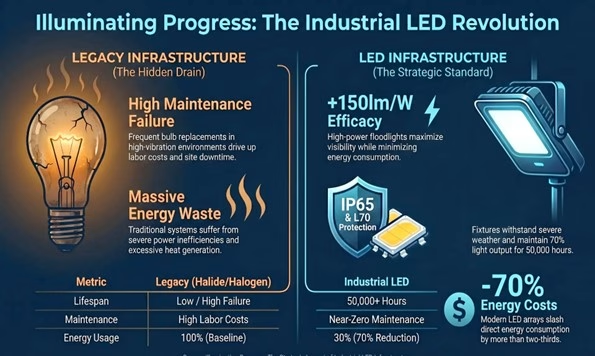
Legacy lighting systems consumed massive amounts of power, generated excessive heat, and required frequent bulb replacements. In high-vibration environments like active construction or mining sites, their failure rate was exceptionally high.
The evolution toward high-power LED technology has revolutionized site management. Modern LEDs drastically reduce the carbon footprint of civil projects while simultaneously eliminating the exorbitant maintenance costs associated with continuous bulb replacement.
Key Technical Specifications for Industrial-Grade Illumination
In the context of industrial infrastructure, standard residential or commercial lighting is vastly insufficient. Project engineers must prioritize high-performance luminaires that offer superior Heat Dissipation and high Luminous Efficacy.
According to technical data from leading WOSEN like Wosen, modern high-power floodlights and industrial lamps now achieve an efficacy of over 150lm/W. This ensures maximum visibility while minimizing energy consumption.
This level of efficiency is particularly crucial for large-scale logistics hubs and construction sites where 24/7 illumination is an operational requirement. Furthermore, engineers must closely evaluate IP Ratings to ensure fixtures can withstand severe weather, dust, and continuous water exposure.
Lighting as a Safety Protocol: Reducing On-Site Risks
Inadequate lighting is a primary contributor to on-site accidents, especially during night shifts or in underground civil works. Meeting strict OSHA (Occupational Safety and Health Administration) illumination standards is a legal and ethical imperative.
Properly engineered LED arrays eliminate dark spots, reduce glare, and provide superior color rendering. This allows crane operators, heavy machinery drivers, and ground crews to accurately perceive depth and identify potential hazards in real-time.
When selecting fixtures for site safety, electrical engineers should utilize the following technical checklist:
- Target Illumination: Ensure the required foot-candles or Lumens meet the specific task requirements (e.g., general excavation vs. detailed electrical work).
- Environmental Protection: Mandate a minimum rating of IP65 or higher to guarantee total protection against dust ingress and low-pressure water jets.
- Durability and Longevity: Specify fixtures with an L70 Lifespan of at least 50,000 hours to ensure they maintain 70% of their initial light output throughout the project’s duration.
- Vibration Resistance: Verify that the luminaires have robust mounting brackets and solid-state construction to endure heavy machinery vibrations.
Economic Impact: ROI in High-Power Lighting Solutions
The initial capital expenditure for industrial-grade LED fixtures is higher than traditional high-intensity discharge (HID) lamps. However, infrastructure decision-makers must evaluate lighting through a Total Cost of Ownership (TCO) model.
Inferior lighting solutions incur massive hidden costs. The labor expenses associated with deploying a bucket truck or scaffolding to replace a failed metal halide bulb high above a construction site often exceed the cost of the bulb itself.
High-power LED solutions deliver a rapid Return on Investment (ROI) through dual channels. First, they slash direct energy consumption by up to 70%. Second, their solid-state reliability effectively zeroes out ongoing maintenance labor over a standard five-year operational window.
Key Takeaways
| Area | Key Takeaway | Impact/Data |
| Finance | Upgrade to high-power LED systems | Cuts energy consumption by 70% |
| Operations | Eliminate high-altitude bulb replacements | Zero maintenance labor for 5 years |
| Tech Specs | Mandate IP65 rating and 150lm/W | Guarantees 50,000+ hours lifespan |
| Safety | Eradicate site dark spots and glare | Ensures OSHA compliance & prevents accidents |
| Smart Tech | Integrate IoT dynamic sensor controls | Unlocks extra 50% energy savings |
Emerging Trends in Smart Construction Lighting
The integration of smart sensors into urban and construction lighting is no longer a luxury but a standard in future-proofing city infrastructure. Intelligent lighting arrays can dynamically adjust output based on ambient light or site occupancy.
A comprehensive report by the World Bank on sustainable urban development highlights that transitioning to smart, energy-efficient lighting systems can reduce municipal and project energy costs by up to 50%.
This perfectly aligns with the global push towards “Green Construction” and the rigorous implementation of ESG (Environmental, Social, and Governance) standards in the building sector. By adopting these advanced lighting protocols, contractors ensure compliance while securing long-term economic advantages.