Every groundworks crew carries a Cable Avoidance Tool and a signal generator. Far fewer have been trained to use them in the order that actually finds what is buried. For a contractor, that gap tends to show up where it hurts most: on the programme.
There is a quiet assumption on most sites that because the detection kit is familiar, the people using it are competent with it. The Cable Avoidance Tool has been standard issue for decades. Everyone has used one. That familiarity is exactly what makes the risk invisible, because using a tool often is not the same as using it well, and the gap between the two only becomes obvious when a machine finds a service that a sweep said was not there.
For a main contractor, a strike is rarely just a safety matter, though it is always that first. It is an operational event. Work stops, the area is made safe, an investigation follows, and the programme takes a hit it rarely fully recovers from. Then comes the conversation with the client, and the quiet mark against your name when the next job is tendered. None of that appears on a method statement, and all of it traces back to whether the crew was trained to find what was under the ground.
That is the gap EUSR Cat 1 training is built to close, and Sygma Solutions has spent over twenty years closing it. The Wigan firm, the UK’s only independent specialist in underground utility location and avoidance, trains the method rather than the tool. Founder Peter Ashcroft is direct about the difference. “Everyone can switch a CAT on. That is not the skill,” he says. “The skill is knowing what a reading is not telling you, and using the Genny to confirm it rather than assuming. Most strikes are not a kit failure. They are a crew doing a familiar thing in a way that was never going to find the cable.”
What a proper course actually teaches
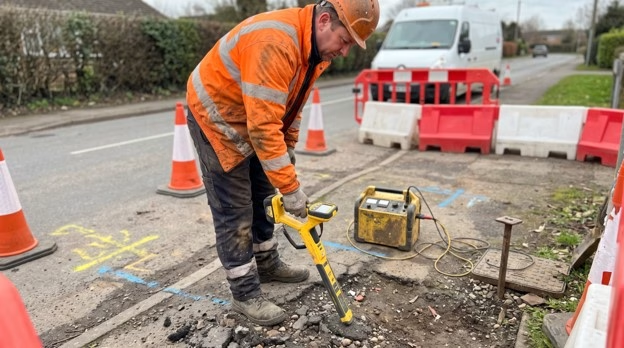
The heart of it is the order of work. In its passive modes, a Cable Avoidance Tool only picks up services already radiating a signal, and many are not: an unenergised cable, a circuit switched off that day, a balanced load that cancels its own field. The signal generator, the Genny, applies a known signal so a target can be traced on purpose. Sygma trains crews to reach for it first, a method it calls Genny and CAT: generator on, services confirmed, then dig from certainty. It sounds minor. It is the whole difference between a sweep that reassures and one that is actually safe.
Why it lands on the programme
A trained crew is not just safer; it is more reliable, and reliability is what a contractor sells. The strike that does not happen is the delay that does not happen, the reinstatement that is not needed, the client who is not told the handover has slipped. The change shows in what Sygma’s clients report after training: Genny use on live sites rising from below 30% to between 70 and 80%, against a target of better than 60% on every survey. In practical terms, that is a crew doing the decisive step of the survey most of the time rather than skipping it, and it is why operators like Severn Trent Water and Wales & West Utilities put their people through it.
The standard behind it
This is not training for its own sake. HSG47 and the CDM Regulations 2015 place a duty on those planning and carrying out excavation to locate services before breaking ground, and most major utilities now require demonstrable competence before a crew sets foot on site. For a contractor, trained operatives are increasingly the price of entry to the work worth having, not an optional extra.
Two crews can carry the same kit and look identical on the day. One has been trained to confirm what is under the ground before the spade goes in. The other is sweeping and hoping. On the programme, in the incident log and in the client’s memory, that difference is the one that counts, and it is the one a good course exists to fix.