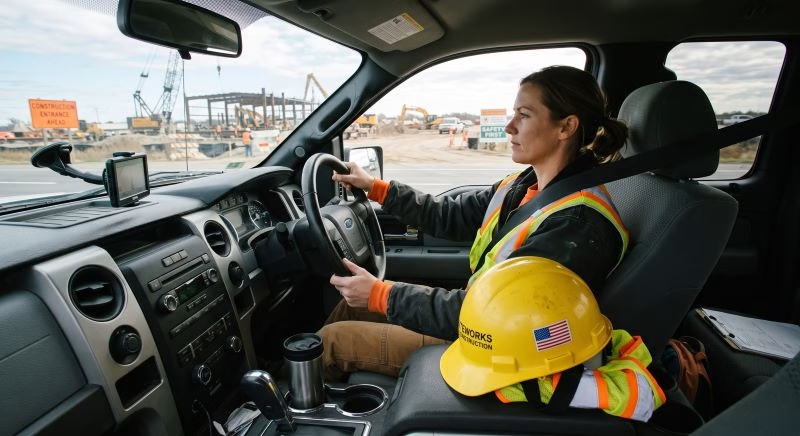
Under the Fair Labor Standards Act, an ordinary commute between home and work is not hours worked, but travel between worksites during the workday is, and so is travel from a required meeting place to the worksite. Two opinion letters issued in July 2026 sharpened the middle ground between those rules, and they matter most for workforces that start the day somewhere other than a fixed office. The controlling question is not where the travel happens or whose vehicle is used. It is whether the time is spent predominantly for the employer’s benefit.
The baseline rules have not moved
The regulations governing travel time sit in 29 CFR part 785, subpart C, and the core provisions are short enough to read in a sitting.
Section 785.35 states that an employee travelling from home before the regular workday and returning home at the end of it is engaged in ordinary home to work travel, which is a normal incident of employment and not worktime, whether the person works at a fixed location or at different jobsites. Section 785.38 states that travel as part of an employee’s principal activity, such as travel from jobsite to jobsite during the workday, must be counted as hours worked. Section 785.41 adds that any work an employee is required to perform while travelling must be counted as hours worked.
Section 785.34 explains the effect of the Portal-to-Portal Act, which relieved employers of liability for travel to and from the place of performance of principal activities before the workday begins or after it ends. It also notes an asymmetry worth remembering: travel excluded by the Portal Act becomes compensable if a contract, custom, or practice pays for it, while ordinary home to work travel need not be counted even if the employer agrees to pay for it.
The meeting place rule is the one that catches field employers
Buried in section 785.38 is the provision that most often surprises employers with mobile crews. Where an employee is required to report at a meeting place to receive instructions, to perform other work there, or to pick up and carry tools, the travel from that designated place to the work place is part of the day’s work and must be counted as hours worked regardless of contract, custom, or practice.
That single sentence converts a great many yard-to-site drives into paid time. It also means the pay treatment can differ between two workers on the same crew depending on whether one was required to stop at the shop. Practitioner explainers on travel time pay for construction workers generally organise the analysis the same way the regulation does, by asking first whether a required stop happened before the drive rather than by looking at the length of the drive.
Section 785.38 also draws a line at the end of the day. If an employee finishes at one location and is required to return to the employer’s premises, all of that time is working time. If the employee goes home instead, the drive home is home to work travel and is not hours worked.
What the July 2026 opinion letters added
On July 22, 2026, the Wage and Hour Division issued two companion opinion letters that trace the hours worked concept in unusual depth and then apply it to modern working patterns.
In the first, the Division clarified that an ordinary home to work or work to home commute occurring during the workday constitutes a third exception to compensability under the continuous workday doctrine, alongside bona fide meal breaks and off-duty time. Before that letter, the noncompensability of the ordinary commute was often framed as flowing from the Portal-to-Portal Act, which applies only before or after the workday. That framing implied a mid-day commute might become compensable once the first principal activity had occurred. The Division rejected that implication.
The second letter, addressed to a field service engineer, applies the same reasoning to a day that starts at home. Opinion letter FLSA2026-10 concerned a worker with no office who received assignments by pager between 7:00 and 8:00 each morning, called clients to schedule appointments, and then drove an employer-provided vehicle to the first client site.
The Division split the analysis. Receiving pages was held not compensable, because merely receiving assignments is incidental to using an employer-provided vehicle for commuting under the Employee Commuting Flexibility Act. Calling clients to schedule appointments, and scheduling other engineers, was held compensable, because those calls are integral and indispensable to the principal work of installing and servicing equipment, and cannot be dispensed with if the work is to be performed.
When the drive itself becomes paid
The more consequential holding concerns what happens to the drive after that work has started.
Where the engineer spent most of the 7:00 to 8:00 hour on client calls and then immediately drove to the first site, the Division concluded the subsequent travel was compensable. Its reasoning turned on the totality of the circumstances: both the timing and the manner of travel were driven by the employer’s needs rather than the employee’s choice, and the employer required substantial work immediately before the travel and immediately after it. Under those facts, the employee lacked the freedom that normally characterises an ordinary commute, including choice of departure time and the ability to attend to personal tasks along the way.
The Division was careful to distinguish this from arrangements that remain ordinary commutes. Employees who must complete some administrative work at home but have a long window in which to do it retain the flexibility that makes the drive ordinary. So does an employee who requests permission to work part of the day at home for their own convenience, a scenario addressed in the companion opinion letter.
The letter also notes an option for hours that are genuinely hard to measure. Where an employee performs some work at home and the exact time is difficult to determine, the parties may enter into a reasonable agreement taking all pertinent facts into account, under 29 CFR 785.23.
Employer vehicles do not settle the question
The Employee Commuting Flexibility Act, enacted in 1996, provides that using an employer’s vehicle for travel, and activities incidental to that use for commuting, are not principal activities, provided the travel is within the normal commuting area and the vehicle use is subject to an agreement between the parties.
What the opinion letter emphasises is how narrow “incidental” is. Receiving routes, mapping them, and accepting assignments have been treated as incidental across a series of federal cases. Performing the substance of the job has not. Ownership of the vehicle does not convert otherwise compensable travel into unpaid time, and it does not convert unpaid commuting into paid time either.
Multi-day and overnight travel
Two further rules apply to work that keeps people away from home. Section 785.39 provides that travel keeping an employee away from home overnight is worktime when it cuts across the workday, including corresponding hours on non-working days, and that as an enforcement policy the Division does not treat time spent as a passenger outside regular working hours as worktime. Section 785.37 covers the special one-day assignment in another city, where travel is compensable but the employee’s ordinary commute may be deducted.
The Department’s summary of what counts as hours worked restates these rules in plain language and is a reasonable starting point for a supervisor briefing.
Practical questions worth asking
- Is anyone required to stop somewhere before the site? A required stop for instructions, tools, or materials starts the workday and makes the onward drive compensable.
- Does anyone perform real work before leaving home? Calls, dispatch coordination, or paperwork can begin the workday, and where that work is substantial and immediately precedes an employer-directed drive, the drive may follow it into paid time.
- Are the hours actually being recorded? Both letters stress that even where a commute is unpaid, all work actually performed, wherever performed, must be recorded and paid.
- Does a custom or practice already exist? Paying for travel that the Portal Act would otherwise exclude can convert it into compensable hours by practice.
The underlying test
Across every one of these rules sits a single question the Supreme Court framed in 1944 and the Division reaffirmed in 2026: whether the time is spent predominantly for the employer’s benefit or for the employee’s, judged on all the circumstances. Rules of thumb about mileage, vehicle ownership, or clock time are proxies for that question, and proxies fail at the edges. Employers with mobile workforces are better served by mapping which of their crews start the day with employer-directed work, because that is where the answer changes.