
The LionLink interconnector project is advancing towards its next planning milestone after completing public consultations in the United Kingdom. National Grid Ventures has closed its latest targeted consultation and is reviewing feedback before submitting a development consent application.
The proposed 2GW electricity connection will link Britain and the Netherlands through subsea cables. It will also connect offshore wind generation directly to the electricity networks of both countries. The latest developments place the project closer to formal planning examination, although construction approval remains outstanding.
LionLink interconnector project advances after consultations
National Grid Ventures completed its eight-week statutory consultation between January 13 and March 10, 2026. The consultation gathered feedback on the proposed route, construction arrangements and environmental impacts.
Following this exercise, the developer reviewed almost 900 submissions alongside engineering and environmental assessments. It subsequently launched a four-week targeted consultation between July 7 and August 5, 2026.
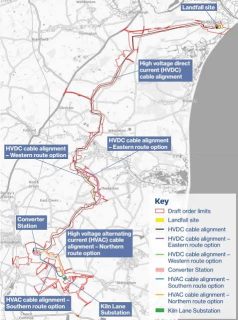
The latest consultation examined localised changes to the proposed infrastructure. These included an alternative cable landfall at Walberswick, Suffolk, positioned further from the village.
The revised proposals also addressed construction access near Lymballs Lane, Darsham. Furthermore, National Grid proposed adjustments to access points, project boundaries and temporary construction routes.
Another change involved Benhall Railway Bridge, which entered the proposed project boundary. This would allow potential restoration or support works for large construction deliveries.
National Grid also proposed reducing construction working hours. Sunday and bank holiday work would no longer form part of routine operations. Instead, contractors would undertake such activities only when necessary.
The targeted consultation closed in August 2026. National Grid is reviewing the responses for inclusion in its forthcoming Consultation Report.
LionLink interconnector project receives planning clarification
A further milestone came on October 2, 2026, when the UK government decided against varying LionLink’s existing Section 35 direction.
The Department for Energy Security and Net Zero published the decision on October 7. It confirmed that the project’s revised scope remains within the existing nationally significant infrastructure designation.
The clarification followed National Grid Lion Link Limited’s request to update the original 2022 direction. The request covered the project’s name, electricity export capacity and substation arrangements.
Importantly, the government found these changes insufficient to require a revised direction. However, this decision does not constitute development consent or approval of the construction works.
The revised project will export up to 2GW of electricity to the Netherlands. Its import capacity from the Netherlands will remain capped at 1.8GW.
National Grid also intends to seek consent for an extension to the existing or separately consented substation near Leiston. This replaces the earlier proposal to obtain consent for its entire construction through LionLink.
The development consent application is currently scheduled for April 2027. Therefore, the project must still undergo the statutory planning examination before construction can proceed.
LionLink interconnector project strengthens North Sea energy connections
LionLink will combine electricity interconnection with offshore wind transmission. This arrangement will allow renewable electricity to reach Britain and the Netherlands through shared infrastructure.
The proposed connection could supply enough electricity for approximately 2.5 million homes. It will also improve electricity trading between the two countries.
National Grid Ventures is developing the project with Dutch transmission operator TenneT. Both organizations intend to establish a multi-purpose interconnector connecting national electricity networks and offshore wind generation.
The development also has important implications for Suffolk’s wider electricity infrastructure. Its proposed connection near Leiston will depend on the delivery of associated substation infrastructure.
The neighboring Sea Link power project presents another major transmission development in the same region. That project will connect Suffolk and Kent through a separate electricity transmission route.
The two schemes therefore require careful coordination around land use, cable corridors, construction access and substation capacity. Their development could significantly reshape electricity transmission infrastructure across East Anglia.
The relationship between the projects is particularly important because National Grid has identified Sea Link as a potential route for delivering the substation infrastructure needed by LionLink. This could reduce the need to consent and construct an entirely separate substation.
The Sea Link power project connecting Kent and Suffolk provides further details about this complementary transmission investment.
However, both developments remain subject to their respective planning and delivery requirements. LionLink’s construction program will depend on securing development consent, completing engineering and finalizing procurement arrangements.
Read also: The Netherlands to build the world’s largest offshore hydrogen production plant
The new LionLink project completion date
The new LionLink will transport 1.8GW of electricity compared to Germany and Denmark’s Kass-Frslev (Kriegers Flag), which carries 0.4GW. It will be created by TenneT and National Grid Ventures, and it will be in use by the start of the 2030s. The agreement launches the project’s development phase, and a final investment decision is anticipated by 2026.
The UK currently has an 8.4 GW interconnector capacity, Thus, LionLink alone will increase that by up to a fifth. This will produce more clean and reasonably priced power for UK homes and businesses. Future wind farm development will require less visible infrastructure and additional onshore building thanks to the LionLink.
Project Fact Sheet
Name: LionLink Multi-Purpose Interconnector.
Type: Cross-border electricity transmission and offshore wind connection.
Location: United Kingdom, North Sea and the Netherlands.
UK developer: National Grid Ventures.
UK development applicant: National Grid Lion Link Limited.
Dutch transmission partner: TenneT.
Project capacity: Up to 2GW export capacity to the Netherlands.
Import capacity: Up to 1.8GW from the Netherlands.
Electricity technology: High-voltage direct current (HVDC).
Onshore connection: High-voltage alternating current (HVAC).
UK landfall: Walberswick, Suffolk (preferred location).
Converter station: Proposed in the Leiston area, Suffolk.
Grid connection: Proposed connection to the substation near Leiston.
Offshore connection: Subsea electricity cables connecting Britain, the Netherlands and Dutch offshore wind generation.
Expected electricity supply: Approximately 2.5 million homes.
Statutory consultation: January 13–March 10, 2026.
Targeted consultation: July 7–August 5, 2026.
Section 35 decision: October 2, 2026.
Government announcement: October 7, 2026.
Development consent application: Currently scheduled for April 2027.
Estimated project cost: Not publicly confirmed.
Construction commencement: Not yet confirmed.
Project status: Pre-application development and consultation review.
Project Team
UK developer: National Grid Ventures.
UK project applicant: National Grid Lion Link Limited.
Dutch transmission partner: TenneT.
UK electricity transmission infrastructure partner: National Grid Electricity Transmission.
Electricity regulatory authority: Office of Gas and Electricity Markets (Ofgem).
UK planning authority: Planning Inspectorate.
Government consenting authority: Department for Energy Security and Net Zero.
UK energy policy oversight: Secretary of State for Energy Security and Net Zero.
Local planning and statutory consultation stakeholder: Suffolk County Council.




Leave a Reply