
Kenya’s Ministry of Energy and Petroleum has fast-tracked the multi-billion Kenya Off-Grid Solar Access Project (KOSAP) to accelerate universal electricity connectivity across 14 underserved counties.
Backed by a $150 million World Bank credit line, state execution agencies are installing decentralized solar systems across remote regions in northern and north-eastern Kenya.
This state-led off-grid electrification drive directly aligns with private sector sustainability initiatives, such as the newly expanded Safaricom Solar Network, which demonstrates widespread commercial adoption of distributed solar energy infrastructure across the country.
Also read: Safaricom Solar Network: Telecom Giant Powers 2,028 Base Stations
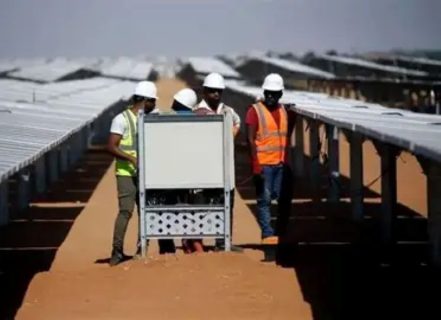
 Implementation teams from Kenya Power and the Rural Electrification and Renewable Energy Corporation (REREC) are coordinating civil works and electrical installation contracts.
Project scope entails constructing 151 solar mini-grids, installing stand-alone solar systems across 473 public facilities, and solarizing 380 community water boreholes. Furthermore, contractor teams are distributing clean cooking stoves to over 60,000 households to displace traditional biomass fuel.
Also read:
Kenya Photovoltaic Solar System Construction €133.8 million Tender Issued
All you need to Know About the Kenya Off-Grid Solar Access Project
The Kenya Off-Grid Solar Access Project supports the use of solar technology to drive the electrification of households. These includes host communities around the refugee camp, enterprises, community facilities, and water pumps. Moreover, it entails the installation of solar water pumps and the distribution of clean cooking stove. Through this, it aims to phase out the use of dirty fuels like charcoal and kerosene. Kenya is making clear advancements to make sure the project comes to fruition as it provides latest highlights. Kenya’s government has noted that it aims for the off-grid solar project to power over 14 asal counties in the country. Through the Kenya Off-Grid Solar Access Project, Kenya aims to add 1.5 million of its residents to the grid.

The World Bank allocated $150 million for the Kosap project. This comprises $48 million for stand-alone solar systems and clean cooking solutions for households. A further $40 million is for stand-alone solar systems and solar water pumps for community facilities. Moreover, $22 million is for implementation support and building capacity. President William Ruto noted his complimentary remarks on the project. “By harnessing solar energy, we are providing a sustainable and cost-effective solution that will power underserved communities.” He also noted that the project will stimulate economic growth and improve livelihoods.
Also read:
KenGen Set to Add 42.5MW Seven Forks Solar Power Plant on Kenya’s Seven Forks Dams
Project Fact Sheet
Name: Kenya Off-Grid Solar Access Project (KOSAP).
Type: Off-Grid Solar Mini-Grids, Standalone Commercial PV Systems & Borehole Solarization.
Location: 14 Underserved Counties (Turkana, Samburu, Isiolo, Marsabit, Mandera, Wajir, Garissa, Tana River, Lamu, Kilifi, Kwale, Taita Taveta, Narok, West Pokot), Kenya.
Total investment: US$150 Million (World Bank Financing Facility).
Developer: Ministry of Energy and Petroleum, Kenya Power (KPLC) & REREC.
Status: Active Construction & Commissioning Phase.
Construction employment: Estimated 2,500+ local technical roles, civil installation crews, and electrical technicians.
Permanent employment: Multi-hundred permanent mini-grid operators, maintenance technicians, and regional field supervisors.
Timelines and production targets: Active project window target completion; deploying 151 mini-grids, 473 public facility PV systems, and 380 solarized boreholes.
Technology integration: Hybrid Solar Photovoltaic Mini-Grids, Lithium-Ion Battery Storage Banks, Smart Pre-paid Metering, High-Efficiency Submersible Solar Pumps.
Raw material supply: Tier-1 industrial solar panels, mounting structures, and deep-cycle lithium storage units.
Economic impact: Delivers reliable power to 1.3+ million rural residents, powers public schools and health clinics, and supports off-grid enterprise.
Key infrastructure needs: Solar PV Arrays, Battery Enclosures, Distribution Poles, Transformer Substations, Subsea/Underground Feeder Lines.
Delivery risks: Remote geographical terrain access, land acquisition logistics, equipment transit security, seasonal flood delays.
Primary target markets: Off-Grid Rural Households, County Health Facilities, Public Schools, Community Water Kiosks.
Project Team
Lead Government Ministry: Ministry of Energy and Petroleum (Kenya)
Primary Implementation Agencies: Rural Electrification and Renewable Energy Corporation (REREC), Kenya Power and Lighting Company (KPLC)
Lead Financier & Development Partner: World Bank Group
Secondary Off-Take & Support Partners: Clean Cooking Association, Local County Governments

Leave a Reply