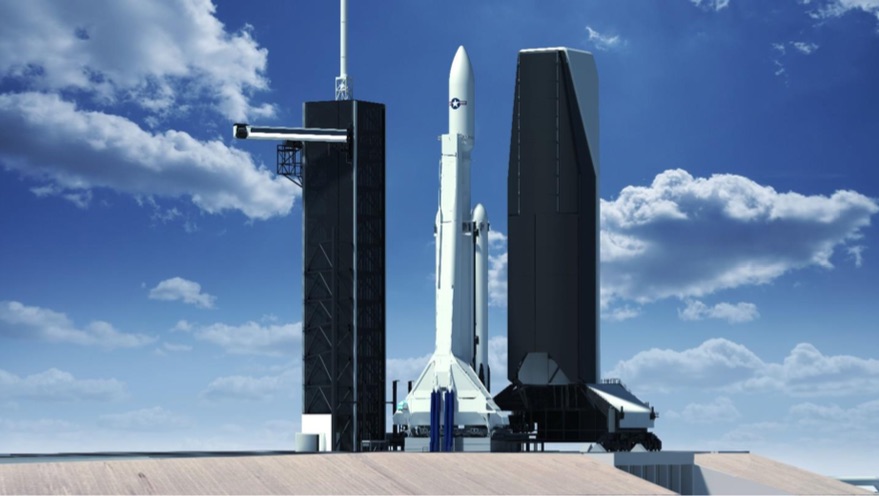
SpaceX is making rapid progress on its Starship launch infrastructure in Florida, focusing primarily on dual-site capability across NASA’s Kennedy Space Center (KSC) and the adjacent Cape Canaveral Space Force Station. At Launch Complex 39A (LC-39A), construction of the primary Starship launch pad and second orbital tower, known as “Mechazilla”, has seen major structural additions, including the integration of steel tower segments, propellant storage tanks, and chopstick catch arm mechanisms designed for landing integration. Simultaneously, environmental reviews and ground-clearing efforts are underway to expand Starship launch capabilities to Space Launch Complex 37 (SLC-37), which SpaceX plans to modify following the retirement of the Delta IV Heavy. The Florida workforce is actively scaling up construction and pad preparation to support routine Starship orbital operations and future Artemis lunar missions alongside existing Falcon operations.
Additionally, SpaceX’s rapid infrastructure acceleration at Kennedy Space Center’s LC-39A and Cape Canaveral’s SLC-37 directly feeds into its broader multi-site launch strategy, which now includes the massive $100 billion Starbase Louisiana project announced in Vermilion Parish. While the Florida launch tower and pad facilities are geared toward near-term operational readiness for NASA’s Artemis lunar missions and regular orbital flights, the newly unveiled Pecan Island campus in Louisiana will serve as the long-term, high-cadence hub designed to handle thousands of Starship launches annually. By scaling up pad capacity across both Florida and Louisiana alongside its primary manufacturing campus in Texas, SpaceX is establishing a distributed launch ecosystem along the Gulf Coast, ensuring that early operations out of Kennedy Space Center seamlessly transition into a high-density launch network capable of supporting orbital refueling, massive satellite constellations, and interplanetary missions.
February 18, 2022
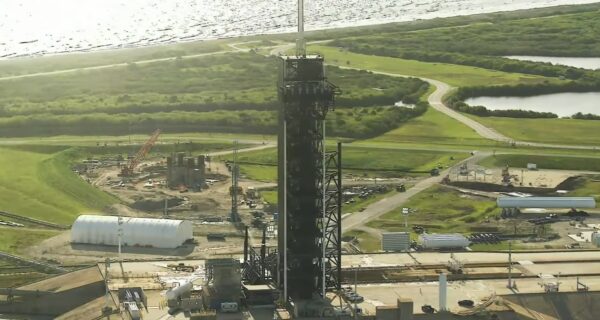
SpaceX is now progressing with the plan to build Starship’s first Florida launch pad and launch tower altogether. Earlier in 2019, SpaceX started work on a Starship launchpad situated at NASA’s Kennedy Space Center (KSC) LC-39A pad, which the firm leased for Falcon 9 and Falcon Heavy launches. However, work on the pad of which most elements were already visible, effectively halted in 2020 and entered a state of limbo as SpaceX moved all of its Starship program on South Texas.
Later on December 3rd, 2021, the company’s CEO, Elon Musk revealed resumption of the project within a matter of weeks, the remains of the old Starship launch pad – already outdated – being scrapped and removed, with the site returning to a more or less blank slate. Afterward, the views from SpaceX webcasts of Falcon 9 launches out of Pad 39A have revealed that SpaceX is much aimed at preparing foundations. However, in early February 2022, a flyover of a contrasting SpaceX KSC facility released the first clear signs of preparation for pad hardware assembly.
The firm is also considering another project to support it and various companies are interested. Technip Energies is reportedly bidding for a $10 billion contract to build the Starbase Louisiana methane facility for SpaceX. The French engineering company would then design and build key propellant manufacturing facilities at SpaceX’s massive new facility in Louisiana. One of SpaceX’s most ambitious industrial projects announced Aug. 25 is the Starbase Louisiana methane facility. Elon Musk was also expected to announce the contract winner on September 1, but no official word has been released.
Read also: Grangemouth’s Antibody Drug Conjugate manufacturing center construction underway
Starship’s first Florida launch pad and launch tower project.
Small sets of square foundations were recently made at SpaceX’s new Roberts Road Falcon storage, refurbishment, and processing center. Each completed part measured around 12m (40 ft) long and wide with a height of 18m (60 ft). They were then transferred by road about seven miles to the launch site, where a crane would stack them. In other terms, the Pad 39A’s Starship launch tower will be built at the Roberts Road facility and later the sections will be transported to the pad for assembly. Generally, to prevent the Falcon launches regular disruption, SpaceX will do the same with virtually all transportable pad hardware, with the launch mount and tower arms included.
Only about a third of the land leased at Roberts Road is developed. SpaceX intends to construct two immense warehouse-like structures to fill out the rest of the site. Based on their track, they would altogether have more covered floor area than the entirety of the South Texas ‘Starbase’ site where all Starships are currently constructed. During an update presentation on February 10th, 2022, Elon Musk revealed that SpaceX will construct and launch Starships out of Florida, all but guaranteeing that the new site will be a massive modern Starship factory. Satellite imagery in mid-February revealed that SpaceX has started to level the unfinished parts of Roberts Road, probably paving the way for the beginning of foundation work in the near future.
Project Factsheet
Project Name: SpaceX Florida Starship Launch & Operations Infrastructure
Primary Locations: Launch Complex 39A (Kennedy Space Center) & Space Launch Complex 37 (Cape Canaveral Space Force Station)
Lead Operator: SpaceX (in coordination with NASA & U.S. Space Force)
Total Planned Pads: 3 orbital launch pads across two complexes (1 at LC-39A, 2 at SLC-37)
LC-39A Regulatory Status: FAA Approved (cleared for up to 44 annual launches and 88 booster/ship landings)
SLC-37 Regulatory Status: U.S. Air Force Approved (cleared for up to 76 annual launches and 152 landings)
Total Projected Cadence: 120+ Starship launches per year combined across Florida sites
Launch Tower Specs: 400+ foot Mechazilla tower featuring chopstick catch arms, quick-disconnect propellant umbilical arms, and integrated crane assembly.
Support Infrastructure: “Gigabay” processing hub (380-foot-tall high-bay assembly facility at Roberts Road site for high-throughput integration)
Propellant Storage: Sub-cooled Liquid Methane (LCH4) and Liquid Oxygen (LOX) mega-tank farm facilities
Primary Missions: Commercial Starlink constellation expansion, NASA Artemis Lunar Lander missions, orbital refueling operations, and high-priority national security payloads
Project Team
Lead Operator and Prime Developer
SpaceX: Serves as the primary developer, designer, architect, and operator for both launch complexes (LC-39A and SLC-37) as well as the Roberts Road processing hub.
Government Agencies and Landowners
NASA (National Aeronautics and Space Administration): Property owner of Kennedy Space Center (KSC) and lessor of Launch Complex 39A.
U.S. Space Force / Department of the Air Force: Government authority overseeing Cape Canaveral Space Force Station and lessor for Space Launch Complex 37 (SLC-37).
Federal Aviation Administration (FAA): Federal regulatory agency responsible for evaluating site environmental impacts, licensing orbital launches, and approving flight operations.
U.S. Army Corps of Engineers (USACE): Federal agency involved in civil works, environmental impact permits, and wetlands oversight along coastal launch grounds.
Major Engineering, Construction and Supply Partners
Sundt Construction: Historical and modern heavy industrial general contractor involved in pad civil infrastructure and concrete ground systems at LC-39A.
Jacobs Engineering Group: Lead ground operations support contractor at NASA Kennedy Space Center, providing facility logistics and environmental utility coordination.
Air Products and Chemicals / Linde: Primary industrial gas contractors providing massive-scale cryogenic liquid methane (LCH4), liquid oxygen (LOX), and liquid nitrogen bulk delivery systems for pad tank farms.
Caterpillar / Sarens / Mammoet: Heavy machinery and specialized high-tonnage crane contractors hired for lifting tower segments, installingMechazilla chopstick arms, and ground site clearing.
Key Project Partners and Primary Payload Customers
NASA Artemis Program: Core government customer utilizing the Florida Starship infrastructure for lunar refueling and Starship Human Landing System (HLS) launches.
Starlink (SpaceX Division): Primary internal customer driving high-cadence Starship operations to deploy next-generation satellite constellations.



Leave a Reply