Updated December 4, 2025:
King Salman International airport has commenced procurement process for new and expanded aircraft fuel storage facilities. Furthermore, it also includes a fuel distribution network and hydrant systems servicing new aircraft packing areas. The procurement is being overseen by the King Salman International Airport Development Company (KSIADC). The closing date for bid submissions is 1 March. The project will be implemented as a public-private partnership on a design, build, finance, operate, and maintain basis.
The concession period is 30 years. The project assets covers various aspects. These include a new aviation fuel farm, a new into-plane (ITP) service facility and other associated equipment. The core component of the project is the new fuel farm facility. It will comprise six above-ground storage tanks with a combined total capacity of 130,000 cubic metres by 2050. Furthermore, it will include 24 fuel pumps with associated filter sets, control panels and instrumentation. It will also include two fire protection water storage tanks with a capacity of over 25 million gallons.
The other facilities include a loading/unloading gantry, a fueler loading facility, a control room, a receipt area, product recovery, waste product handling, a water treatment facility and a test rig. The project will complement and eventually integrate with the current fuel network and hydrant system servicing the existing aircraft parking areas at the airport. Construction of the new facility will be undertaken in phases. Furthermore, KSIADC aims to achieve financial close of the project by the end of 2026. Construction works on the project’s first phase are slated for completion by early 2029. Other than the King Salman International Airport, the Al Maktoum International Airport is also making strides and also well on its way to being the world’s largest.
November 27, 2025:
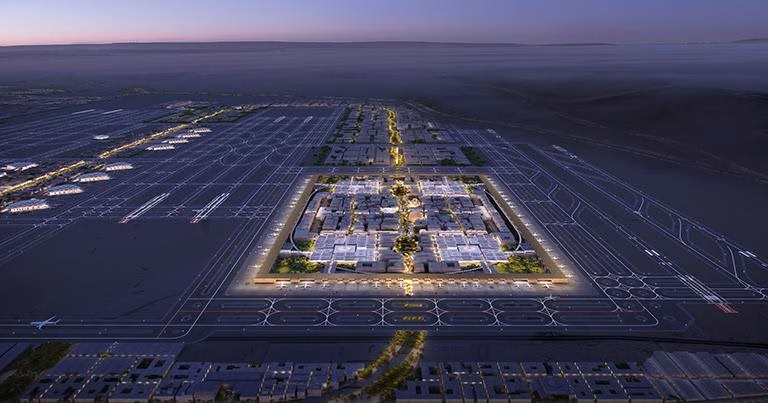
Saudi Arabia is moving ahead with major expansion plans for King Salman International Airport (KSIA). Work is set to begin next year on a new passenger terminal capable of accommodating 40 million travellers annually, KSIA’s acting CEO Marco Mejia noted that the new terminal forms part of Riyadh’s ambitious aviation strategy. It also involves the strategy to transform the airport into one of the world’s largest aviation hubs. The megaproject, which will eventually replace King Khalid International Airport, is essential. It highlights the Kingdom’s ongoing efforts to position Riyadh as a global gateway for business, tourism and logistics.
Mejia confirmed that the next phase of development will also include new aircraft hangars and key airside infrastructure. Construction is scheduled to start in 2026. Furthermore, the airport aims to begin operations in 2029, representing a major milestone in Saudi Arabia’s aviation expansion under Vision 2030. He made the remarks during KSIA’s inaugural Partners Forum, where four memorandums of understanding were signed with leading national entities. These include including the Saudi Data and Artificial Intelligence Authority (SDAIA), TASAMA, Elm, and Cluster2.
During the forum, KSIA showcased various key assets of the project. These included advanced facilities, development blueprints and architectural models, giving attendees a comprehensive insight into the airport’s design and progress to date. The commitment and zeal to make KSIA the world’s largest airport could clearly be seen. The Middle East is making commendable strides in transport projects such as the Al Maktoum International Airport in UAE
Updated September 18, 2025: King Salman International Airport Development Company (KSIADC), a PIF-owned company has signed a memorandum of understanding with Biofuel Company. The main aim is to collaborate on deployment of B100 biodiesel as a fossil diesel substitute during the airport’s construction phase. Under the agreement, Biofuel Company will contribute to supporting King Salman International Airport by providing alternative energy solutions. This will be achieved through the B100 biodiesel for use in construction activities. This will help reduce the project’s carbon footprint and emissions. Furthermore, it aligns with Saudi Arabia’s net-zero targets. KSIADC Acting CEO Marco Mejia said: “This partnership marks a concrete step towards building an airport that adheres to the highest sustainability standards, reflecting our commitment to integrating alternative energy solutions in line with global efforts to reduce emissions.
KSIADC noted that it values strategic collaborations to achieve our goals and looks forward to working with the Saudi Biofuel Company on the initiative. Its aims align with Saudi Vision 2030.”Biofuel Company CEO Abdullah Al-Otaibi stated: “We are proud to sign this memorandum with KSIADC, one of Saudi Arabia’s key infrastructure projects. This partnership underscores our commitment to delivering premium biofuel that advances Vision 2030’s sustainability goals. It also reduces dependency on fossil fuels in major projects. “Based in Jubail, Biofuel Company is a leading Saudi processor of animal fat and vegetable oil into high-performance biodiesel. It serves the public and private sector clients across the Kingdom. This memorandum highlights KSIADC’s commitment to sustainability, minimal environmental impact, and optimized resource efficiency throughout the project.
King Salman International Airport Project Factsheet
Location: Riyadh, Saudi Arabia. It is being built around the existing King Khalid International Airport.
Owner/Operator: King Salman International Airport Development Company (KSIADC), owned by Saudi Arabia’s Public Investment Fund (PIF).
Size: The airport will cover an area of approximately 57 square kilometers (22 square miles).
Capacity:
- Passengers: Expected to accommodate 100 million passengers annually by 2030 and also 185 million passengers annually by 2050.
- Cargo: Expected to handle 3.5 million tons of cargo annually by 2050.
Runways: The airport will have six parallel runways.
Terminals: The development includes:
- New terminals for commercial carriers.
- Terminal 6 specifically for low-cost carriers.
- Also a new private aviation terminal with hangars.
- The existing terminals of King Khalid International Airport will be absorbed or replaced.
- An iconic terminal is also planned.
Design and development partners:
- Master Plan Designer: Foster + Partners (British architectural firm).
- Engineering Consultant: Jacobs.
- Delivery Partner for three new terminals: Bechtel.
- Delivery Partner Contracts: Parsons Corporation.
- Sustainability: The project aims for LEED Platinum certification through the incorporation of green initiatives and renewable energy sources.
February 05, 2025: The implementation of the world’s largest airport project in Saudi Arabia takes shape as tenders have been issued this week following several firms submiting runway prequalification forms in early February. The project is being overseen by the King Salman International Airport Development Company (KSIADC), which is also backed up by the Saudi Arabia’s Public Investment Fund to ensure its implementation. KSIADC has noted that it has received prequalification from firms seeking a contract to develop King Salman Airport’s third runway. The scope of implementation on the contract also entails the construction of taxiways at the airport.
Once completed, the third runway will add to the existing two runways at Riyadh’s King Khalid International Airport. Once the world’s largest airport is complete, the King Khalid International Airport is expected to become part of it as it will be integrated with the King Salman International Airport as one. KSIADC prequalified companies last year in September for various construction works in the airport. These include main engineering, procurement, construction packages (EPC), early and enabling works, and specialist systems and integration. The prequalification also entailed work on special systems, material and equipment, engineering, and design, among others. The title for the world’s largest airport is in contention with Dubai also gunning to be there by upgrading the Al-Maktoum international airport.
Also read:
UK-based Mace Wins The Delivery Partner Role on the World’s Largest Airport Project
The Scope of Implementation on the World’s Largest Airport Project
The project’s scope of implementation has brought on board various local and international-based companies. Foster+Partners is on deck in designing the master plan for the world’s largest airport project. These entail the terminals, six runways, and a multi-asset real estate area. Furthermore, US-based Jacobs is expected to provide specialist consultancy services for the master plan. They are also expected to provide the design of the new runways. UK-based Mace is part of the fold as it was awarded the delivery partner role on the project. Local firm Nera was awarded the airspace design consultancy contract.

The scale of the King Salman International Airport covers an area of 57 square kilometers. This allows for six parallel runways, including the existing terminals at King Khalid International Airport. Moreover, it includes 12 sq. kilometers of airport support facilities, recreational facilities, and other logistics. Once completed in 2030, it will be the world’s largest operating airport by capacity, according to GlobalData. The airport will be able to accommodate up to 120 million passengers by 2030, expected to rise to 185 million by 2050.
Also read:
Leave a Reply