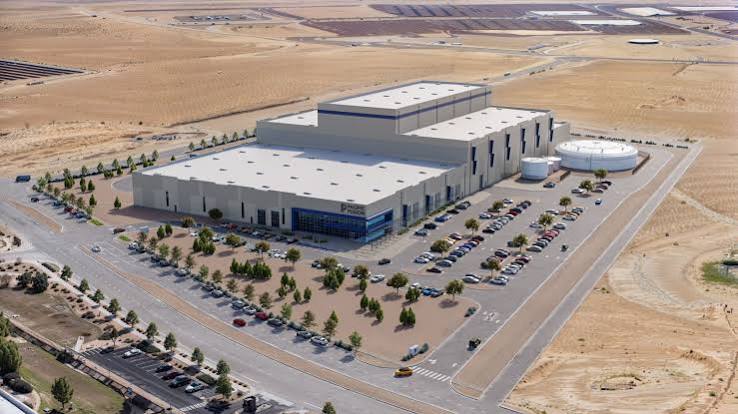
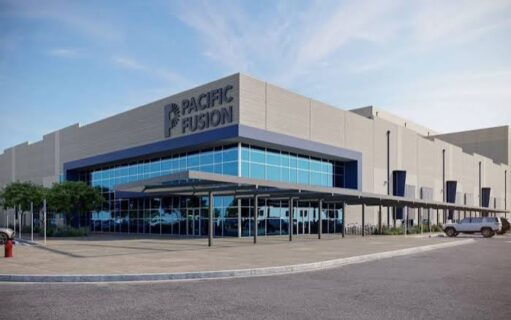
Pacific Fusion has broken ground on a $1 billion research and manufacturing campus in Albuquerque, deepening New Mexico’s role in the company’s push to build a commercially viable fusion-energy system. The roughly 225,000-square-foot campus at Mesa del Sol will house Pacific Fusion’s first Demonstration System, a machine designed to produce more fusion energy than the energy stored in the equipment used to drive the reaction — a milestone known as net facility gain that the company is targeting by 2030.
The facility will handle research, testing and manufacturing; it will not operate as a power plant or supply electricity to the grid. Pacific Fusion expects the project to create more than 200 permanent jobs, plus hundreds of construction and regional supply-chain positions, and says it has raised more than $1 billion in private capital to advance its technology.
“Less than a year ago, we announced that Pacific Fusion had selected New Mexico for this extraordinary investment, and today, construction begins,” Gov. Michelle Lujan Grisham said at Tuesday’s groundbreaking.
Why New Mexico
Pacific Fusion pointed to the state’s long history in pulsed-power research and high-energy-density science, citing proximity to Sandia and Los Alamos national laboratories, a specialized technical workforce and an established advanced-manufacturing base as key factors in the site decision.
The technology behind the campus
Pacific Fusion is pursuing pulser-driven inertial fusion, a method that uses powerful electrical pulses to compress and heat a small deuterium-tritium fuel target until it reaches fusion conditions. The approach builds on decades of work at Sandia National Laboratories’ Z Machine — one of the world’s most powerful pulsed-power research facilities — which relies on brief, high-current electrical pulses to create the extreme temperatures and pressures needed for fusion and high-energy-density experiments.
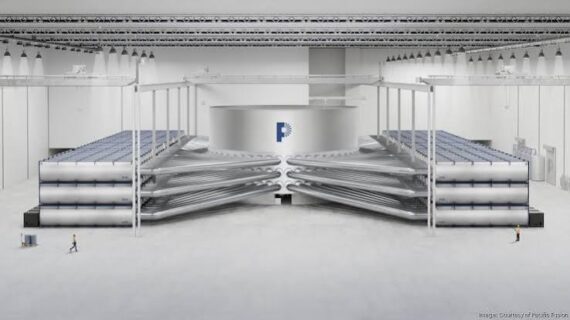
The company plans to scale that approach with modular hardware: its Demonstration System is expected to use 156 pulser modules, each designed to store electrical energy and release it in a controlled burst lasting a fraction of a millionth of a second. General Atomics, which has collaborated with Pacific Fusion on the technology, said each module is designed to deliver about two terawatts of peak power per pulse and described the modules as compact, replaceable units that manufacturers can build and assemble in parallel — an approach meant to address repetition, one of fusion’s central engineering challenges. A commercial system would need to repeat the fusion process reliably, rapidly and affordably while managing the damage each shot causes to components.
Recent test results
Pacific Fusion reported in July that its Sirius pulsed-power prototype had completed more than 3,000 shots through a cooperative research agreement with Lawrence Livermore National Laboratory, delivering 60 gigawatts in a 100-nanosecond pulse at 95% energy efficiency. The company said a larger prototype reached approximately 440 gigawatts of peak output power and 1.1 megavolts in an 80-nanosecond pulse. In February, Pacific Fusion also reported results from four experiments on Sandia’s Z Machine using small aluminum-and-plastic targets designed to generate their own internal magnetic field rather than relying on external coils; each experiment sent about 22 million amps through a target in roughly 120 nanoseconds.
These results mark engineering progress, not commercial fusion power generation. Pacific Fusion still has to show that a much larger system can operate repeatedly and reach net facility gain.
Manufacturing base in Los Lunas
Pacific Fusion is already building its New Mexico manufacturing base in Los Lunas, where a 200,000-square-foot Build Center at Los Morros Business Park is producing components for eventual assembly at Mesa del Sol. The company had hired more than 70 people in New Mexico by the groundbreaking; earlier plans called for about 100 employees at Los Lunas by the end of 2026 and the first 156 modules manufactured by roughly the end of 2027. Pacific Fusion has described Los Lunas as a relatively light manufacturing operation, with no heavy water use and no expected heavy power demand.
Federal involvement
The National Nuclear Security Administration and Pacific Fusion signed a memorandum of understanding Tuesday covering possible collaboration on high-yield fusion, high-energy-density science and related technical areas. The agreement creates a framework for cooperation but does not provide a specific federal funding award; any individual projects or financial commitments would require separate agreements. It reflects the dual-use nature of pulsed-power technology, which can support both fusion research and national-security work, including nuclear stockpile stewardship.
What net facility gain does and doesn’t mean
Fusion is often described as an abundant, carbon-free energy source that doesn’t depend on weather and, unlike fission, doesn’t rely on a self-sustaining chain reaction. But it isn’t free of radioactive materials or engineering risk. Pacific Fusion’s system is expected to use deuterium-tritium fuel; tritium is radioactive, and the high-energy neutrons that deuterium-tritium fusion produces can damage and activate surrounding materials. A future commercial plant would still need to solve fuel recycling, tritium production, component replacement, heat capture and electricity generation.
That’s why net facility gain isn’t the same as net electricity delivered to the grid — a power plant would need to produce more electricity than its pulsed-power equipment, cooling systems, fuel systems and other infrastructure require to operate. Pacific Fusion has pointed to the mid-2030s as its target for an eventual commercial system, contingent on further technical and economic progress. For now, New Mexico’s opportunity from the project is industrial rather than electrical, resting on whether its national laboratories, universities, manufacturers and technical workforce can help build a broader fusion-energy supply chain.
State policy context
Lujan Grisham signed New Mexico’s Energy Transition Act in 2019, setting the state on a path toward a zero-carbon electricity sector, and the state has since expanded its Advanced Energy Equipment Tax Credit to include fusion machines and essential components. Ultimately, the project’s success will hinge less on its investment total or job count than on whether Pacific Fusion can turn laboratory experiments into a reliable, repeatable and economically competitive system capable of eventually producing electricity.
Pacific Fusion’s Albuquerque campus isn’t yet an electricity project — its near-term output is experimental data, pulsed-power hardware and manufacturing capacity. That makes the Los Lunas Build Center as consequential as Mesa del Sol: if Pacific Fusion can manufacture hundreds of complex modules on schedule, it will have solved one of the industrial bottlenecks that has slowed fusion development for decades. The 2030 net-facility-gain target is a corporate objective, not a guaranteed timetable, and even hitting it wouldn’t prove the company has solved the economics of commercial power. The NNSA agreement adds credibility and strategic weight but isn’t a commercial contract or funding guarantee — which leaves New Mexico officials with a continuing obligation to detail public incentives, safety oversight, workforce numbers and measurable economic benefit as the project moves forward.
Pacific Fusion’s investment adds to a broader wave of advanced-technology projects taking shape across New Mexico. In Sandoval County, Castelion is developing Project Ranger, a 1,000-acre hypersonic manufacturing campus designed for solid rocket motor production, testing and final assembly. The project is expected to support about 300 manufacturing jobs and more than $220 million in private investment.
Project Factsheet
- Company: Pacific Fusion, founded in 2023, headquartered in California’s Bay Area
- Project: Research and manufacturing campus at Mesa del Sol, Albuquerque
- Investment: Approximately $1 billion
- Campus size: Approximately 225,000 square feet
- Purpose: Assemble and operate Pacific Fusion’s first Demonstration System
- Power status: Will not operate as a commercial power plant or supply grid electricity
- Technology: Pulser-driven inertial fusion using high-current electrical pulses
- Fuel: Deuterium and tritium
- Demonstration System: Designed around 156 pulser modules
- Company target: Net facility gain by 2030
- Planned employment: 200+ permanent jobs, plus hundreds of construction and supply-chain jobs
- Los Lunas facility: 200,000-square-foot Build Center at Los Morros Business Park
- Los Lunas role: Manufacturing components for the Demonstration System
- Los Lunas employment: 70+ hired by groundbreaking; about 100 planned by end of 2026
- Manufacturing target: First 156 modules by approximately end of 2027
- Recent prototype: Sirius pulsed-power prototype completed 3,000+ shots
- Reported Sirius performance: 60 gigawatts in a 100-nanosecond pulse at 95% efficiency
- Reported larger prototype: 440 gigawatts peak output, 1.1 megavolts in an 80-nanosecond pulse
- Sandia experiments: Four experiments using ~22 million amps in ~120 nanoseconds
- Federal agreement: NNSA-Pacific Fusion MOU on high-yield fusion and high-energy-density science cooperation
- Tax incentives: Advanced Energy Equipment Tax Credit includes fusion machines and components
- Commercial timeline: Mid-2030s target for a commercial fusion system, per Pacific Fusion



Leave a Reply