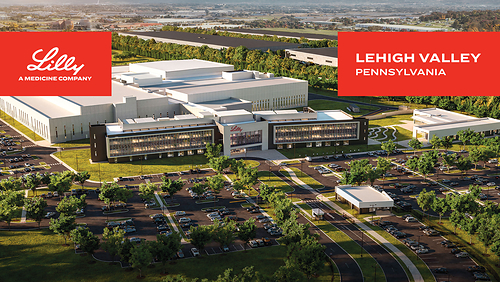
Eli Lilly and Company has broken ground on a $3.5 billion pharmaceutical manufacturing facility in Fogelsville, Pennsylvania, advancing its expansion of U.S. drug production capacity for injectable medicines and next-generation obesity treatments, including its investigational weight-loss drug retatrutide.
The November 12, 2026, groundbreaking marks the start of construction on one of the largest pharmaceutical manufacturing investments in Pennsylvania. Located in Upper Macungie Township in the Lehigh Valley, the approximately 925,000-square-foot facility is expected to become operational by 2031 and create 850 permanent jobs, alongside approximately 2,000 construction jobs.
The investment is part of Lilly’s broader $50 billion commitment to expanding pharmaceutical manufacturing in the United States. The Pennsylvania plant will be one of four new facilities in the company’s expansion program dedicated to injectable medicines and devices, reflecting the growing importance of manufacturing capacity as Lilly advances its obesity and diabetes treatment pipeline.
Retatrutide puts next-generation obesity drugs at the center of the investment
A major focus of the Lehigh Valley facility will be supporting production of next-generation obesity treatments, including retatrutide, Lilly’s investigational triple hormone receptor agonist.
Unlike medicines that target only GLP-1 or a combination of GLP-1 and GIP receptors, retatrutide activates three hormone receptors: glucose-dependent insulinotropic polypeptide (GIP), glucagon-like peptide-1 (GLP-1) and glucagon. This mechanism makes it a distinct candidate in the development of treatments for obesity and related metabolic conditions.
The medicine remains under clinical investigation and has not yet received U.S. regulatory approval. Lilly plans to submit a Biologics License Application to the Food and Drug Administration in the first quarter of 2027.
The company’s decision to invest in additional injectable manufacturing capacity comes as it prepares for the potential commercial expansion of its next-generation obesity medicines. However, Lilly has not disclosed the facility’s planned annual production capacity or the specific share of output that will be allocated to retatrutide.
Lilly Chair and CEO David A. Ricks said the investment will help the company prepare for the growing need for new treatments.
“Obesity is one of the biggest health challenges of our time, and the science to treat it is moving quickly,” Ricks said. “This $3.5 billion investment means we’ll be able to make these medicines in Pennsylvania for people here at home and around the world.”
Pennsylvania backs the $3.5 billion pharmaceutical investment
The groundbreaking advances a project first announced on January 30, 2026, when Lilly and Pennsylvania Governor Josh Shapiro revealed plans for the company’s first manufacturing facility in the Commonwealth.
Pennsylvania committed up to $100 million in economic development support to help secure the investment. The package includes up to $50 million in tax credits through the PA EDGE program, a $25 million PA SITES grant and a $25 million Pennsylvania First grant.
The state also committed up to $5 million through the Redevelopment Assistance Capital Program to support workforce training.
The project will occupy approximately 925,000 square feet across multiple buildings at the Fogelsville Corporate Center, near Interstate 78. Its location provides access to regional transportation infrastructure and the Lehigh Valley’s established industrial and workforce base.
Local development approvals have also progressed. Upper Macungie Township supervisors approved the project’s final land development plan and sewage planning module on September 2, 2026, including traffic mitigation requirements to address additional construction and workforce activity.
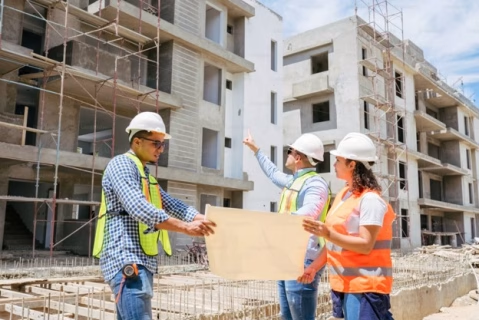
Peak construction activity is anticipated between the fourth quarter of 2027 and the first quarter of 2029, when as many as 1,500 workers could be on site at one time.
AI and automation will shape the new drug manufacturing plant
Lilly plans to integrate artificial intelligence, machine learning, advanced data analytics and digitally connected systems throughout the Pennsylvania facility.
The technologies will support automated manufacturing processes, improve production consistency and strengthen quality control as the company expands its output of injectable medicines and medical devices.
According to Lilly, its existing manufacturing procedures involve more than 5,000 documented steps for each production run, with individual units imaged and inspected more than 70 times. The new facility will build on these quality-control practices through expanded digital automation.
Edgardo Hernandez, Lilly’s executive vice president and president of Manufacturing Operations, said the facility will use next-generation systems to strengthen manufacturing reliability.
“Lehigh Valley will build on that discipline with next-generation automation and digital systems, so we can do things right the first time and help patients count on their medicines for years to come, made in Pennsylvania,” Hernandez said.
The facility is also targeting Leadership in Energy and Environmental Design (LEED) Gold certification, aligning the manufacturing expansion with Lilly’s stated environmental and sustainability commitments.
850 permanent jobs and a $1 million community investment
Once operational, the plant is expected to create 850 high-wage positions, including engineers, scientists, laboratory technicians and manufacturing operations personnel.
Approximately 2,000 construction jobs are also expected as the facility is developed and brought online. Lilly has already begun recruiting for positions in the Lehigh Valley.
The company is also committing up to $1 million over five years to the Upper Macungie Township Community Fund. The funding will support a planned initiative at the Upper Macungie Community Center focused on nutrition, healthy living, access to fresh food, health resources and community programming for local families.
How Pennsylvania fits into Lilly’s wider U.S. manufacturing expansion
The Lehigh Valley investment is one part of Lilly’s broader effort to expand domestic pharmaceutical production. Since 2020, the company has announced 10 new U.S. manufacturing sites, covering active pharmaceutical ingredients, injectable medicines and devices, and genetic medicines.
Another major investment is the company’s $6.5 billion pharmaceutical manufacturing facility at Generation Park in Houston, Texas. Lilly broke ground on that project in September 2026, with the site expected to manufacture active pharmaceutical ingredients for small-molecule medicines, including its oral GLP-1 treatment Foundayo (orforglipron). The Houston development is expected to create more than 600 permanent jobs and approximately 4,000 construction jobs, with operations targeted for 2030. While the Houston facility will strengthen production of drug ingredients, the new Pennsylvania plant will expand capacity for injectable medicines and devices, giving Lilly complementary manufacturing capabilities across two major U.S. investments.
With construction now underway in the Lehigh Valley, Lilly is advancing another major component of its domestic manufacturing strategy. The facility’s expected 2031 opening will position it to support the company’s expanding injectable medicine portfolio as demand for obesity and metabolic disease treatments continues to shape pharmaceutical manufacturing investment.
Project Factsheet: Eli Lilly Pennsylvania manufacturing Facility
- Project: Eli Lilly Lehigh Valley Manufacturing Facility
- Developer/Owner: Eli Lilly and Company
- Investment: $3.5 billion
- Location: Fogelsville, Upper Macungie Township, Lehigh County, Pennsylvania
- Facility size: Approximately 925,000 square feet
- Project scope: Injectable medicines and medical devices manufacturing
- Planned medicines: Next-generation obesity treatments, including investigational retatrutide
- Permanent jobs: 850
- Construction jobs: Approximately 2,000
- Peak construction period: Q4 2027–Q1 2029
- Pennsylvania economic development support: Up to $100 million
- Community commitment: Up to $1 million over five years
- Groundbreaking: November 12, 2026
- Expected operational date: 2031


Leave a Reply