Constructionreview

Blog

  • Pacific Coast Intermodal Port Project in Oregon receives US$100m for construction

    Pacific Coast Intermodal Port Project in Oregon receives US$100m for construction

    The Oregon Legislature has approved $100 million in state funding for the Pacific Coast Intermodal Port, a transformative public-private initiative that will establish a modern container terminal at the Oregon International Port of Coos Bay. The announcement was made recently by port officials, marking a significant milestone for the long-anticipated infrastructure project.

    A similar rail project aiming to boost efficiency in the transfer of containers is the upgrade to  the Port of Long Beach as part of a transformative rail expansion aimed at boosting freight efficiency and reducing environmental impact.

    Pacific Coast Intermodal Port capacity

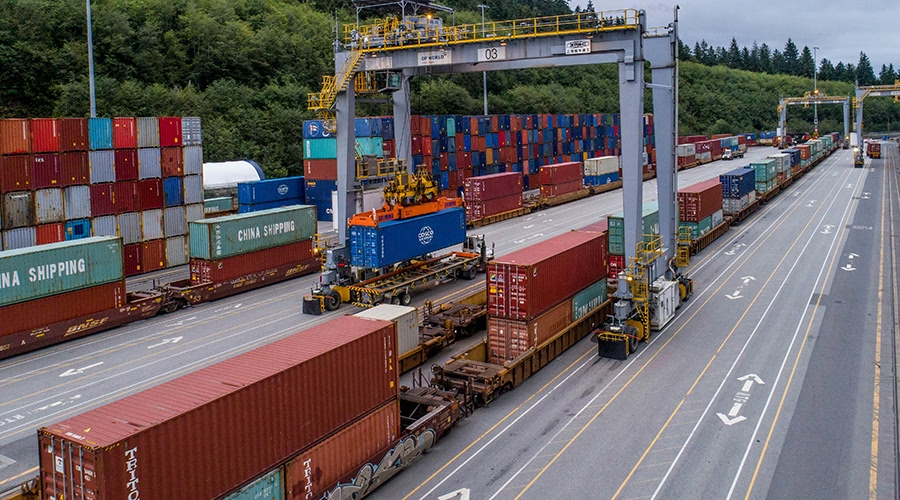
    The planned terminal is set to offer berths for two container ships and will initially handle 1.2 million twenty-foot equivalent units (TEUs)—equivalent to about 800,000 containers—annually, with scalable capacity up to 2 million TEUs. This major investment aims to enhance Oregon’s role in international trade while creating a direct ship-to-rail connection linking the southwestern coast to inland U.S. markets.

    In addition to the newly approved state funding, the project has already secured $58 million from U.S. Department of Transportation grant programs, underlining strong federal support for the port’s development.

    “This project will unlock critical supply chain potential not just for Oregon, but for the broader western United States,” said port officials in a statement. “It’s the first new container terminal on the U.S. West Coast in decades and a major step forward for trade efficiency and sustainability.”

    Location of the Port

    The terminal’s location on the Coos Bay Rail Line offers a strategic advantage. Containers will be transferred directly to rail and transported inland via a Union Pacific Railroad connection in Eugene, creating a seamless logistics link to the Midwest and beyond.

    Port leaders emphasized that the new terminal will support multiple sectors, including agriculture in the Willamette Valley, manufacturing in the Columbia Gorge, and a wide range of exporters across the Pacific Northwest.

    Beyond domestic benefits, Coos Bay’s proximity to East Asian ports could position it as a faster and more environmentally friendly alternative to existing West Coast ports. The shorter ocean routes are expected to reduce shipping time and cost while lowering greenhouse gas emissions.

    Construction on the terminal is expected to begin once environmental reviews and permitting are completed. Upon completion, the Pacific Coast Intermodal Port will serve as a vital hub in modernizing America’s maritime infrastructure and boosting global competitiveness.

    Also Read: Houston Ship Channel Project 11 expansion Secures $131 Million Boost

    Summary:

    • Oregon Legislature approves $100 million for the Pacific Coast Intermodal Port project in Coos Bay.
    • Terminal will initially handle 1.2 million TEUs annually, with future capacity up to 2 million TEUs.
    • Project includes a direct ship-to-rail connection via the Coos Bay Rail Line and Union Pacific link in Eugene.
    • Supported by an additional $58 million in federal transportation grants.
    • First new container terminal on the U.S. West Coast in decades, aimed at increasing shipping capacity.
    • Will benefit agriculture, manufacturing, and export sectors across Oregon and the western U.S.
    • Shorter shipping route from East Asia could reduce costs, transit time, and carbon emissions.
    • Construction to begin after environmental approvals are completed.
  • Modular Data Center Construction

    Modular Data Center Construction

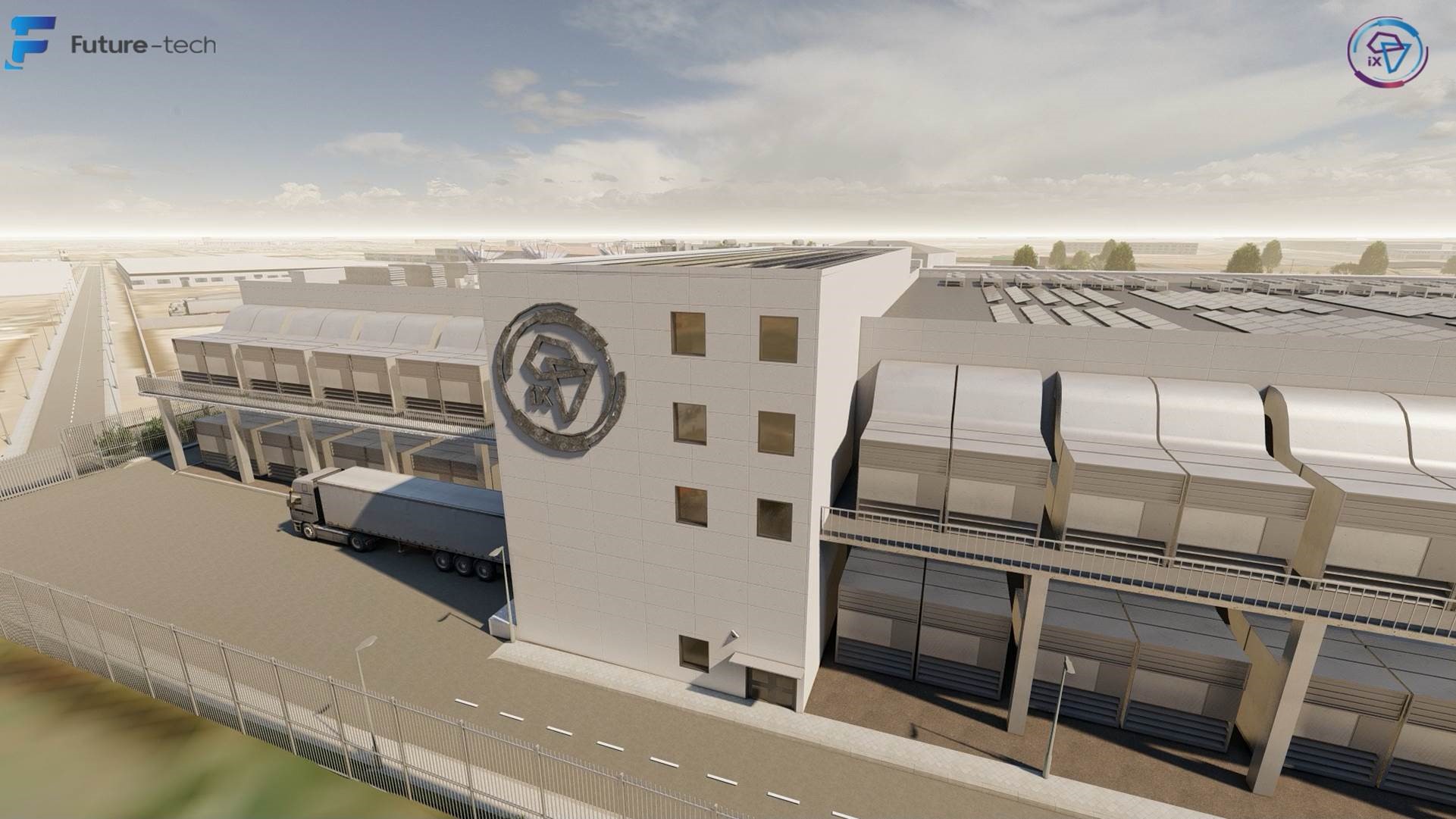
    As global demand for data processing and storage accelerates, the traditional approach to building data centers is evolving. Enter modular data center construction—a method that offers faster deployment, easier scalability, and better cost control. In an industry where time-to-market and operational efficiency are critical, modular designs are increasingly becoming the go-to solution for both hyperscale developers and enterprise clients.

    What Is a Modular Data Center?

    A modular data center is built using prefabricated modules or components that are manufactured off-site and assembled quickly on location. These modules can include power units, cooling systems, server rooms, and security infrastructure. Each module is designed to integrate seamlessly into the broader data center ecosystem, allowing for a plug-and-play style of deployment.

    This approach contrasts with traditional data center construction, which is typically site-built from the ground up over months—or even years—of planning and construction. Modular systems significantly reduce that timeline.

    Speed: Cutting Build Time Dramatically

    One of the most attractive features of modular data centers is speed. Because much of the infrastructure is pre-engineered and built in parallel with site preparation, deployment can take just a few months instead of a year or more.

    For cloud providers and content delivery networks, this means faster go-live dates and the ability to respond quickly to shifting market needs. In regions experiencing sudden spikes in digital demand—such as emerging markets or cities adding 5G coverage—modular solutions allow companies to scale infrastructure rapidly.

    Scalability: Grow As You Go

    Traditional data centers often require massive up-front investments and fixed capacity planning. With modular systems, operators can start small and expand incrementally as demand increases.

    This is especially important in edge computing, where smaller-scale facilities are needed closer to end users to reduce latency. A company can deploy a single module at an edge location and then add additional modules as traffic grows, avoiding overbuilding and optimizing operational costs.

    Even the world’s first underwater data center to be located in Shanghai’s Lin-gang Special Area and powered entirely by offshore wind energy will host modular computing units cooled directly by seawater.

    Cost Advantages and Predictability

    Prefabricated modules offer greater cost predictability. Because components are standardized and produced in a controlled factory environment, there is less room for delays, budget overruns, or design inconsistencies.

    Additionally, modular builds often require fewer workers on-site and shorter construction timelines, leading to reduced labor costs and permitting expenses. Standardized builds can also reduce maintenance complexity and downtime, translating into long-term operational savings.

    A Fit for Sustainability Goals

    Many modular data centers are designed with energy efficiency in mind. Integrated cooling systems, renewable-ready power modules, and optimized airflow design all contribute to a reduced carbon footprint. Some modular builds are even designed to be relocated or repurposed, offering flexibility that aligns with circular economy principles.

    The Road Ahead

    Modular construction is no longer a niche strategy—it’s quickly becoming a standard in modern data center development. Whether supporting a hyperscale provider expanding globally or a telecom company building edge infrastructure, the modular approach delivers unmatched flexibility, speed, and cost-effectiveness. As digital demand continues to climb, modular data centers will play a central role in building the internet’s physical backbone.

    Examples of modular data centers currently under construction:

    Meta’s Jeffersonville, Indiana Facility


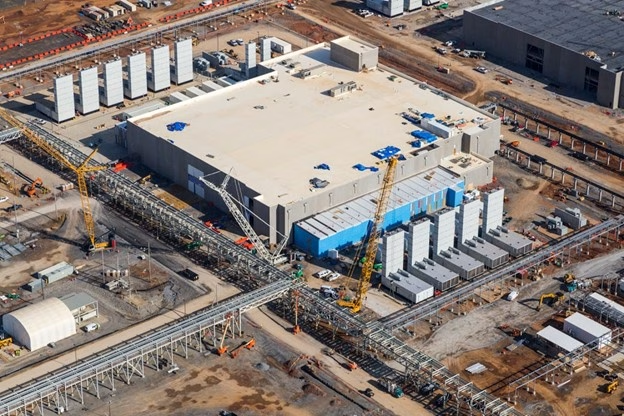
    In January 2024, Meta broke ground on a nearly 700,000‑square‑foot data center in Jeffersonville, Indiana, which is being assembled using prefabricated modular components. Each module—complete with power, cooling, and IT racks—is manufactured off‑site and “plugged in” on location, dramatically reducing construction time and complexity.

    K2 Strategic’s Johor, Malaysia Campus


    Singapore‑based K2 Strategic deployed two 40 MW modular buildings in Johor, Malaysia, using a fully containerized design. Each module arrived as a self‑contained unit—complete with chilled‑water cooling, power distribution, and server racks—and was commissioned on site in just nine months, earning the project DCD’s 2025 Editor’s Choice Award for its speed and technical ingenuity.

    Eviden’s Jupiter Exascale Data Center in Jülich, Germany


    To host Europe’s first exascale supercomputer, Eviden is erecting a turnkey modular data center built from around 50 pre‑built modules. These include 20 IT container units, 15 power‑feed containers, and 10 logistics modules, all integrated into a single 2,300 m² facility—allowing rapid on‑site assembly and future scalability.

    Meta’s Cheyenne, Wyoming Build


    Also part of Meta’s 2025 rollout, the Cheyenne, Wyoming campus (over 700,000 sq ft) is using modular assemblies to streamline construction and ensure consistent quality across power, cooling, and server halls. The project, by Fortis Construction, is expected to be operational in 2026.

    Each of these projects demonstrates how modular construction—whether via fully containerized modules or factory‑built structural units—can slash deployment timelines, improve cost predictability, and simplify future expansions.

  • All You Need to Know About Egypt’s Gulf of Suez Wind Farm II, Africa’s Largest Wind Power Plant

    All You Need to Know About Egypt’s Gulf of Suez Wind Farm II, Africa’s Largest Wind Power Plant

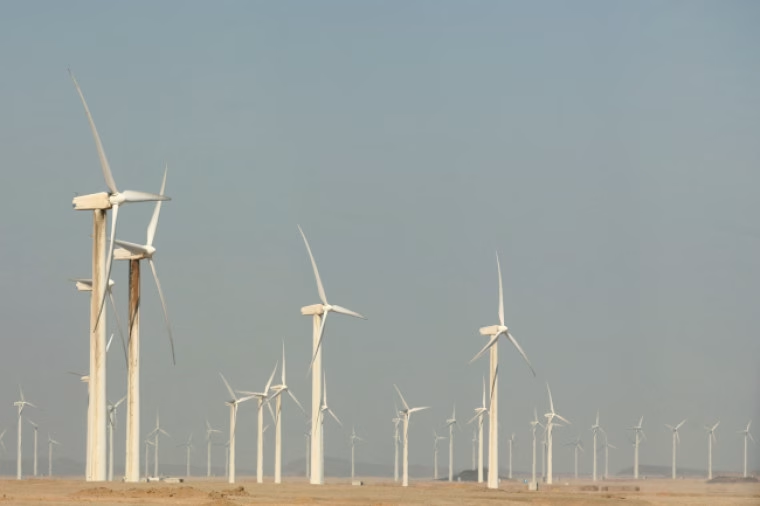
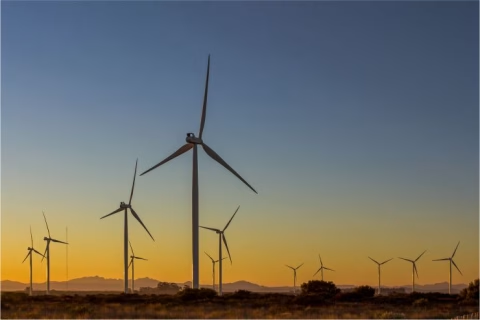
    The Gulf of Suez Wind Farm II with a capacity of 650 MW is Africa’s largest wind power plant built in the Arab Republic of Egypt. The wind farm was completed and kicked off commercial operation on June 30, 2025.

    The wind power plant is located in the Gulf of El Zayt along the Gulf of Suez. Furthermore, the Gulf of Suez Wind Farm II has a total of 84 wind turbines each with a capacity of 6.0 MW each and 20 wind turbines with a capacity of 7.5 MW each. Additionally, the latter are the largest-class onshore wind turbines in the world.

    Gulf of Suez Wind Farm II in Egypt commenced commercial operations and was commissioned on June 30, 2025. The project is a gigantic project with a total capacity of 650 MW. Moreover, it is the largest functional wind power facility in Africa and the Middle East. The project, which is owned by Red Sea Wind Energy (consortium of Eurus Energy, Toyota Tsusho, Engie, and Orascom Construction), was commissioned ahead of schedule.

    Apart from the Suez II Wind Farm, Egypt has a vibrant pipeline of renewable energy projects coming up such as Infinity Power’s solar-battery project. The project is expected to produce 1,200 MW once complete and is is estimated will cost $1 billion. Another notable one is the Infinity Power’s 200 MW Wind Project in Ras Ghareb that is set to commence construction in September 2025.

    Also read: Siemens Gamesa Signs Agreement for Establishing 500MW Gulf of Suez Wind Power Project

    Gulf of Suez Wind Farm II
    The winf farm with a capacity of 650 MW is Africa’s largest wind power plant built in the Arab Republic of Egypt.

    Project Factsheet

    Project name: Gulf of Suez Wind Farm II. Also, it is referred to as Gulf of Suez 2 Wind Farm or Red Sea Wind Energy.

    Location: Gulf of Suez, near Ras Ghareb, Red Sea Governorate, Egypt.

    Capacity: 650MW

    Number of turbines: The 650 MW project is comprises of 104 wind turbines. 84 for the initial 500 MW and 20 for the 150 MW extension.

    Cost: $790 million

    Developers: Toyota Tsusho Corporation, Eurus Energy Holdings Corporation, ENGIE, and Orascom Construction

    Also read: Africa’s largest solar photovoltaic farm Obelisk solar project in Egypt to receive US$184m

    Operator of the Gulf of Suez Wind Farm II

    The sole operator of Gulf of Suez Wind Farm II is Red Sea Wind Energy S.A.E. This is a local operating company that has investments from Eurus Energy, Toyota Tsusho, France-based independent power producer Engie S.A., and Egyptian construction company Orascom Construction PLC.

    Also read: Why Battery Storage is Becoming Essential for Solar and Wind Projects

    Significance of the Project

    The generated electricity from the wind power plant will be supplied to the Egyptian Electricity Transmission Company under a 25-year power purchase agreement. Additionally, the wind project will provide electricity that is equivalent to the power consumption of approximately 1,100,000 Egyptian households. Also, it is expected to cut CO2 emissions by approximately 1,450,000 tons annually.

    Also read: AMEA Power Commissions Amunet Wind Power Plant Project in Egypt, Africa’s Largest Wind Power Plant

  • UK’s Biggest EV Battery Plant Construction Project in Somerset

    UK’s Biggest EV Battery Plant Construction Project in Somerset

    Updated September 11, 2025- The Somerset Battery EV plant is a landmark industrial project spearheaded by Agratas which is a subsidiary of the Tata Group. The project is expected to become UK’s Biggest EV Battery Plant. Additionally the project has a planned annual capacity of 40 GWh. It will produce sustainable battery cells and packs for electric vehicles, primarily serving Jaguar Land Rover while also supplying other manufacturers. The project is a cornerstone of the UK’s EV transition.

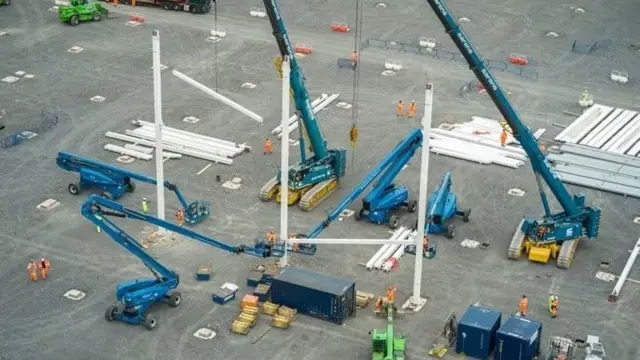
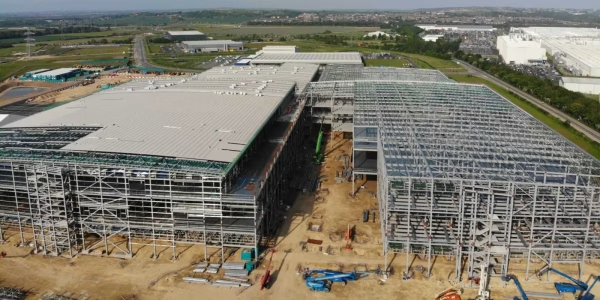
    Earlier, developers behind the UK’s biggest electric vehicle (EV) battery plant said they had reached a “major milestone” in its construction. The first steel frames on the site at Puriton in Somerset are now in place. Agratas, Tata Group’s global battery business, is investing £4bn in the former Royal Ordnance Factory site just off junction 23 of the M5. The construction of the EV battery plant is expected to take two years. Moreover, 500 people are expected on site by the end of 2025.

    The number is expected to go up to 2,000 in 2026. The company said the steel structure was being erected in phases, with the build beginning at the north of the site. Moreover, they noted it is the start of a more visible construction work on the site and comes after 17,000 piles were driven down into the ground to stabilize the building’s foundations. Agratas said all the steel used for the build was being sourced from British suppliers.

    Also read:

    UK Approves 140 MW Oaklands Farm Solar Park in South Derbyshire

    The Scope of Implementation on UK’s Biggest EV Battery Plant

    The scope of implementation on UK’s biggest EV battery plant is one that is expected to revolutionary. Earl Wiggins, vice president of manufacturing operations at Agratas, said it was “a proud moment.” “It is the start of a new chapter where our vision for a world-leading facility starts to visibly take shape,” Mr Wiggins said. The company has promised to use sound-reduced equipment, electric plant if possible. Moreover, they noted that no cutting or grinding works will take place on Sundays.

    UK’s Biggest EV Battery Plant
    Bosses behind the UK’s biggest electric vehicle (EV) battery plant said they had reached a “major milestone” in its construction.

    The aim is to try and minimize the impact on local residents. Bosses revealed in April that the main building will now be 84 metres (279 ft) shorter than originally proposed. Moreover, the first factory building will not open until 2027, a year later than previously anticipated. Agratas said 1,500 operational jobs would be created when it opens in 2027, with 4,000 jobs on offer once they expand across the whole site.

    Similar Projects

    In another similar battery project, Fidra Energy has secured funding for the Thorpe Marsh BESS Project. This battery battery will stand as the largest in UK and among Europe’s largest. Furthermore, this BESS project is of significance as it will provide power to many homes in the UK.

    Also read:

    £500 Million Investment Planned for UK’s First Regional Hydrogen Transport and Storage Network

    Balfour Beatty awarded £833 million contract for NetZero Teesside Power Plant

  • Data Center Construction Projects Are Springing Up in Africa, The New Frontier

    Data Center Construction Projects Are Springing Up in Africa, The New Frontier

    As global demand for digital infrastructure grows, Africa is fast becoming a promising frontier for data center development. The continent, long underserved in terms of digital infrastructure, is now seeing a surge in data center investments driven by rising internet penetration, mobile adoption, cloud services demand, and favorable regulatory reforms.

    “Africa accounts for less than 1% of the world’s data centre capacity even as mobile data usage grows by around 40% annually – nearly double the global average,” said the report, highlighting a massive infrastructure gap that the new build-outs aim to close”

    This quote from a Reuters report underscores the urgent need for digital infrastructure on the continent, with mobile data traffic surging yet hosting capacity still lagging far behind.

    The Digital Surge

    Over the past decade, Africa’s digital landscape has transformed dramatically. The number of internet users has grown exponentially, powered by affordable smartphones, improved connectivity, and undersea cable expansions such as Equiano, 2Africa, and PEACE. This has triggered demand for local content hosting, cloud computing, and enterprise services – all of which require robust data center infrastructure.

    Multinational tech giants like Microsoft, Google, Amazon Web Services, and Huawei have recognized the region’s potential. Microsoft Azure opened data centers in South Africa as early as 2019, and AWS followed suit with its Cape Town region. More recently, Google has announced plans for cloud regions across the continent, including Kenya and Nigeria.

    Nigeria will also soon open Equinix’s LG3 data center in Lagos. The US$22 million facility is part of the American multinational company’s US$100 million digital infrastructure investment in Africa. Morocco has also partnered with American tech firm, Iozera to build a cutting edge 386MW data center and AI hub that will be located in the city of Tetouan.

    Data Center construction projects are springing up in Africa the new frontier
    Africa is no longer just consuming digital content, it is also becoming a hub for storing and distributing it.

    Rising Local and Regional Players for Data Center Projects in Africa

    While global corporations bring in capital and expertise, African companies are also emerging as significant players in the data center space. Liquid Intelligent Technologies (formerly Liquid Telecom) operates several Tier III data centers across countries like South Africa, Kenya, and Zimbabwe. Africa Data Centres, a subsidiary of Cassava Technologies, is also rapidly expanding its footprint, targeting over 10 countries in the coming years.

    Nigeria

    Airtel Data Center in Nigeria

    Airtel Nigeria has revealed that it will be investing  $120million in building its data centre in the country. The data centre will become the largest in the country after its completion with a capacity of 38 megawatts.

    In Nigeria, MainOne (acquired by Equinix) has become a key player, while Raxio Group is developing facilities in Uganda, Ethiopia, Mozambique, and the Democratic Republic of Congo.

    Sifiso Dabengwa Data Center

    MTN Nigeria launched Sifiso Dabengwa Data Centre, West Africa’s Largest Tier III Data Centre. Roger Shutte who is MTN Nigeria’s General Manager for Infrastructure, revealed to the press during a briefing that the facility will be scaling up to 14 or even 20 megawatts. This, Roger said, will depend on future demand.

    Nigeria Visa Data Center

    Visa is also eyeing a piece of the cake in Nigeria and announced plans to invest in a Visa data center in the country. This was during a visit by the Regional President of Visa for Central and Eastern Europe, the Middle East, and Africa (CEMEA), Mr Andrew Torre.

    South Africa

    Teraco, a Digital Realty company and Africa’s largest interconnection hub, has recently completed the expansion of its JB4 Bredell Campus data centre in Ekurhuleni, Johannesburg. The JB4 Africa now becomes largest standalone data centre, with 50MW of critical IT power.  South Africa’s role as sub-Saharan Africa’s technology hub is unquestionable.

    Kenya

    Konza Technopolis Data Center

    The Kenyan government said last year that it was setting aside KSh5.2 billion for the construction of a new data center in Konza Technopolis, a new Smart City being constructed outside the capital Nairobi.

    Data Center construction projects are springing up in Africa the new frontier
    Konza Technopolis Data Center

    Airtel Plans Data Center

    Airtel Africa reported that the company plans to build a new data center in Nairobi, Kenya, marking its second facility in Africa after Nigeria. The telecommunications company also recently held a ground breaking ceremony for the $150 million, 44 MW data center project located in Tatu City, a suburb of Nairobi. Airtel’s new data center in Nairobi expects commissioning at the beginning of 2027.

    Ethiopia

    BitCluster Data Center Ethiopia

    Early last year, BitCluster became the first Russian company to open a data center in Ethiopia, rated at 120 MW capacity. The data center is located in the Ethiopian capital of Addis Ababa and covers a total area of 30,000 square meters.

    Why Africa? Why Now?

    Several key factors are accelerating this growth:

    • Population and Market Size: Africa is home to over 1.4 billion people. It is also home to the world’s youngest and fastest-growing population.
    • Digital Transformation: Governments and enterprises are digitizing services. This is driving demand for cloud infrastructure.
    • Data Sovereignty Laws: More African countries are introducing regulations that require local data storage, boosting the need for more in-country data centers.
    • Green Energy Potential: Countries like Kenya, South Africa, and Ethiopia offer access to renewable energy, which is essential for sustainable data center operations.

    Challenges Faced by Data Center Projects in Africa

    Despite the momentum, Africa’s data center boom faces several hurdles. Power reliability remains a critical issue, particularly in countries with unstable electricity grids. High construction and operational costs, limited technical talent, and regulatory bottlenecks can also slow progress. However, increasing collaboration between governments, investors, and developers is helping mitigate these issues.

    The Road Ahead for Africa Data Center Projects

    Africa’s data center market is expected to grow at a compound annual rate of over 12% through 2028, according to industry analysts. With the right mix of investment, policy, and innovation, the continent could advance past traditional stages of digital development and become a critical node in the global data economy.

    From Lagos to Nairobi and Cape Town to Kigali, the rise of data centers in Africa continues to signal the technological shift reshaping the continent’s economic future. Wholesomely, Africa is no longer just consuming digital content, it is also becoming a hub for storing and distributing it.

  • The World’s Largest Airport, King Salman International Airport, Sets Terminal Tender Deadline

    The World’s Largest Airport, King Salman International Airport, Sets Terminal Tender Deadline

    The world’s largest airport, King Salman international airport, has already issued a tender deadline for some of its works. King Salman International Airport Development Company (KSIADC) has allowed firms until 9 July to submit proposals. The proposals are for a contract to develop the first phase of the airport’s Terminal 6. Furthermore, it also covers the Iconic Terminal at King Salman international airport (KSIA) in Riyadh. The tender notice was issued on 17 April as KSIADC plans to deliver the package on an early contractor involvement (ECI) basis.

    The company is backed by the Saudi sovereign wealth vehicle the Public Investment Fund. The ECI process requires selected contractors to submit methodologies for the project and a design proposal. In May, US firm Bechtel Corporation had been appointed as the delivery partner for he terminals at KSIA. Bechtel will manage the delivery of three new terminals, including the terminal for commercial carriers. It also includes Terminal 6 for low-cost carriers and a new private aviation terminal with hangars.

    The entire scheme is divided into eight assets. These are:

    • Iconic Terminal
    • Terminal 6
    • Private aviation terminal
    • Central runway and temporary apron
    • Hangars
    • Landside transport
    • Cargo buildings
    • Real estate

    Also read:

    Firms Prepare Runway Bids for the World’s Largest Airport Project, King Salman International Airport

    The Project Scale on the King Salman International Airport

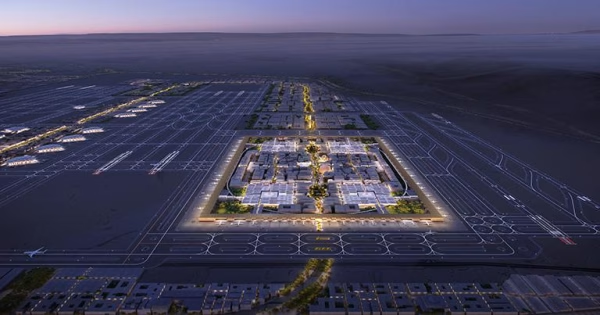
    The project scale of the airport covers an area of about 57 square kilometers (sq. km). As the world’s largest airport will allow for six parallel runways and will include the existing terminals at the airport. Furthermore, it will include 12 sq. km of airport support facilities, residential and recreational facilities, retail outlets and other logistics real estate. If the project is completed on time in 2030, it will become the world’s largest operating airport in terms of passenger capacity.

    King Salman International Airport
    The project scale of the airport covers an area of about 57 square kilometers (sq. km).

    The airport aims to accommodate up to 120 million passengers by 2030. Furthermore, it will include 185 million by 2050 with the goal for cargo is to process 3.5 million tonnes a year by 2050. Saudi Arabia plans to invest $100bn in its aviation sector. Riyadh’s Saudi Aviation Strategy, announced by the General Authority of Civil Aviation, aims to triple Saudi Arabia’s annual passenger traffic to 330 million travelers by 2030. It also aims to increase air cargo traffic to 4.5 million tonnes and raise the country’s total air connections to more than 250 destinations.

    Also read:

    World’s Largest King Salman International Airport Latest Project Update

    Bechtel Signs Agreement for Delivery Partner Role for Three New Terminals at King Salman International Airport, World’s Largest Airport Project