Constructionreview

Blog

  • Hunts Point Marine Terminal: Modernizing Freight and the Bronx Waterfront

    Hunts Point Marine Terminal: Modernizing Freight and the Bronx Waterfront

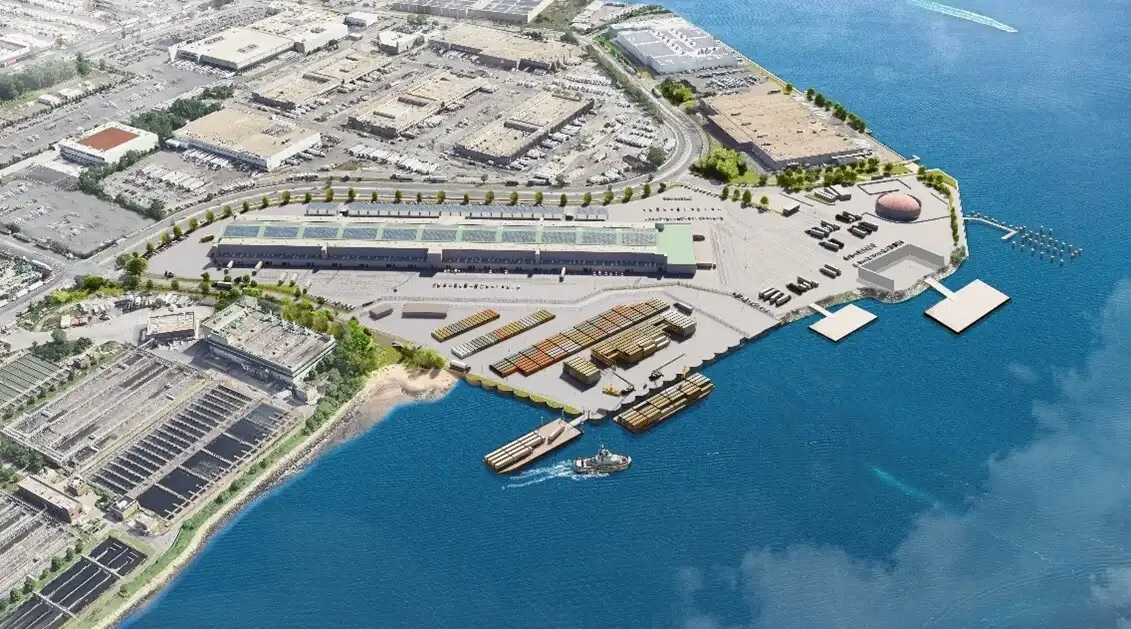
    A new Hunts Point Marine Terminal will be built in the South Bronx on the site of the former Vernon C. Bain Correctional Center, a decommissioned jail barge. The project, announced in June 2025 by New York City Mayor Eric Adams and the NYC Economic Development Corporation (NYCEDC), is part of the city’s “Harbor of the Future” initiative, which includes the recently announced $3.5 billion Brooklyn Marine Terminal redevelopment. The new terminal will expand water-based freight movement, reduce truck traffic, and boost economic activity.

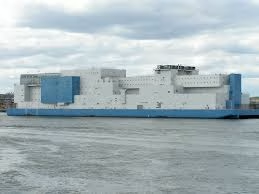
    The Bain Center, better known as “The Boat,” has been moored off the Bronx coast since 1992, originally towed in to provide relief from Rikers Island crowding. It was officially decommissioned in 2023. The new announcement marks the end of an era for the controversial jail complex and the beginning of a new chapter focused on business, sustainability, and community investment.

    Today, we are adding another destination to that harbor by clearing out the old jail barge in the Bronx and building a new Hunts Point Marine Terminal in its place,” Mayor Adams announced at a press conference in front of the barge.

    The new marine terminal will be a freight transfer point, where goods arriving by ship will be unloaded and redistributed throughout the five boroughs using cleaner modes of transportation. The project will remove an estimated 9,000 truck trips per month from city streets, according to city officials, which will alleviate traffic congestion and pollution — two perennial issues in Hunts Point.

    “This is a brand new concept for how we move goods around the city,” said Andrew Kimball, President of the NYC Economic Development Corporation (EDC).

    Projected Economic Impact

    The economic and health benefits are also profound. The project, the City Hall says, will generate 400 construction jobs, 100 permanent jobs, and nearly $4 billion in economic benefit over 30 years. Authorities say reduced diesel emissions from trucks could also mean improved respiratory health for residents, especially in a community where asthma rates still rank among the country’s highest.

    “Shutting down the jail barge is not only about reducing jail capacity — it’s about healing a painful legacy and advancing environmental justice for communities that have long borne the weight of carceral infrastructure,” said Stanley Richards, President and CEO of the Fortune Society.

    This is about investing in and empowering the people of Hunts Point and the Bronx,” said Deputy Mayor for Housing, Economic Development, and Workforce Adolfo Carrión Jr., a former Bronx Borough President.

    Read also: Chobani Announces US$1.2 Billion Yogurt Plant in Rome, New York

    Political victory

    The announcement is also a personal and political victory for Bronx Council Member Rafael Salamanca Jr., a long-time supporter of removing the barge. This is a game-changer economically,” said Salamanca. “The barge has been an eyesore on the Bronx waterfront since the early 1990s. Previous administrations made the promise to eliminate it but never came through. Mayor Adams made that promise to me on the campaign trail — and he came through.”.

    The NYC EDC ensured that they would issue a Request for Proposals (RFP) soon to find a company to oversee the green disposal of the huge 800-bed barge. Kimball estimated that removal would occur within 60 to 90 days.

    Marine terminal design work has already begun and should finish by around 2030 or 2031, aligning with the development timeline of other significant freight infrastructure projects, such as the $3.7 billion redevelopment of the Brooklyn Marine Terminal, which also received a $164 million federal grant and $18 million in city upgrades.
    Read also: Arkansas Pushes Ahead with Controversial 3,000-Bed Prison Project Amid Funding and Community Backlash

    Hunts Point Marine Terminal: Modernizing Freight and the Bronx Waterfront
    Hunts Point Marine Terminal: Modernizing Freight and the Bronx Waterfront

    Broader investment in Hunts Point

    As part of its broader investment in Hunts Point’s future, EDC also announced $1.4 million in funding to establish an Economic Mobility Network. The initiative will connect Bronx residents with green economy jobs and jobs at the Food Distribution Center in partnership with local community-based organizations, including The Point CDC, Rocking the Boat, and the Bronx River Alliance.

    In another effort to increase access and livability along the Bronx waterfront, the city will invest over $28 million to extend bike paths along the whole stretch.

    The announcement was also met with approval from activists who push for the total closure of Rikers Island.

    “Just like Rikers, the Boat has facilitated mass incarceration and dehumanization,” said Darren Mack, Co-Director of Freedom Agenda. “Today’s announcement represents a victory for all of our members who suffered harm from it and raised their voices to call for its shutdown. Eric Adams still has time to make good on his previous promises.”

    As the Vernon C. Bain Center is soon to be a memory, the city officials assert that the rebirth of Hunts Point as a hub of contemporary freight movement, green industry, and community development is finally within reach.

    Read also: New York City lays out plans for the largest mass timber residential project on Staten Island

    Hunts Point Marine Terminal Project Factsheet

    Project Overview

    Location: Hunts Point, South Bronx waterfront

    Timeline: Design completion by 2030-2031

    Barge Removal: 60-90 days from contractor selection

    Economic Impact

    Jobs Created: 400 construction jobs + 100 permanent positions

    Economic Benefit: Nearly $4 billion over 30 years

    Additional Investment: $1.4 million for Economic Mobility Network

    Reduced truck traffic: The new terminal will function as a logistics hub, moving cargo with barges and ferries to complete “last-mile delivery” in the five boroughs. This will eliminate up to 9,000 truck trips each month, reducing emissions and improving air quality for the Hunts Point community.

    Community investment: Beyond the terminal, the city is investing $28 million to expand waterfront access and improve the Greenway for local residents.

    Part of a larger strategy: The Hunts Point terminal is a component of the city’s broader “Blue Highways” initiative, which promotes freight transport by water to reduce road congestion.

    Read also: Greenbacker Begins Construction on New York’s Largest Solar Farm

  • Ethiopia Reaches 95% Completion on its New Naval Headquarters with Russian Support

    Ethiopia Reaches 95% Completion on its New Naval Headquarters with Russian Support

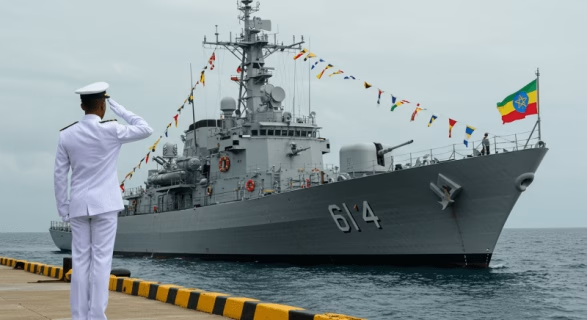
    Ethiopia’s new naval headquarters based in Addis Ababa’s Janmeda area is taking shape as it attains 95% completion. The 3-hectare site boasts a four-story complex that is expected to house facilities such as administrative offices. Furthermore, a medical clinic, meeting halls, sports facilities and other support infrastructure are accounted for in the project. Officials have noted that the project is on track and completion expectations are as scheduled. The project’s aim aligns with Ethiopia’s broader strategy to reassert itself as a regional power in the Horn of Africa. Despite being a landlocked country since Eritrea’s independence in 1993, Ethiopia has sought to improve its maritime capabilities. The construction of a naval headquarters advance this aim as it improves the nation’s capabilities to safeguard trade routes. Furthermore, it ensures the nation is able to respond to global maritime threats and ensure access to international waters via allied ports in Djibouti and Sudan.

    Also read:

    Ethiopia Relaunches $445M Plan for Sub-Saharan Africa’s Tallest Tower

    The Scope of Implementation on Ethiopia’s New Naval Headquarters

    Ethiopia’s New Naval Headquarters
    Ethiopia’s new naval headquarters based in Addis Ababa’s Janmeda area is taking shape as it attains 95% completion.

    The scope of implementation on Ethiopia’s new naval headquarters follows a cooperation agreement signed between Russia and Ethiopia on March 2025. Russia’s government pledged to support Ethiopia in its naval development and training. The creation of a naval headquarter in the country underscores this commitment as part of the Russo-Ethiopian partnership. The implementation of the project comes at the backdrop of increasing Russian military presence on the continent. Other than Ethiopia, Moscow has been expanding its presence in countries like Mali. Once operational, the naval base will increase Ethiopia’s power in the defense and foreign policy realms. Historically, Ethiopia used to have a navy until 1993, and it enjoyed access to the Red Sea via Eritrea. But now that it lost its coast, the country has relied so much on the Port of Djibouti to perform sea commerce. The current undertaking represents a shift towards recreating lost capabilities of a far-distant past and adapting to the new regional security context.

    Also read:

    Ethiopian Teachers Association starts construction of multi-storey building

    Newly built Ethiopian Embassy building in Ankara inaugurated

  • Construction Begins on African Development Bank Group Country Office in Zambia

    Construction Begins on African Development Bank Group Country Office in Zambia

    The African Development Bank Group has officially launched construction of its Zambia office in Lusaka, marking a major milestone in its 54-year relationship with Zambia. The African Development Bank Zambia office construction project began with a groundbreaking ceremony on Friday, attended by top government officials, diplomats, development partners, and private sector leaders.

    Growing Presence and Investment

    The Bank first opened a temporary office in Zambia in 2007 with only four staff members. Since then, its presence has grown significantly, now employing 20 permanent staff and managing a $1 billion active portfolio. Over the years, the Bank has invested a total of $2.7 billion in various sectors across the country.

    Eco-Friendly and Future-Focused Design

    The new African Development Bank office building, set for completion in 2027, will be a modern, eco-friendly facility designed with sustainability and staff wellness in mind. Features will include low energy consumption systems, wastewater recycling, spacious green areas, conferencing facilities, and wellness amenities. The African Development Bank Zambia office construction is expected to enhance local infrastructure and set a new standard for smart office buildings in the region.

    Aslo Read: Congo Secures Funding from African Development Bank (AfDB) to Conduct Hydropower Feasibility Studies

    Government Welcomes Long-Term Commitment

    Speaking at the ceremony, Zambia’s Minister of Finance and National Planning, Dr. Situmbeko Musokotwane, highlighted the importance of the development. “This is more than a groundbreaking — it’s a strong vote of confidence in our nation, our leadership, and our people,” he said. Dr. Musokotwane also extended appreciation to the Bank for its continued support and financial contributions to Zambia’s growth.

    Boost to the Local Economy

    Also in attendance were African Development Bank Vice President Nnenna Nwabufo and Director of Real Estate Management Gail Meakin, along with other senior figures. The African Development Bank Zambia office construction is expected to create jobs and stimulate business activity during both its building phase and long-term operations. This project reinforces the Bank’s commitment to Zambia and strengthens its regional presence.

  • Nigeria Set to Revive the Multi-Billion Dollar Ajaokuta Steel Plant Project

    Nigeria Set to Revive the Multi-Billion Dollar Ajaokuta Steel Plant Project

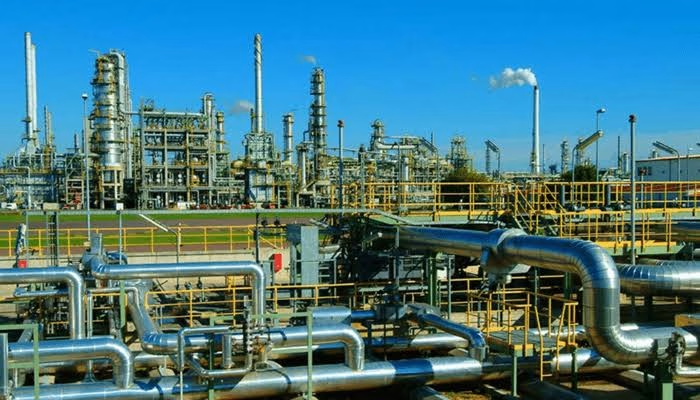
    Nigeria’s Minister of Steel Development Shuaibu Abubakar Audu has stated that the Federal Government has reached an advanced stage in its efforts to revive the long awaited comatose Ajaokuta Steel Plant Project that is located in Kogi state.

    This information regarding the project was disclosed by the minister during the weekend while hosting various stakeholders of the All Progressives Congress (APC). This event was held in Kogi State at his country home in Ogbonicha, Ofu Local Government Area of the state.

    Ajaokuta Steel Plant Project Factsheet

    Location: Ajaokuta, Kogi State, Nigeria

    Initial capacity (Phase 1): 1.3 million tonnes of liquid steel every year.

    Planned expansion: the expansion is expected to increase capacity to 2.6 million tonnes and further to 5.2 million tonnes per annum in coming phases.

    Thermal power plant: 110 MW capacity (2 generators of 55MW each).

    Other facilities: the project also entails a lime production plant and an alumino silicate refractory plant. Also, it entails a tar bonded dolomite plant, water treatment and recirculation facilities, extensive gas facilities.

    Recent revival efforts:

    • President Tinubu’s administration created the Federal Ministry of Steel Development in 2023.
    • A Memorandum of Understanding (MoU) was signed with a Russian consortium (including Tyazhpromexport) for rehabilitation, completion, and operation.
    • Plans for a full technical and financial audit are in place to attract private investors. This paves way for privatization of the steel plant.

    Also read: $400 Million Ogun Stellar Steel Plant Breaks Ground in Nigeria

    MOU Signed for the Project

    The minister mentioned that the Federal Government has already signed a Memorandum of Understanding (MOU) with the Original Equipment Manufacturers (OEM). Additionally, the minister said that the government has further extended its search for private investors to China to make investments in the steel plant. This move is expected to mark a big step towards the plant’s resuscitation eventually.

    “We are doing an amazing job. The journey has kicked off, and we will be able to turn Ajaokuta and deliver results hastily”, Audu mentioned.

    Furthermore, he stressed that the move underscored the bold reforms and developmental strides of the President Bola Tinubu-led administration over the previous two years to boom the economy through steel development.

    Also read: Nigeria’s $3.3 Billion Brass Industrial Park and Methanol Complex

  • The $4.3B Santa Cruz-Pajaro Passenger Rail Project Takes Shape

    The $4.3B Santa Cruz-Pajaro Passenger Rail Project Takes Shape

    Santa Cruz County, June 2025 — The long-anticipated Zero Emission Santa Cruz-Pajaro Passenger Rail Project has evolved steadily from early concept to a formalized plan, now on the cusp of environmental review — pending approval from the Santa Cruz County Regional Transportation Commission (RTC) this August.

    The concept of passenger rail in the region has been under development for over a year, but recent months have seen the project gain sharper definition and public visibility. What began as a broad exploration of potential rail alignments and station sites has transformed into a detailed draft report, summarized and presented to the public in early June.

    From Idea to Action: A Timeline of Key Developments

    March 2025: Decision on Intercity Rail

    At a pivotal March 20 meeting in Watsonville, the RTC voted 9-1 to pursue an intercity rail service over a light rail option. The intercity approach promises a faster, more efficient trip, and better alignment with California’s state rail plan, making it more likely to attract state and federal funding.

    At the same time, concerns emerged over projected infrastructure costs of the Santa Cruz-Pajaro Passenger Rail Project, particularly a staggering $980 million estimate for replacing or upgrading all 33 bridges along the 22-mile corridor. RTC staff had earlier recommended replacing 23 bridges, but commissioners requested a reevaluation to explore less costly alternatives.

    April 2025: First Look at Rail Design and Stations

    In April, county residents were given a first glimpse of what the system might look like. Engineering consultants from HDR, Inc. presented early plans including up to 10 permanent stations and seasonal stops, with a projected travel time of 40 to 45 minutes between Natural Bridges State Beach and Pajaro.

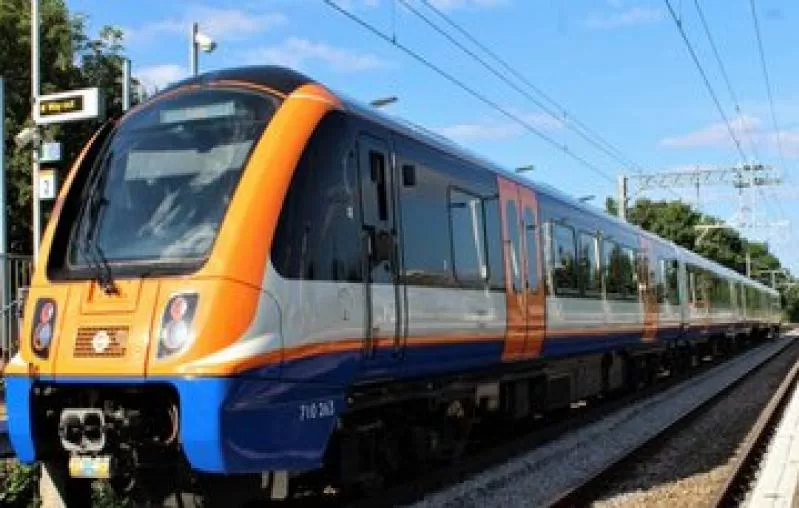
    The hydrogen-powered “Stadler FLIRT” train was identified as the preliminary model under study. Known for its quiet operation and flexibility, the train can run on battery, hydrogen, diesel, or hybrid power. Officials emphasized its suitability for a route with numerous short-to-medium-distance trips.

    Public input also began to shape alignments, with special attention paid to areas like Watsonville’s Walker Street and Santa Cruz’s Beach Street, where existing infrastructure and public use require careful navigation.

    Also Read: The Uinta Basin Railway Project in Utah: Update and Timeline

    June 2025: Executive Summary Released

    The release of the Executive Summary of the draft report on Friday marks the Santa Cruz-Pajaro Passenger Rail Project most significant step yet. Key highlights from the summary include:

    Construction cost estimated at $4.3 billion.

    Annual operations costs between $31 million and $41 million.

    Weekday ridership projections between 3,500 and 6,000.

    The ride between Santa Cruz and Pajaro would take 40–45 minutes.

    28 of 33 bridges may still need replacement, but cost details remain pending.

    Nine core stations have been proposed:

    Natural Bridges Drive

    Downtown Santa Cruz (Depot Park)

    Seabright

    17th Avenue in Live Oak

    Capitola

    Cabrillo College

    Aptos

    Downtown Watsonville

    Pajaro

    Two key public meetings in June are aimed at sharing costs, ridership forecasts, and station designs with residents, building momentum toward the full public hearing in August.

    What’s Next?

    If the RTC approves the full conceptual report in August, the next major step will be launching the environmental review process — a multi-year effort that would address regulatory compliance, environmental impact, and further engineering.

    However, concerns about the nearly $1 billion in bridge costs remain unresolved. In March, RTC commissioners requested a deeper analysis of whether all 33 bridges require full replacement or if selective upgrades might reduce costs without compromising safety.

    Public Engagement and Future Uncertainty

    Despite excitement about the project’s promise — faster travel, reduced emissions, and multimodal connectivity — questions about funding, feasibility, and long-term maintenance loom large.

    In a region known for its environmental values and transit challenges, the Santa Cruz-Pajaro passenger rail project stands at a crossroads — no longer just a concept, but not yet a certainty.

    The coming months will be critical. Public input, cost revisions, and commission decisions will determine whether this $4.3 billion vision stays on track or gets derailed by financial and logistical realities.

  • Kenya and Ethiopia Agree to Build Multi-Million-Dollar Cross-Border Infrastructure Projects

    Kenya and Ethiopia Agree to Build Multi-Million-Dollar Cross-Border Infrastructure Projects

    Kenya and Ethiopia have agreed to collaborate on working on cross-border infrastructure projects aimed at enhancing bilateral trade. This was during a meeting in Addis Ababa on June 5 as part of the Horn of Africa Gateway Development Project (HOAGDP). The two countries agreed on transformative programmes to improve the movement of goods, people, and digital services across the Ethiopian-Kenyan border.

    One of the features Ethiopia and Kenya agreed to support the construction of two bridges across River Dawa (Rhamu and Suftu). These bridges will be a passage of hope that will carry vehicles across the other side. Furthermore, it conveys aspiration to the underserved communities to access healthcare, education and markets. The main objective are to enhance infrastructural connectivity, socio-economic development and trade facilitation. Furthermore, it will promote cross-border development between Ethiopia and Kenya, the joint communique noted.

    Also read:

    US$517m Kenya-Ethiopia highway scheduled for completion in 2015

    Scope of Implementation on the Kenya-Ethiopia Cross-border Infrastructure

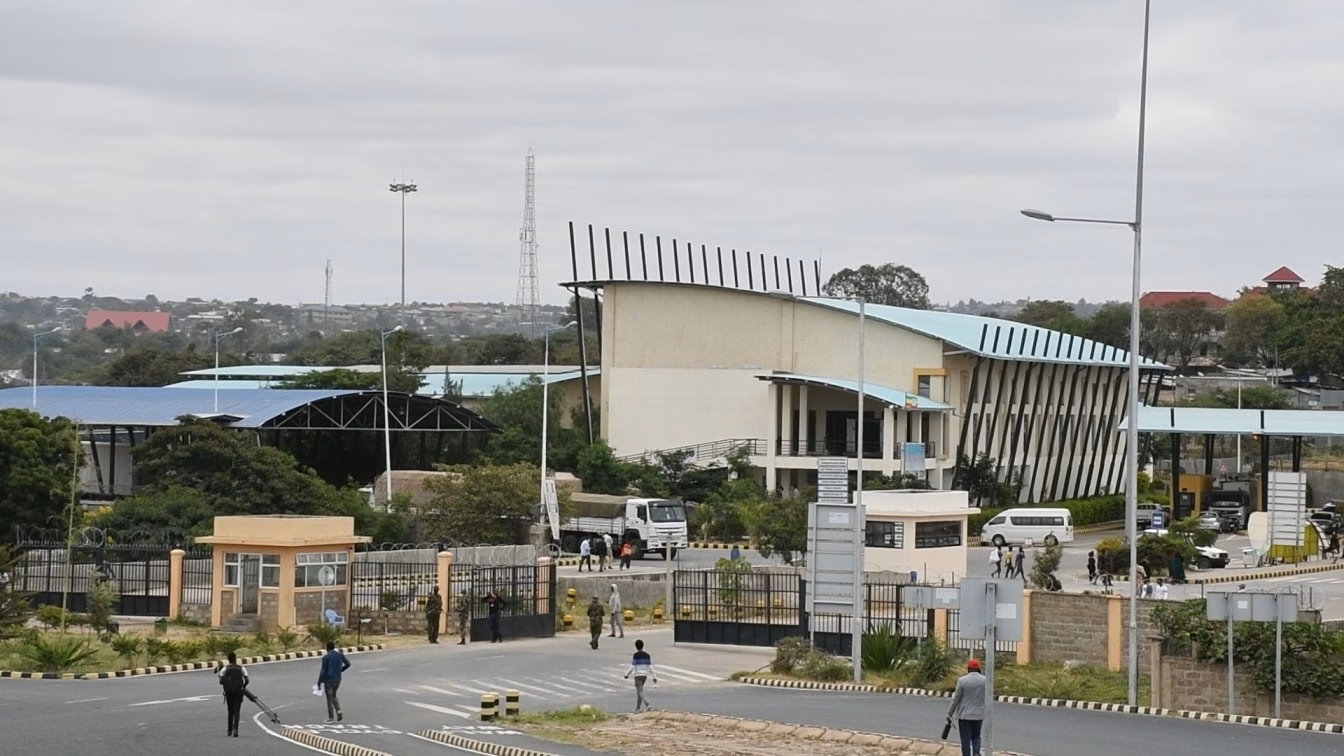
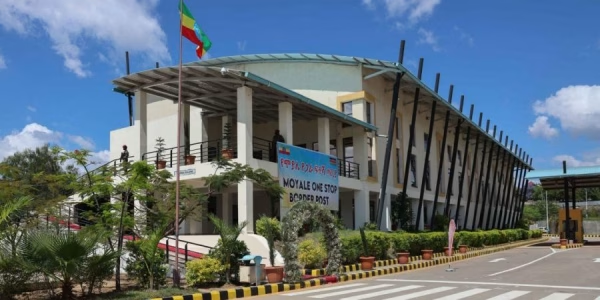
    The scope of implementation on the Kenya-Ethiopia cross-border infrastructure also includes the One-Stop Border Post (OSBP) at Rhamu. The Trade Facilitation Center at Suftu is also in the scope, at a meeting that was convened under the auspices of the Inter-Governmental Authority on Development (Igad). These measures are seen as a demonstration of Igad’s commitment to operationalize the African Continental Free Trade Area (AfCFTA). Furthermore, it will strengthen seamless trade between Ethiopia and Kenya by reducing border-crossing times. It will also reduce transport costs and make regional goods more competitive in international markets.

    Kenya-Ethiopia Cross-border Infrastructure
    Kenya and Ethiopia have agreed to collaborate on working on cross-border infrastructure projects aimed at enhancing bilateral trade.

    Both states are committed to also complete the cross-border fibre optic connectivity, improve cross border digital services, and enhance access to emerging technology. The two nations agreed on the location for a one-stop border post at Rhamu, a trade facilitation center at Suftu and access roads and bridges at both regions. The meeting occurred in the presence of senior government officials led by Ahmed Shide, Minister of Finance of Ethiopia. Cyrell Odede Wagunda, Principal Secretary for the State Department for Investments and Assets Management of the National Treasury of Kenya.

    Also read:

    $13.8 Billion 3000-Kilometre Kenya-Ethiopia Railway Construction Agreement Signed

    Kenya-Ethiopia Transmission line, Eastern Electricity Highway