Constructionreview

Blog

  • $2 Billion Rironi-Mau Summit Highway Construction Commencement Set for August

    $2 Billion Rironi-Mau Summit Highway Construction Commencement Set for August

    The long-awaited Rironi-Mau Summit Highway Construction Commencement is set for August. This information was announced by President William Ruto. The President said that both the design work and other technical aspects of the highway project are almost complete.

    Additionally, the groundbreaking of the project is scheduled for two months’ time.

    Rironi-Mau Summit Highway Construction Project Factsheet

    Length: Approximately 170-175 kilometers

    Cost: Approximately $2 billion

    Financing model: Public-Private Partnership (PPP) model, with the contractor expected to recover costs through toll collections.

    Project start date: August

    Completion date: July 2027

    Contractors and previous agreements:

    • Previous agreement: in the previous agreement, a concession agreement was signed with a consortium of French firms under Rift Valley Connect. This consortium comprised of Vinci Highways SAS, Meridiam Infrastructure Africa Fund, and Vinci Concessions SAS. This agreement was for a 30-year concession to design, build, finance, operate, maintain, and transfer the highways.
    • Termination of the previous agreement: unfortunately, the Kenyan government terminated the agreement with the French consortium. This was as a result of a contractual dispute and disagreement on terms. The Kenyan government is expected to pay a Ksh6.2 billion contractual obligation settlement.

    Current bids:

    Rironi-Mau Summit Highway Construction Commencement and Completion Date

    “The highway project is expected to start in August.We have come to an agreement with the contractors to speed up the project and finish it by the year 2027. However, if not, they should have done a substantial portion of the project of it by that time,” he said.

    Also read: Kenya’s 170-Kilometer Nakuru-Nairobi Highway Construction to Commence in July

    The President made these remarks at an event in which he hosted a delegation of leaders from Nakuru County at State House, Nairobi, on Wednesday.

    The attendees of the event included Nakuru Governor Susan Kihika, Trade and Investments Cabinet Secretary Lee Kinyanjui, and other leaders.

    Number of Lanes on the Highway

    President Ruto elaborated that the Rironi-Mau Summit Road will consist of four lanes from Rironi to Naivasha town. Additionally, it will consist of improvements on the Maai Mahiu-Naivasha road.

    Also read: Kenya’s €1.3 Billion Nairobi-Nakuru Dual-Carriageway Deal to be Awarded to a Chinese Contractor

    Lastly, the road will eventually expand to six lanes from Naivasha town to Nakuru City. This is in order to adequately accommodate the high volume of traffic on this route.

    Also read: Kenya to Secure Multi-Billion Loan for the Construction of the 124-kilometre Kenya-Tanzania Road

  • All to Know About the 1 GW Obelisk Solar Project in Southern Egypt

    All to Know About the 1 GW Obelisk Solar Project in Southern Egypt

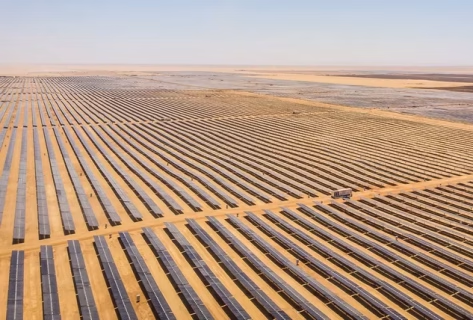
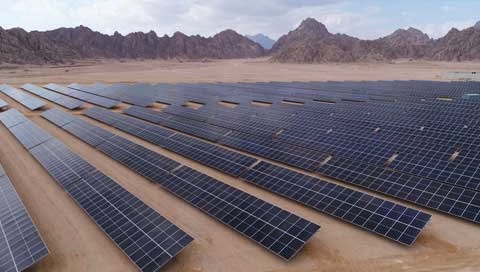
    The Obelisk Solar Project is a landmark hybrid renewable energy development in Egypt that is set to become one of Africa’s largest solar-plus-storage facilities.The solar project is located in the Qena Governorate, specifically the Nagaa Hammadi area. The project features a total solar photovoltaic (PV) capacity of approximately 1.1 GW integrated with a 200 MWh Battery Energy Storage System (BESS).

    Developed by Scatec ASA, this more than $590 million initiative joins projects such as the Dandara Solar Project in pushing for Egypt’s energy transition goals, as it will supply clean, reliable, and dispatchable power to the Egyptian Electricity Transmission Company (EETC) under a 25-year Power Purchase Agreement (PPA). The integration of the BESS is particularly significant, as it marks one of the country’s first utility-scale battery systems, designed to address the intermittency of solar power, enhance grid stability, and help Egypt reach its target of having 42% renewable energy in its power mix by 2030.

    Developed by Scatec ASA, this more than $590 million initiative joins projects such as the Dandara Solar Project in pushing for Egypt's energy transition goals
    Developed by Scatec ASA, this more than $590 million initiative joins projects such as the Dandara Solar Project in pushing for Egypt’s energy transition goals

    Updated 16th October 2025: The Obelisk project in Qena Governorate is being developed by Scatec ASA, through its special-purpose vehicle, Obelisk Solar Power. It reached financial close for about US$479 million, covering nearly 80% of its estimated US$590 million total cost. Obelisk features two phases: first phase has 561 MW solar plus the full 200 MWh battery system; second phase adds 564 MW solar. The project has a 25-year USD-denominated PPA with the Egyptian Electricity Transmission Company, backed by a sovereign guarantee.  It expects to operate fully by Q3 2026, generate about 2,772 GWh/year, cut approximately 1 million tonnes CO₂ emissions annually, and create some 4,000 construction and 50 permanent jobs.

    The development stands among the key renewable ventures featured in Egypt’s top solar power projects in development, reflecting Egypt’s strategic push to expand solar capacity, attract foreign investment, and accelerate its transition toward a low-carbon economy.

    Published 12 June 2025: The African Development Bank Group (AfDB) has approved a financing package of up to $184.1 million to support the development of the Obelisk solar power project in southern Egypt, which will be the largest solar photovoltaic (PV) plant in Africa. The landmark initiative includes a 1-gigawatt solar plant and a 200 MWh battery energy storage system (BESS), designed to deliver clean, reliable energy while enhancing grid resilience.

    Strategic Location and Structure

    Located in Qena Governorate, the project involves the design, construction, operation, and maintenance of a solar power facility integrated with advanced energy storage. The Egyptian Electricity Transmission Company will purchase the power under a 25-year Power Purchase Agreement, ensuring long-term energy delivery to the national grid.

    Robust Financing Package

    The total cost of the Obelisk solar power project exceeds $590 million, with funding from multiple sources:

    • $125.5 million from AfDB’s ordinary resources

    • $20 million from the Sustainable Energy Fund for Africa (SEFA)

    • $18.6 million from the Canada-African Development Bank Climate Fund

    • $20 million from the Climate Investment Funds’ Clean Technology Fund
      Additional financing will be secured from other development finance institutions.

    Scatec Commences Construction of 1.1GW Obelisk Solar PV and BESS Project in Egypt

    Alignment with Egypt’s NWFE Platform

    The project is part of Egypt’s Nexus of Water, Food, and Energy (NWFE) platform and has been granted a Golden License for its strategic role in addressing energy challenges. Egypt’s Minister of International Cooperation, Dr. Rania Al-Mashat, emphasized that the Obelisk project supports Egypt’s goal to reach 10GW of renewable capacity by 2030 while phasing out 5GW of fossil fuel power.

    Environmental and Socioeconomic Benefits

    Expected to be fully operational by Q3 2026, the Obelisk solar power project will:

    • Generate 2,772 GWh annually

    • Reduce CO₂ emissions by ~1 million tons per year

    • Create 4,000 jobs during construction and 50 permanent roles, with focus on youth and women employment

    • Help Egypt reach 42% renewable energy share by 2030

    International Support and Replicability

    AfDB Vice President Kevin Kariuki and Canada’s Ambassador to Egypt Ulric Shannon praised the project for enhancing energy security, economic development, and climate resilience. AfDB’s Wale Shonibare highlighted its potential for replication across Africa as a model of public-private cooperation in renewable energy.

    FACT SHEET: Obelisk Solar Power Project

    Project Name Obelisk Solar Power Project
    Location Qena Governorate, Southern Egypt
    Type Solar PV + Battery Energy Storage (200MWh)
    Capacity 1 GW (solar) + 200 MWh (storage)
    Expected Completion Q3 2026
    Annual Generation 2,772 GWh
    Emissions Reduction ~1 million tons CO₂ annually
    Project Cost $590+ million
    AfDB Financing $184.1 million total package
    Off-taker Egyptian Electricity Transmission Company
    Jobs Created 4,000 (construction), 50 (permanent)
    Strategic Program Egypt’s Nexus of Water, Food and Energy (NWFE)
    Target 42% renewable energy by 2030 in Egypt
    Partners AfDB, SEFA, Government of Canada, CIF
  • Ozinga Breaks Ground on North America’s Largest Low-Carbon Cement Manufacturing Facility in Indiana

    Ozinga Breaks Ground on North America’s Largest Low-Carbon Cement Manufacturing Facility in Indiana

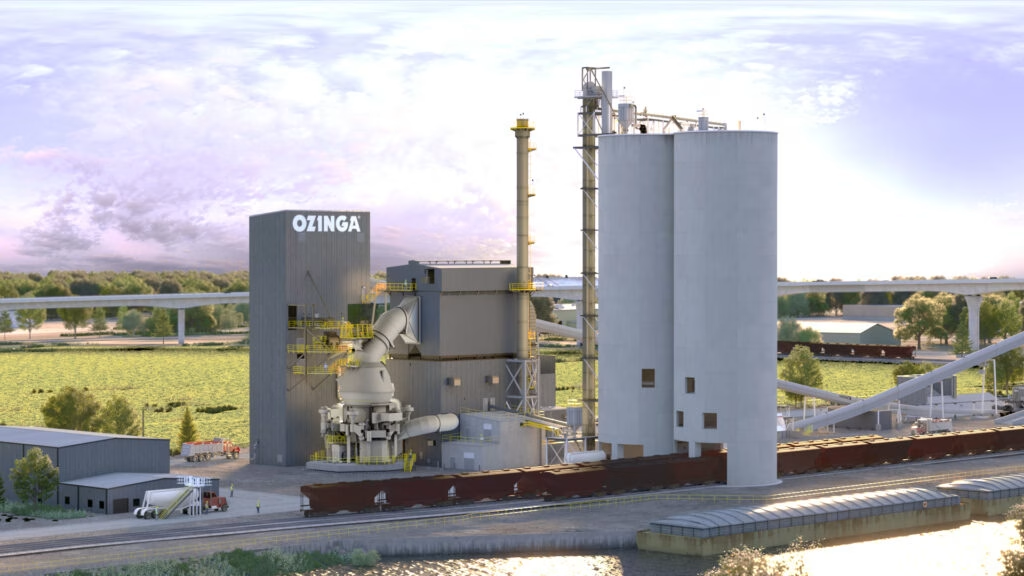
    Ozinga, one of the leading providers of concrete and construction materials, recently broke ground on a state-of-the-art low-carbon cement manufacturing facility in East Chicago, Indiana. It is expected to open in the second quarter of 2026 as the largest of its type in North America.

    The centerpiece of the plant’s operations will be the MVR5300-C6 vertical roller mill, engineered by Gebr. Pfeiffer. Consisting of six individual rollers, the mill is designed to be energy-efficient and reduce carbon footprints, a new standard for sustainable cement production. It will become the largest vertical roller mill to be installed on the continent upon its completion.

    “This is not a plant, it’s a technology milestone,” continued Timothy Burden, President of Gebr. Pfeiffer Americas. “The MVR5300-C6 is a new benchmark for sustainable cement production.”.

    The facility will manufacture ASTM C989-compliant slag cement and custom low-carbon blends under the CarbonSense brand of Ozinga. The products meet ASTM C1157 performance specification and can achieve reductions of up to 80% of embodied carbon in concrete. At full capacity, the facility is projected to capture more than 700,000 metric tons of CO₂ emissions annually—significantly lowering the environmental footprint of construction in the U.S.

    This is the kind of investment that constructs communities and brings real opportunity to our local families,” East Chicago Mayor Anthony Copeland said.

    Jobs

    Development and ongoing operations will provide approximately 150 new jobs, driving economic growth in the region.The facility’s strategic position provides direct rail, highway, and inland waterway access through the Great Lakes, ideally suiting it to serve customers throughout the United States and Canada.

    With this project, Ozinga reaffirms its commitment to sustainable infrastructure, resilient supply chains, and revived American manufacturing.

    Read also: Chicago Fire FC Unveils Plans for New $650 Million Stadium

    Ozinga Low-Carbon Cement Manufacturing Facility in East Chicago, Indiana: Project Factsheet

    Project Overview

    Ozinga has broken ground on a state-of-the-art low-carbon cement manufacturing facility in East Chicago, Indiana, set to become the largest of its kind in North America.

    Key Details

    Location: East Chicago, Indiana

    Completion: Q2 2026

    Scale: Largest low-carbon cement plant in North America

    Jobs Created: ~150 positions

    Technology & Equipment

    Primary Equipment: MVR5300-C6 vertical roller mill by Gebr. Pfeiffer

    Features: Six independent rollers for maximum energy efficiency

    Distinction: Largest vertical roller mill installation on the continent

    Purpose: Minimize carbon emissions and optimize sustainable production

    Primary Products:

    ASTM C989-compliant slag cement

    Custom low-carbon blends (CarbonSense brand)

    ASTM C1157 performance-compliant materials

    Sustainability

    Up to 80% reduction in concrete embodied carbon

    700,000+ metric tons CO₂ offset annually

    Sets new benchmark for sustainable cement production

    Ozinga’s new Low-Carbon Cement Manufacturing Facility in Indiana: Strategic Advantages

    Transportation Access: Direct rail, highway, and Great Lakes waterway connections

    Market Reach: Positioned to serve U.S. and Canadian customers

    Economic Impact: Strengthens regional manufacturing and job creation

    Key Stakeholders

    Developer: Ozinga (concrete and building materials supplier)

    Technology Partner: Gebr. Pfeiffer (mill manufacturer)

    Read also: Infinium Begins Construction on World’s Largest eFuels Facility in West Texas

  • When will the Mobile International Airport be completed?

    When will the Mobile International Airport be completed?

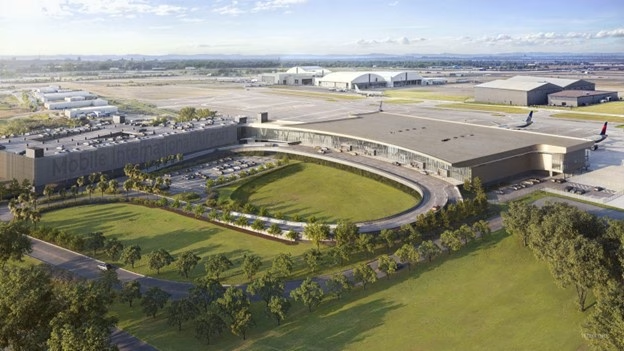
    MOBILE, Ala. – The much-anticipated Mobile International Airport will now open later than originally planned, with a new completion date set for September 2026, according to the Mobile Airport Authority. This marks a delay from earlier projections of a 2025 opening, but officials emphasize that the project remains on budget at $380 million, a rare feat in today’s infrastructure landscape.

    “We had to choose whether being on budget or being on time was more important. And the Mayor and I agreed that completing this on budget was the biggest priority,” said Authority Chairman Luckett Robinson.

    Construction began in 2024 and continues at the Brookley Aeroplex, just two miles from downtown Mobile, with significant progress visible at the end of last year including a roofed terminal building and concrete supports rising for the five-story parking garage.

    New Timeline & Travel Readiness

    Originally targeted for November 2025, the date was first pushed to March 2026 due to concerns about airline transition during the holiday season — a period airlines avoid due to operational disruptions. Now, the Airport Authority is confident the terminal will be ready by September 2026, with flights beginning in the fall.

    What’s Being Built

    The over $380 million investment includes:

    • A brand-new terminal with 5 gates (4 domestic, 1 international swing gate)

    • Potential for expansion to 12 gates as traffic grows

    • A 1,250-space parking garage

    • Continued operation of the existing low-cost terminal with 2 gates

    • Integration with downtown infrastructure — highways, rail, port, and waterways

    “This project is transformational not only for Mobile but for Baldwin County as well,” noted former board chairman Chris Curry.

    Cleveland Council Approves $1.6 Billion Airport Terminal Overhaul Legislation

    Airline Recruitment Underway

    With the structure nearing completion, the focus is shifting to airline partnerships. The authority has begun outreach to major carriers in hopes of securing expanded service options.

    What’s Happening Now

    Although much of the work remains out of public view, the build is progressing steadily.

    • The terminal building is under roof

    • First round of structural inspections is complete

    • Concrete supports for the parking garage are under construction

    • More inspections and interior work to follow into 2025

    Andy Wilson, the new executive director, confirmed in a December 2024 interview that the project was “progressing as anticipated.”

    FACTSHEET: Mobile International Airport Project

    Feature Detail
    Project Cost $380+ million
    Start of Construction 2024
    New Completion Date September 2026
    Initial Gates 5 (4 domestic, 1 international swing gate)
    Expansion Potential Up to 12 gates
    Parking Garage Capacity 1,250 spaces
    Location Brookley Aeroplex, 2 miles from downtown Mobile
    Current Status Terminal under roof, parking structure rising
    Airline Recruitment Underway
    Lead Authority Figures Luckett Robinson, Andy Wilson

    Conclusion:
    Despite timeline shifts, the Mobile International Airport remains a cornerstone infrastructure project for Alabama’s Gulf Coast. With strategic access, growing economic relevance, and an eye on attracting top-tier airlines, the new airport is set to redefine regional air travel once its doors open in fall 2026.

  • Kenya Advances the Construction of the Multi-Million-Dollar Kisumu-Malaba SGR Project

    Kenya Advances the Construction of the Multi-Million-Dollar Kisumu-Malaba SGR Project

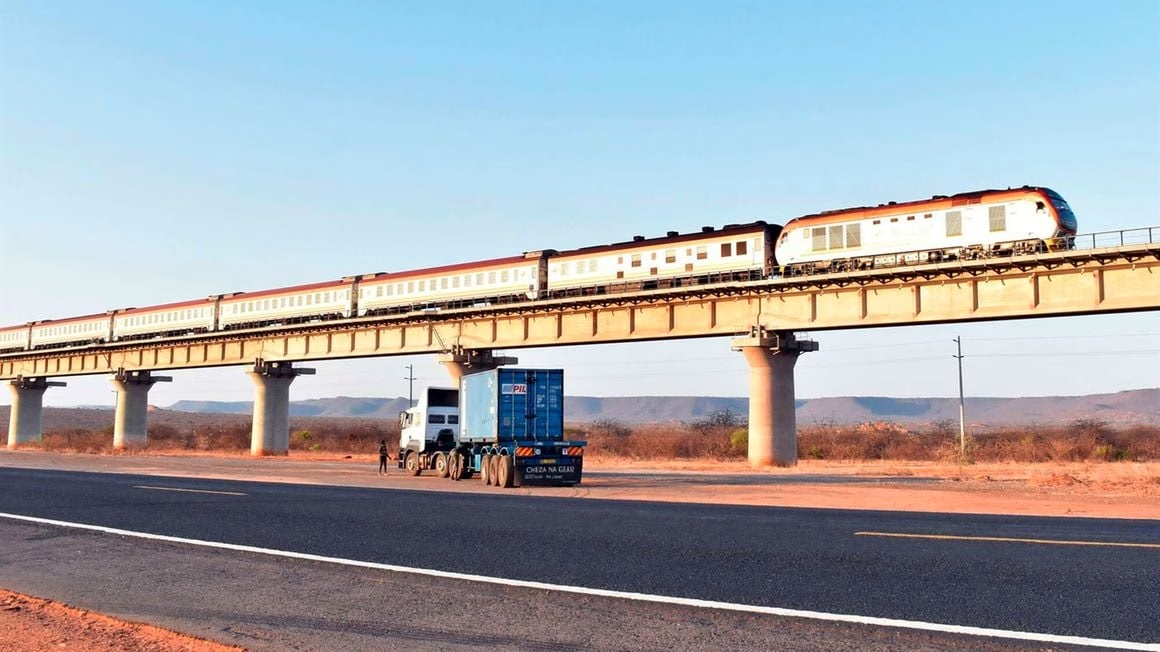
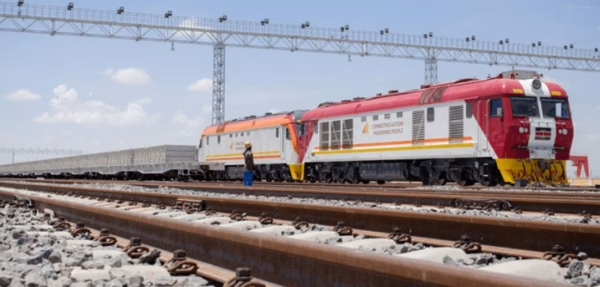
    The construction of the Kisumu-Malaba SGR project is taking shape as the government hopes to implement it in the second half of the year. This follows the completion of route mapping as well as land acquisition. The implementation of the project is expected to cost ksh.581 million, stretching from Naivasha to Malaba. Once completed, the 369-kilometer line is designed to improve the viability of the railway by linking it to Uganda.

    It will also link other nations across the East African region such as Rwanda and the Democratic Republic of Congo. Most of the countries are also developing their sections of the railway, with Kenya making commendable advancements. Completion of route mapping and land acquisition moves the project closer towards implementation. “The current program we have is a 2B 2C which will kick off in the second half of the year, “ noted Abdi Bare, Chair of Kenya Railways.

    Further developments for the Madaraka express is the introduction of a Mombasa commuter train from Miritini to the Mombasa Station in the CBD that was announced in August.

    Also read:

    Funds obtained for Kisumu-Kisian-Busia/Kakira-Malaba-Busitema-Busia expressway project

    The Scope of Implementation of the Kisumu-Malaba SGR Project

    The scope of implementation of the Kisumu-Malaba SGR project is expected to roll out once various phases are complete. Kenya Railway’s managing director Philip Mainga noted that they have already completed various aspects needed. “We have identified the route, we have also identified the people to be compensated for that route,” he said. Moreover, he noted that the environmental impact assessment is nearing completion and will be done by the end of the month. Financial institutions were proposed to fund 30% of the project. The Kenyan government will raise 30% and then consortium do the remaining 40%.

    Kisumu-Malaba SGR Project
    The construction of the Kisumu-Malaba SGR project is taking shape as the government hopes to implement it in the second half of the year.

    Despite this, the corporation looks to develop new funding models. “We also have the lapset, where the road has already been done so working on looking for a financier for a PPP project that can be able to leave from Lamu port to Ethiopia and southern Sudan,” Bare added. They were speaking at the eighth anniversary celebrations of Madaraka Express operations, which to date, has varied over a 15.3 million passengers and 39.7 million tons of cargo. Most Kenyans are hopeful the project will fill the gaps that remain in the transport sector. This also includes the Malaba route and the ambitious Ethiopian route.

    Also read:

    Construction of Naivasha-Kisumu-Malaba Standard Gauge Railway (SGR) Route set to begin

    Construction of Kisumu-Kakamega road Mamboleo flyover to be completed in July

  • Kenya’s Government Provides Updates on the $751 Million Mombasa-Mtwapa Highway Project

    Kenya’s Government Provides Updates on the $751 Million Mombasa-Mtwapa Highway Project

    Kenya’s government has noted that the Mombasa-Mtwapa Highway project is 90% complete through its government spokesperson Isaac Mwaura. The highway linking Nyali Bridge to Mtwapa is being transformed into a dual carriageway. The transformation includes the construction of service lanes, interchanges, and pedestrian bridges. In addition, the project features modern lighting and roadside commercial amenities. Funded by the African Development Bank, the European Union, and the Kenyan government, the road stretches over 40 kilometers from Mombasa to Kilifi.

    With some minor delays due to compensation for land and utilities, the majority of sections are still on schedule. The Mombasa-Mtwapa Highway project is part of the East African Coastal Corridor projects aimed at improving trade and transportation at the regional level. It will reduce travel time greatly while improving trade and tourism. The project is, to date, being estimated to be finished late in 2024 or early 2025. The government continues to monitor outstanding work, including quality checks, conserving the environment, and monitoring on compensation.

    Also read:

    454-Kilometre Kenya-Tanzania Road to be Completed in 2024

    Project Factsheet

    Significance:

    • Enhances efficiency in transportation by reducing travel time from Mombasa to Kilifi.
    • Enhances Kenya’s regional integration of the East African Coastal Corridor.
    • Spurs economic growth through increased tourism, property development, and cargo transportation.
    • Encourages urbanization and commercial investment via roadside integrated infrastructure.

    Infrastructure:

    • Dual carriageway upgrade from Nyali Bridge to Mtwapa, and along the way to Kwa Kadzengo.
    • Includes six grade-separated interchanges, service roads, streetlights, and footbridges.
    • Roadside commercial stops and amenities are planned to stimulate local economic activity.
    • Covers over 40 kilometers along the Mombasa-Kilifi corridor.

    Developer:

    • Funded by the African Development Bank, European Union, and Government of Kenya in collaboration.
    • Maintained by the Kenya National Highways Authority (KeNHA) under routine oversight.
    • Implementation monitored for quality, compensation, and environment standards.

    Funding:

    • Financed by a mix of multilateral grants and national government subsidy.
    • A component of the overall East African transport development plan.
    • Aligns with Kenya’s vision for sustainable infrastructure development and regional trade facilitation.

    Challenges:

    • Delays in construction due to land compensation process and relocation of utility services.
    • Coordination of urban traffic management during construction stages.
    • Safety, quality control, and getting the balance of the infrastructure on time.
    • Final works anticipated for completion latest by late 2024 or early 2025.

    The Significance of the Mombasa-Mtwapa Highway Project

    Mombasa-Mtwapa Highway project
    Kenya’s government has noted that the Mombasa-Mtwapa Highway project is 90% complete through its government spokesperson Isaac Mwaura.

    Once completed, the Mombasa-Mtwapa Highway project will improve the efficiency of transport and boost economic development. It will also facilitate the transportation of passengers and cargo. The real estate properties along the highway have already increased in value by twice their original value. The project will also attract investment in tourism, housing, and warehousing. Moreover, it will promote regional integration, enhances safety, and stimulates development. The government remains committed to its completion on time. The upgrading of the highway covers Nyali Bridge to Kwa Kadzengo. Upgrades include the implementation of six interchanges, lights, and footbridges. Though there were delays but completion phases are in progress.

    Also read:

    Kenya to Secure Multi-Billion Loan for the Construction of the 124-kilometre Kenya-Tanzania Road
    Tanzania Government Seeks Approval for Construction of Controversial 452-kilometer Serengeti Road