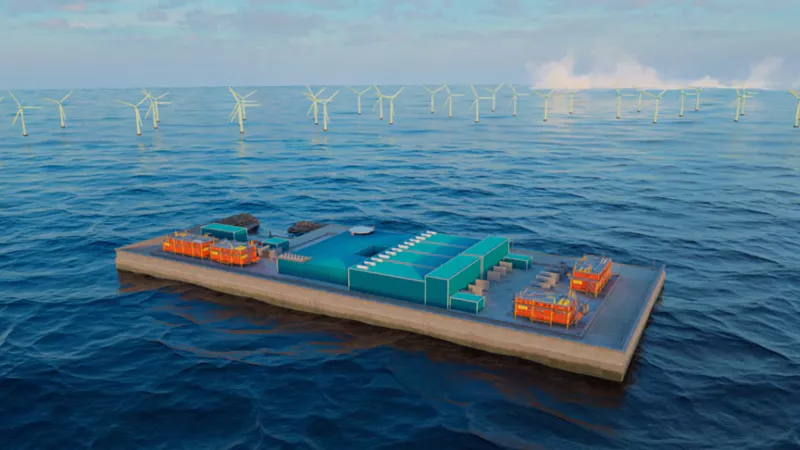
Elia Transmission Belgium has secured a €1 billion green credit facility from the European Investment Bank for the second phase of the Princess Elisabeth Energy Island, an artificial hub 45 kilometres off the Belgian coast. It is the largest energy infrastructure loan the bank has made in the Benelux, and it funds the alternating current backbone only.
The facility was confirmed by the EIB in early September 2026, though the paperwork is older than the announcement: EIB project documentation puts the signing at 17 July 2026, and Elia made its first drawdown around the end of that month. The money buys the island’s 220 kilovolt offshore substation, its 66 kilovolt switching stations, transformers, and the six three phase 220 kilovolt cables that will carry power to an onshore substation in Belgium.
What the EIB is actually covering
The headline number is a loan, not a project cost, and the distinction matters here more than usual.
EIB documentation estimates the total investment in this second phase at roughly €2.296 billion, which puts the bank’s €1 billion at about 44% of the phase. The first phase, backed by a €650 million green credit facility agreed in October 2024, carried an estimated cost of around €1.1 billion, so the bank covered closer to 59% of that tranche. Total EIB exposure now stands at €1.65 billion against roughly €3.4 billion of disclosed phase costs.
For scale in the same sector, Norges Bank Investment Management put €1.4 billion into RWE’s Nordseecluster and Thor offshore wind projects, and that bought a stake in generating assets rather than a lender’s position in transmission. Elia has said the favourable terms are expected to hold down overall financing costs and limit the pass through to consumer bills, a live political question in Belgium as electricity affordability stays near the top of the federal agenda.
The transmission bill against a generation benchmark
Roughly €2.3 billion of second phase spending will connect the first two wind farms in the zone, about 2.1 GW of the planned capacity. That works out near €1.1 million per megawatt of connection capacity, for cables, substations and transformers alone, with no turbines attached.
Set that against onshore construction in the same year. OX2’s 472 MW Rajamäenkylä and Honkakangas wind farms in Finland were costed at €700 million for the pair, or about €1.48 million per megawatt including 70 Nordex turbines, towers, roads and grid connection. The comparison is not like for like, and it is not meant to be. It is a way of showing why offshore grid connection has become the pinch point in North Sea planning: the wires for a Belgian offshore farm cost nearly as much per megawatt as an entire Finnish wind farm.
Foundations are done, the interior is not
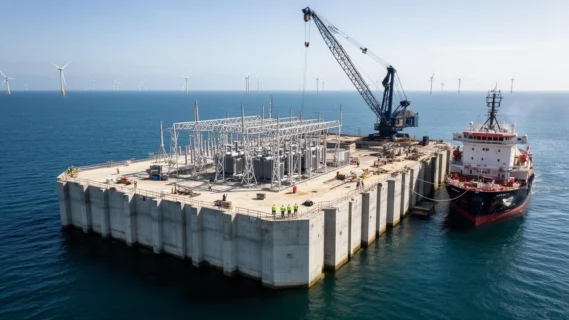
Construction has passed its most visible milestone. The 23rd and final caisson was installed in August 2026, completing the foundation works, according to DEME, which is delivering the island through TM Edison, a consortium with Jan De Nul.
The numbers behind that ring of concrete are considerable. Each caisson measures 58 metres by 28 metres and stands between 23 and 32 metres high depending on whether it carries a storm wall, weighs approximately 22,000 tonnes, and took about three months to build. All 23 were cast at Vlissingen in the Netherlands, with around 300 people on site each day and installation running from April 2025 through two offshore campaigns. Tractebel and its subsidiary IMDC have handled design review, structural and geotechnical work and full time construction management for Elia.
What remains is the part that carries the electricity. Elia has to finish the island’s interior, lay the subsea and onshore cable systems, described by Power Technology as totalling around 165 kilometres at 220 kilovolts, and install the electrical plant. The operator is working toward readiness in 2031, the year the first wind farms in the zone are expected to connect. Six hectares of sand inside a concrete ring is not yet a substation.
The HVDC hole in the middle of the plan
The emphasis on alternating current in the EIB announcement is the tell. This project has already been cut back once, and the financing marks the edge of what survived.
In February 2025 Elia suspended the signing of final contracts for the island’s high voltage direct current equipment, citing extraordinary global price increases for that hardware. Four months later the federal government instructed the grid operator not to sign the negotiated contract at all, and to work with energy regulator CREG on a cheaper alternative concept. Estimates of the island’s cost had by then run well beyond the roughly €2.1 billion originally discussed, with figures above €7 billion reported in the Belgian press and HVDC named as the main driver.
The consequence is specific. The alternating current design now financed serves the first two lots in the zone, about 60% of planned capacity. The third and largest lot, at 1,400 MW, was to be connected through two HVDC converter stations, one offshore and one on the Belgian coast, and those same converters would have carried the hybrid Nautilus link to Britain. Neither is being built. The island is still being constructed with space reserved for a future UK interconnector, and the government has kept a second cross Channel link on its agenda, but the facility signed in July buys the backbone rather than the converters on which the zone’s final tranche and the British connection both depend. CRO’s earlier overview of the energy island’s phasing predates that decision.
The auction was reset, and the onshore grid is catching up
There is no point building a hub with nothing to plug into it, and for a year that was the risk.
The tender for Princess Elisabeth Zone I, a 46 square kilometre site rated at 700 MW, was launched in November 2024 with an award due in December 2025. The federal government halted it in July 2025. Energy Minister Mathieu Bihet cited legal uncertainty, an unrealistic timetable and a vague financial framework, and the government also pointed to the schedule for the offshore grid itself and the onshore reinforcements the zone requires. The island’s own delay was part of why the auction could not proceed.
A rebuilt framework arrived a year later. A draft royal decree went out for consultation in April 2026, and the Council of Ministers approved the revised regime in July. As reported by reNEWS, the price ceiling is gone, support moves to a single two sided contract for difference in which the lowest strike price wins, the maximum construction period extends from four years to five, the separate regime for fixed price power purchase agreements is removed, and citizen participation becomes voluntary rather than mandatory. Prequalification now imports the EU Net Zero Industry Act, with binding criteria on cybersecurity, sustainability, corporate responsibility and supply chain resilience, including a requirement that at least 75% of turbines are not manufactured or assembled in China, a cap of four critical components sourced from China, and a ceiling of 85% on Chinese permanent magnets. Bihet defended the pause, arguing the government had opted for a tender that would hold up legally and give investors confidence.
Onshore, the picture improved in the same window. Flemish minister Jo Brouns granted permits for the Ventilus grid reinforcement on 27 April 2026, according to law firm Loyens & Loeff. Ventilus and Boucle du Hainaut are the mainland links that let the island’s output reach demand centres, and both have absorbed years of local opposition.
What is still unresolved
Belgium currently operates about 2.26 GW of offshore wind, enough for roughly 10% of national electricity demand according to industry body Belgian Offshore Platform. The Princess Elisabeth Zone is designed to add between 3.15 GW and 3.5 GW, which would more than double the fleet, with turbines coming online from 2031.
Four things stand between the financing and that outcome. No wind farm in the zone has been awarded, so the relaunched 700 MW tender still has to attract a winning bid under untested rules. The 1,400 MW third lot has no connection route until the HVDC replacement concept Elia is developing with CREG is settled and priced. The Nautilus interconnector to Britain remains unbuilt and unfunded. And the island’s own remaining scope, interior works, 165 kilometres of cable and the electrical installations, has to be delivered against a 2031 date that has already moved once.
Neither Elia nor the government has published a revised total cost for the island since the HVDC decision, which is the single most useful number still missing from the public record.
Project at a Glance
- Project Name: Princess Elisabeth Energy Island, also known as Modular Offshore Grid 2
- Location: Belgian North Sea, approximately 45 km off the coast near Ostend, inside the Princess Elisabeth Zone
- Client and Owner: Elia Transmission Belgium
- Project Value: Phase one estimated at around €1.1 billion and phase two at approximately €2.296 billion (EIB project documentation); no consolidated total published since the HVDC scope was removed in 2025
- Funding: €650 million EIB green credit facility (October 2024) and €1 billion EIB green credit facility (signed 17 July 2026), for €1.65 billion of EIB support
- Main Contractor: TM Edison, a consortium of DEME and Jan De Nul
- Engineering and Construction Management: Tractebel with IMDC
- Key Components: 6 hectare island formed by 23 concrete caissons of about 22,000 tonnes each, a 220 kV offshore substation, 66 kV switching stations, transformers, and six three phase 220 kV alternating current cables to shore totalling around 165 km
- Descoped Elements: Two HVDC converter stations serving the 1,400 MW third lot and the Nautilus interconnector to the United Kingdom, dropped on cost grounds in 2025 and under redesign with regulator CREG
- Zone Capacity Enabled: 3.15 GW to 3.5 GW of new offshore wind, of which the financed alternating current design serves about 60%
- Construction Start: Caisson fabrication began at Vlissingen in 2023, offshore installation from April 2025, foundations completed August 2026
- Expected Completion: Island readiness targeted for 2031, when the first wind farms in the zone are expected to connect
- Onshore Dependencies: Ventilus, permitted April 2026, and Boucle du Hainaut
Project Team
- Owner and Grid Operator: Elia Transmission Belgium
- Lender: European Investment Bank
- Main Contractor: TM Edison, a consortium of DEME and Jan De Nul
- Owner’s Engineer and Construction Manager: Tractebel with IMDC
- Caisson Fabrication Yard: Vlissingen, Netherlands, with finishing works at the Scaldia terminal
- Energy Regulator: CREG
- Tendering Authority: Belgian federal government, FPS Economy, under Energy Minister Mathieu Bihet
- Onshore Reinforcement Permitting: Flemish government, Ventilus permits granted by Minister Jo Brouns
- Sector Body: Belgian Offshore Platform
- Wind Farm Developers for Zone Lot I: Not yet awarded, with a consortium of Ocean Winds, Otary and Eneco among declared bidders for the zone
- HVDC Converter Supplier: Not yet awarded



Leave a Reply