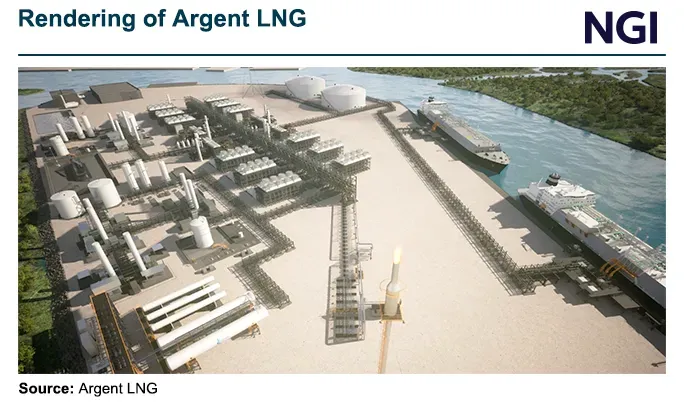
A formal request to clear Gulf of America shipping channels for supertanker-scale LNG traffic has landed at the U.S. Coast Guard, marking the third and final federal agency Argent LNG needs to bring into active review for its proposed $18 billion export terminal at Port Fourchon, Louisiana.
The company submitted its Waterway Suitability Assessment (WSA) under 33 CFR Part 127, asking the Coast Guard to evaluate whether Belle Pass, Bayou Lafourche, and the Gulf approach channels can safely handle LNG carriers ranging from 125,000 to 260,000 cubic meters in capacity. It’s a required step for any LNG export facility in the U.S., and it now puts Argent LNG in active engagement with all three agencies whose sign-off determines whether the 25 million-tonne-per-annum terminal gets built: the Coast Guard, the Federal Energy Regulatory Commission, and the Department of Energy.
Argent LNG had already cleared an earlier regulatory hurdle before this filing: DOE authorization to ship up to 25 million tonnes a year to countries with U.S. free trade agreements. That approval settles one lane of the company’s export plans, while a broader authorization covering non-FTA markets — the larger and more contested share of the global buyer pool — is still working its way through DOE review.
Three Agencies, One Timeline
The WSA filing doesn’t happen in isolation. FERC has eleven Resource Reports from Argent LNG sitting in its pre-filing environmental review docket, covering everything from wildlife impact to cultural resources, as the commission works toward a Draft Environmental Impact Statement — the gating document before a Certificate of Public Convenience and Necessity. On the DOE side, the company already has what it needs on paper: Order No. 5447, signed July 23, 2026, grants a 20-year authorization to export the full 25 MTPA to Free Trade Agreement countries, while a separate non-FTA application sits in Docket No. 26-28-LNG.
That leaves the Coast Guard filing as the piece that had been outstanding. Port Fourchon’s geography does some of the argument for Argent LNG here: the port sits on a deepwater channel currently and is expected, under the 2028 Water Resources Development Act, to be authorized for dredging to 50 feet and widening to 475 feet. The Greater Lafourche Port Commission, which operates Port Fourchon, confirmed to Construction Review Online that this deepening is still being worked through and is tracking for authorization under WRDA 2028. The port already handles roughly 95 percent of Gulf offshore production traffic — meaning the vessel-management infrastructure a WSA typically scrutinizes is largely already in place.
Reading Between the Regulatory Lines
Jonathan Bass, Argent LNG’s chairman and CEO, framed the filing as part of a broader pattern rather than a standalone event: “Each agency engagement is a de-risking event.” That’s a useful lens for a project still years from a final investment decision — the company is betting that visible, sequential regulatory progress builds commercial and financial confidence even before permits are in hand.
It’s also worth noting what the release doesn’t say: there’s no indication yet of when the Coast Guard expects to complete its assessment, and the WSA process itself doesn’t have a fixed statutory timeline the way FERC’s NEPA review does. That’s a detail worth watching rather than assuming.
The Scale of the Build
At full build-out, Argent LNG’s Port Fourchon facility carries a price tag of roughly $18 billion, placing it among the largest LNG export projects currently proposed in the U.S. The design calls for 12 modular liquefaction trains supplied by Baker Hughes under its NMBL platform, feeding two marine loading berths built for direct deepwater access — meaning cargo ships can reach open Gulf shipping lanes without navigating the inland traffic that slows down some competing Gulf Coast terminals. Argent has structured its early offtake commitments around long-term buyers spread across Europe, Asia, and the Caribbean, positioning the terminal as a diversified export point rather than a single-market play.
Momentum Beyond Permitting
The regulatory push has been paired with a run of commercial agreements — memoranda of understanding with Ukraine’s Naftogaz and Turkey’s BOTAŞ, a strategic cooperation deal with EPİAŞ for 5 MTPA into Southeast and Central Europe, and a heads of agreement with the Bangladeshi government for up to 5 MTPA. Argent LNG also awarded a marine and site engineering contract to GIS Engineering of Galliano, Louisiana, keeping the work inside the state under what the company calls its Louisiana First procurement approach.
The company is targeting a final investment decision and construction start in December 2027, with first LNG production projected for the first quarter of 2030.
Gulf Coast infrastructure spending isn’t limited to energy exports right now — ports across the region are also investing heavily in vessel-traffic capacity for passenger and cargo growth, a pattern visible in Port Tampa Bay’s newly launched cruise terminal project on Florida’s west coast, where site work is now underway ahead of a 2029 opening.
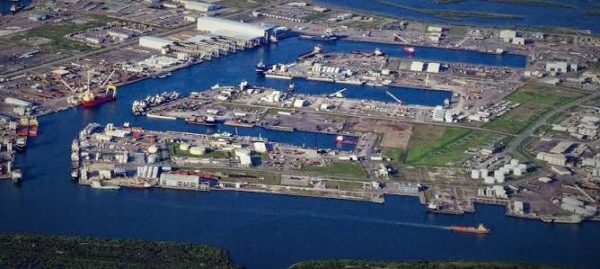
Port Fourchon, Louisiana
Project Factsheet: Argent LNG’s Proposed Export Terminal at Port Fourchon, Louisiana
- Project: 25 MTPA LNG export terminal, Port Fourchon, Louisiana ($18B estimated cost)
- Latest filing: Waterway Suitability Assessment submitted to USCG under 33 CFR Part 127
- Waterways under review: Belle Pass, Bayou Lafourche, Gulf approach channels
- Channel deepening: Deepening to 50 ft and widening to 475 ft expected to be authorized under WRDA 2028 (not yet authorized)
- DOE authorization: 25 MTPA / 20-year term, FTA nations (Order No. 5447, July 23, 2026); non-FTA application pending
- FERC status: Eleven Resource Reports filed; Draft EIS pending
- Technology: 12 modular Baker Hughes NMBL liquefaction trains, two marine loading berths
- Target FID/construction start: December 2027
- First LNG target: Q1 2030


Leave a Reply