
The Eastern Green Link 4 (EGL4) project has advanced following the award of a £2 billion cable supply contract to Prysmian and a subsequent contract for its converter stations to Siemens Energy.
Jointly developed by National Grid Electricity Transmission and SP Energy Networks, the 2GW high-voltage direct current (HVDC) link will connect Fife, Scotland, with Norfolk, England. This will be through 640km of subsea and underground cables.
Another milestone was also reached on 30 October 2026. The National Grid submitted the Development Consent Order application for EGL4 and Eastern Green Link 3 to the Planning Inspectorate. Subject to planning consent, construction is expected to begin in 2028, with completion targeted for 2033.
Additionally, the Eastern Green Link project is designed to increase electricity transmission capacity and reduce grid congestion. It is also designed to enable more renewable power to reach consumers across Britain.
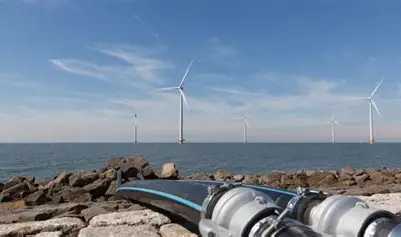
Prysmian Awarded $2.7 Billion Eastern Green Link 4 Contract
Reported February 4, 2026 – Prysmian has secured a landmark £2bn ($2.7bn) contract to supply the essential cabling for Eastern Green Link 4 (EGL4). This project entails a massive subsea electricity superhighway.
Developed through a joint venture between National Grid Electricity Transmission and SP Energy Networks, this project is a cornerstone of Britain’s strategy to expand its power grid. It is also a means to combat climate change. The link will connect Fife in Scotland to Norfolk in England. This will also provide a high-capacity route for clean energy to flow where it is needed most.
Scope of the Project
The scale of the engineering involved is significant. The agreement covers over 640km of High Voltage Direct Current (HVDC) cable. 530km will be laid beneath the sea while 116km will run underground. By utilizing HVDC technology, the project ensures maximum efficiency for long-distance transmission, making it easier to integrate renewable power sources into the national grid. Once completed in 2033, EGL4 will be capable of transmitting up to 2GW of electricity. This is enough to power more than 1.5 million homes with clean and sustainable energy.

This project is also part of a broader effort to reinforce the UK’s east coast energy infrastructure. National Grid project director James Goode highlighted that EGL4 is “critical” for moving large volumes of affordable, home-grown energy efficiently and at scale. This partnership also builds on Prysmian’s existing relationship with National Grid. The company is also providing cabling for the Eastern Green Link 1 project. EGL-1 is currently under construction between Torness and Hawthorn Pit.
Planning Timeline
Looking ahead, the development team expects to submit formal planning applications in both Scotland and England in 2026. If approved by the Secretary of State for Energy Security and Net Zero, construction is slated to begin in 2029. This long-term investment represents a major step toward a more secure and greener energy future for consumers across Britain.
The subsea cable also makes “landfall” at Anderby Creek, Lincolnshire. This is before running underground to Norfolk.
Eastern Green Link 4 Project Factsheet
Capacity: 2GW
Total Cable Length: Over 640 km
Route and Infrastructure
- Northern Terminus (Scotland): Fife.
- A new converter station will be located at Westfield (near Ballingry).
- The subsea cable makes “landfall” at Kinghorn.
- Southern Terminus (England): Norfolk.
- A new converter station will be built near Walpole.
Developers: Joint venture between National Grid Electricity Transmission and SP Energy Networks (a subsidiary of ScottishPower).
Main Cable Supplier: Prysmian
Converter Stations: Siemens Energy
Timeline
- 2024–2025: Public consultations and technical assessments.
- 2026: Submission of formal planning applications.
- 2029: Expected commencement of construction.
- 2033–2034: Targeted completion and operational date.




Leave a Reply