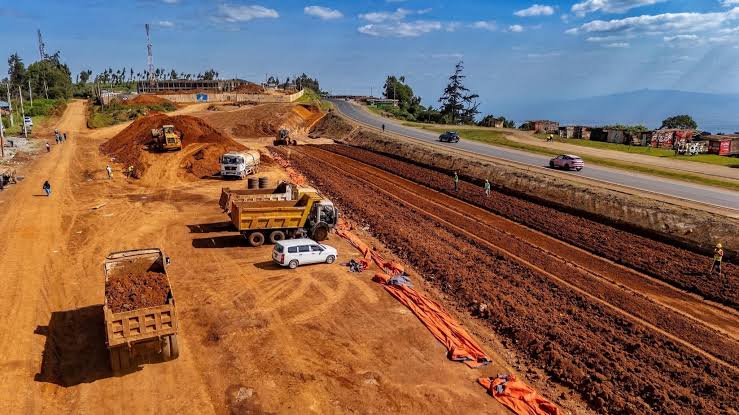
The Rironi Mau Summit Highway is gaining a digital and renewable-energy layer as construction advances along Kenya’s strategic Northern Corridor. The KSh200 billion project, will integrate solar-powered facilities and fiber optic infrastructure.
The 233-kilometre highway will connect Rironi in Kiambu County with Mau Summit in Nakuru County. It will also strengthen links between Nairobi, western Kenya and neighboring countries.
China Road and Bridge Corporation (CRBC) leads construction on the Rironi-Naivasha-Gilgil section. Shandong Hi-Speed Road and Bridge International handles the Gilgil-Nakuru-Mau Summit section.
The latest construction update places the Rironi-Naivasha section at about 80% completion. The contractor now targets full tarmacking of that section by December 2026.
Rironi Mau Summit Highway integrates solar-powered facilities
The Rironi Mau Summit Highway will incorporate solar energy to support major road operations after construction. Project manager Eric Yu said contractors plan to install solar panels with three million watts of capacity.
The system will power facilities along the highway while supporting the project’s environmental objectives. Consequently, the renewable-energy component could reduce reliance on conventional electricity sources during road operations.
Yu disclosed the solar plan during a briefing in Naivasha on August 29, 2026. He said the project team continues adopting modern technologies across the highway.
Meanwhile, the highway project includes environmental restoration measures alongside its construction activities. KeNHA plans to plant 20,000 trees along affected sections.
The agency began the restoration program with the National Youth Service and Kenya Prisons Service. It also plans to replace trees removed during road construction.
These measures add an environmental component to one of Kenya’s largest transport infrastructure projects. They also respond to concerns surrounding vegetation clearance along the construction corridor.
Rironi Mau Summit Highway to carry fiber optic infrastructure
The Rironi Mau Summit Highway will also accommodate fiber optic infrastructure to expand high-speed connectivity. The network will support businesses, institutions and communities along the transport corridor.
The government has planned fiber deployment alongside the highway as part of its universal connectivity program. ICT Cabinet Secretary William Kabogo announced the approach in November 2025.
The fiber cables will run underground and through existing infrastructure, including power poles. This approach can reduce deployment disruption while extending Kenya’s national broadband backbone.
Furthermore, the fiber network could support digital services as commercial activity expands around the upgraded highway. It therefore gives the road project a wider role beyond passenger and freight transport.
The highway forms part of Kenya’s Northern Corridor, which carries significant cargo between Mombasa and East and Central African markets. Its expansion should improve freight movement and regional connectivity.
The project will provide four lanes between Rironi and Naivasha. However, the Naivasha-Nakuru section will expand to six lanes because of higher traffic volumes.
The design also includes an elevated section through Nakuru and a four-lane connection towards Mau Summit.
Rironi Mau Summit Highway construction advances toward 2027
KeNHA says the wider highway construction currently stands at about 20% completion. The authority expects the broader project to reach completion by June 2027.
The Rironi-Naivasha section, however, has moved considerably faster than the wider corridor. Its December 2026 tarmacking target could provide earlier relief for motorists.
The upgraded route should reduce congestion, improve road safety and shorten travel times. It should also strengthen economic activity in towns along the corridor.
The project has already created employment opportunities for skilled and unskilled workers. Small businesses along the route are also benefiting from increased construction activity.
The government launched the project in November 2025 under a public-private partnership involving CRBC and the National Social Security Fund. The first phase covers 139 kilometers across the A8 and A8 South roads.
The Rironi-Mau Summit Highway also forms part of Kenya’s broader push to expand strategic road infrastructure and strengthen regional connectivity. This investment comes as the government pursues additional financing for major transport corridors, including the 124-kilometre Kenya-Tanzania road project. Together, these projects could improve domestic mobility while supporting trade links with neighboring countries.

Project Fact Sheet
Project: Rironi-Mau Summit Highway
Type: Highway expansion and dualling project
Location: Kiambu, Nyandarua and Nakuru counties, Kenya
Corridor: Northern Transport Corridor
Total project length: Approximately 233 kilometers
Current project value: KSh200 billion
Project commencement: November 2025
Target overall completion: June 2027
Rironi-Naivasha tarmacking target: December 2026
Rironi-Naivasha configuration: Four-lane dual carriageway
Naivasha-Nakuru configuration: Six-lane highway
Nakuru section: Elevated road planned through the town
Nakuru-Mau Summit configuration: Four-lane dual carriageway
Solar capacity: Approximately three million watts
Digital infrastructure: Fiber optic network
Environmental program: 20,000-tree planting exercise
Financing model: Public-private partnership
Key transport role: Passenger and freight movement along the Northern Corridor
Expected benefits: Reduced congestion, improved safety, faster travel and stronger regional trade
Project Team
Developer: Government of Kenya
Road authority: Kenya National Highways Authority (KeNHA)
Private-sector partner: National Social Security Fund (NSSF)
Contractor, Rironi-Gilgil section: China Road and Bridge Corporation (CRBC)
Contractor, Gilgil-Mau Summit section: Shandong Hi-Speed Road and Bridge International
Environmental implementation partners: National Youth Service and Kenya Prisons Service
ICT policy lead: Ministry of Information, Communications and the Digital Economy
Roads and Transport oversight: Ministry of Roads and Transport
National government oversight: Government of Kenya
Construction supervision: Kenya National Highways Authority (KeNHA)


Leave a Reply