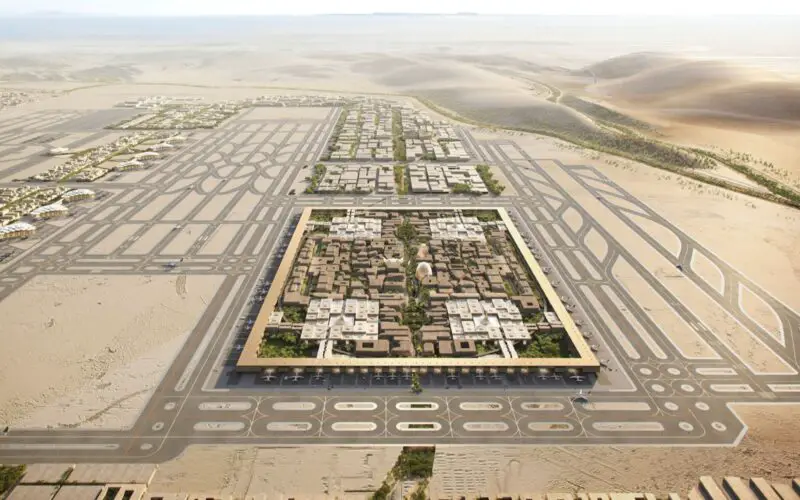
The King Salman International Airport project continues to advance as Saudi Arabia develops a major aviation hub in Riyadh. Authorities aim to expand passenger handling capacity and strengthen global connectivity. Moreover, the project supports long-term aviation growth under Vision 2030. Consequently, the development positions Riyadh as a key logistics and travel hub.
Saudi Arabia initially announced the project as part of a broader aviation expansion strategy. The airport will rise on the existing King Khalid International Airport site. Furthermore, planners designed the facility to become one of the largest globally by passenger capacity. Therefore, the project reflects the Kingdom’s ambition to lead global air transport infrastructure.
King Salman International Airport Project Progresses with Active Construction Works
The King Salman International Airport project has entered early execution phases as of 2026. Authorities have finalized the master plan and initiated preparatory works. Additionally, reports indicate that construction on key components, including runway infrastructure, has begun.
Meanwhile, terminal expansion works at the existing airport continue to support phased development. Riyadh’s airport capacity is expected to increase significantly through ongoing upgrades. In fact, capacity is projected to grow from 42 million passengers in 2025 to about 56 million by the end of 2026.
Furthermore, authorities plan to begin major construction packages in phases. One key terminal expansion is expected to start construction in 2026. Consequently, the project is transitioning from planning into full-scale development.
King Salman International Airport Project Targets Global Capacity Leadership
The King Salman International Airport project aims to set new global benchmarks in aviation capacity. The airport will handle up to 120 million passengers annually by 2030. Moreover, long-term plans target up to 185 million passengers by 2050.
The development will feature six parallel runways and extensive support facilities. Additionally, the airport will cover approximately 57 square kilometers. Therefore, it ranks among the largest airport developments worldwide.
At the same time, Saudi Arabia’s aviation sector continues to record strong growth. Passenger traffic exceeded 140 million in 2025, reflecting rising demand. As a result, large-scale infrastructure investments remain critical.
Integration with National Aviation Expansion Strategy
The King Salman International Airport project aligns with wider infrastructure investments across Saudi Arabia. Authorities continue upgrading airports in Jeddah and other cities. Similarly, Riyadh’s ongoing terminal transformation enhances current operations.
Meanwhile, the Mecca airport project complements this national strategy. That project focuses on improving direct access for pilgrims to the holy city. Consequently, both developments highlight a coordinated approach to aviation expansion.
Additionally, the King Salman International Airport shall have approximately 12 square kilometers of airport support facilities, residential and recreational facilities, retail outlets and other logistics real estate. Its construction is expected to be completed and opened for operation by 2030.
In its opening year, the airport will have the capacity to accommodate up to 120 million passengers per annum. By 2050, its annual passenger capacity will be increased to 185 million and its cargo capacity to 3.5 million tones over the same period.
King Salman International Airport project team thus far
So far, a couple of companies have been appointed to actualize the project. Mace Group Ltd, commonly known as Mace, was recently selected to serve as the delivery partner for the world’s largest in terms of annual passenger capacity.
Mace is a global consultancy and construction firm headquartered in London, United Kingdom. The firm was selected following an international tender announced back in 2023. Multiple international firms competed for the contract which comprises project and design management, cost consulting and procurement information.
The London-based company was selected owing to its considerable experience in airport construction and maintenance. One of the company’s notable projects includes the largest airport in Europe, London’s Heathrow Airport. Last year, Mace was appointed as the delivery partner for three major improvement projects at Heathrow.
Another company appointed for the development of the King Salman International Airport project is Foster + Partners. The latter is a global studio for architecture, engineering, and urban and landscape design, headquartered in London as well. The company will carry out the master plan for the world’s largest airports by passenger capacity and design the airport’s buildings.
Lastly, Jacobs, a US-based company that provides a full spectrum of professional services including consulting, technical, scientific and project delivery for the government and private sector, was appointed to design infrastructure at the proposed King Salman International Airport.
Economic impact of the world’s largest airports by passenger capacity
Beyond its architectural marvels, King Salman International Airport is expected to be a significant economic boon for Riyadh and Saudi Arabia as a whole. It is expected to create hundreds of thousands of jobs, both directly related to the airport’s operations and in ancillary sectors.
Furthermore, the project is in line with Saudi Arabia’s Vision 2030 which aims to diversify the country’s economy away from oil dependence by fostering growth in tourism and logistics. The world’s largest airport’s scale and capabilities are foreseen to attract new business, boosting the country’s position as a global logistics hub.
Also Read
John Glenn International Airport receives US$2 billion expansion approval
$55 Million E-commerce Cargo Center Unveiled at Addis Ababa International Airport
Project Fact Sheet: King Salman International Airport Project
Project Name: King Salman International Airport Project
Location: Riyadh, Saudi Arabia
Estimated Cost: $30 Billion
Project Type: Airport expansion
Status (2026): Early construction and phased development
Site Area: Approximately 57 km²
Runways: Six parallel runways (planned)
Passenger Capacity:
- 120 million passengers annually by 2030
- 185 million passengers annually by 2050
- Cargo Capacity: Up to 3.5 million tonnes annually
Key Features:
- Multiple terminal complexes
- Integrated logistics and commercial zones
- Advanced passenger processing systems
- Sustainable and smart airport infrastructure
Strategic Alignment: Saudi Vision 2030
Project Team: King Salman International Airport Project
Project Owner: Public Investment Fund (PIF)
Developer: King Salman International Airport Development Company
Supervising Authority: General Authority of Civil Aviation (GACA)
Master Planner / Designer: Foster + Partners
Program Management: To be confirmed (multi-consultant structure expected)
Main Contractors: To be tendered / partially awarded in phases
Infrastructure Partners: Multiple international and local firms (phased procurement)
Operators: To be determined
Financial Backing: Public Investment Fund (PIF)