SpaceX data centres plans have received regulatory approval to deploy up to one million satellites designed to operate as orbital data centres. The US Federal Communications Commission (FCC) issued the authorisation on November 25, 2026, for the company’s proposed Starmind constellation. The approval marks a major step towards moving artificial intelligence (AI) computing infrastructure beyond traditional land-based facilities.
The approval allows SpaceX to establish a network of orbital computing modules that will process data in space before transmitting it to Earth. Furthermore, the company intends to use solar energy to power the satellites. This approach is expected to provide computing capacity while reducing dependence on land-based electricity and cooling infrastructure.

FCC Authorisation for SpaceX Data Centres Covers One Million Satellites
The FCC’s Space Bureau granted SpaceX’s application under Order DA 26-1273. The authorisation covers up to one million non-geostationary satellites operating at altitudes between 500 and 1,002 kilometres. These satellites will occupy six orbital shells with different altitude and inclination configurations.
However, the decision was granted in part and deferred in part, subject to conditions. In particular, it authorises radio-frequency communications for backup and emergency telemetry, tracking and command operations. The system will primarily rely on optical inter-satellite links to transfer data between satellites.
Additionally, the FCC approved backup communications in the Ka-band frequency ranges of 18.8–19.3 GHz for space-to-Earth links and 28.6–29.1 GHz for Earth-to-space links. These connections will support emergency operations and maintain command capabilities across the constellation.
Solar-Powered Computing Infrastructure for SpaceX Data Centres
The Starmind network is designed to address growing demand for computing capacity, particularly from AI applications. Conventional data centres require substantial electricity and cooling systems. Consequently, their development has increased pressure on power grids, land availability and water resources in several markets.
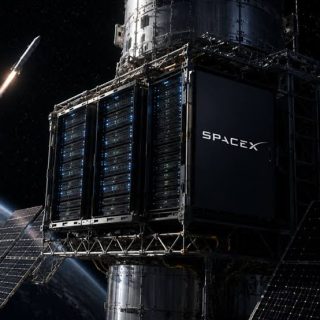
SpaceX data centres proposes to address some of these challenges by placing computing infrastructure in orbit. The satellites are expected to use solar power, which could provide a more consistent energy source than many terrestrial installations. Moreover, the company believes that operating in space could reduce certain land-based infrastructure and maintenance requirements.
The satellites will also connect with other spacecraft, including units within the Starlink network. As a result, SpaceX intends to use its existing satellite communications capabilities to support data transmission between orbital computing modules and users on Earth.
Nevertheless, the SpaceX data centres will require substantial technological development. Heat management, satellite manufacturing, launch capacity and orbital coordination remain important engineering considerations. Therefore, the scale of the authorisation should not be interpreted as confirmation that the entire constellation will be deployed.
Deployment Depends on Starship and Regulatory Milestones
SpaceX’s proposed deployment programme depends partly on the development of its Starship launch system. The reusable rocket is expected to carry large numbers of satellites into orbit and help reduce the cost of deploying the constellation.
Under the reported FCC deployment schedule, SpaceX must begin deployment by November 2033. It is expected to have 100,000 satellites in orbit by November 2035 and 500,000 by November 2038. The full authorised constellation is targeted for completion by November 2040.
However, achieving these milestones will depend on launch vehicle performance, manufacturing capacity and the ability to maintain the satellites in their assigned orbital positions. In addition, the FCC’s conditions and other applicable regulatory requirements will influence the deployment process.
Implications of SpaceX Data Centres on the Global Data Centre Industry
The approval introduces a new direction for the development of large-scale computing infrastructure. Traditionally, data centre investment has focused on land-based campuses supported by power stations, electricity networks and cooling systems. However, orbital computing could create an alternative infrastructure model for certain AI workloads.
Furthermore, the decision could encourage competition in the emerging space-based data centre market. The FCC indicated that it is also reviewing applications for other orbital data centre proposals. This could expand investment opportunities across satellite manufacturing, launch services, optical communications and advanced computing technologies.
Despite these prospects, the concept faces significant technical and environmental questions. Scientists and industry stakeholders have raised concerns about orbital congestion, space debris, satellite brightness and the practical challenges of removing heat from computing equipment in space. Consequently, the commercial viability of large orbital data centre networks remains to be demonstrated.
For SpaceX, the Starmind approval establishes a regulatory pathway for pursuing a much larger computing infrastructure business. Its eventual success will depend on whether the company can translate the authorisation into a technically viable, financially sustainable and operational satellite network.




Leave a Reply