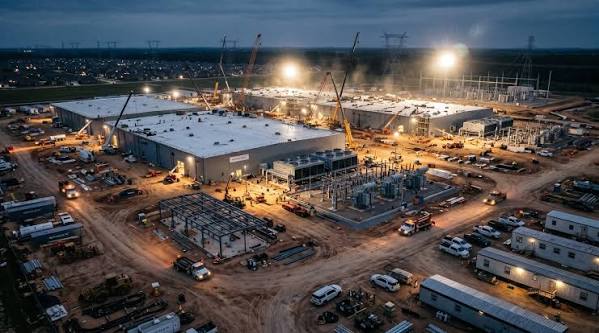
SpaceX is seeking local tax incentives for a proposed $24 billion gas-fired power plant and supercomputing facility in Starbase, Texas, after the city posted a public hearing notice on November 6 outlining the company’s request.
The notice identifies Space Exploration Technologies Corp. as the applicant and property owner for an approximately 444-acre site east of Brownsville, between Boca Chica Boulevard and the Port of Brownsville. The proposed development would include a gas-fired power plant and a supercomputing facility, with an estimated initial-phase investment of approximately $24 billion.
The Starbase City Commission is scheduled to consider a property tax abatement and a related economic development agreement at a public hearing on December 9 at 7 p.m. The notice does not disclose the value of the requested tax relief, the proposed agreement terms or the economic commitments SpaceX would make in return.
The hearing marks the next public step for a development that would combine large-scale computing infrastructure with dedicated electricity generation.
SpaceX seeks two local economic incentives
The public hearing will address two separate agreements under Texas law.
The first is a property tax abatement under Chapter 312 of the Texas Tax Code. The second is an economic development agreement under Chapter 380 of the Texas Local Government Code, which allows municipalities to provide economic development assistance through arrangements such as grants, loans or other incentives.
The notice does not specify the proposed abatement percentage, its duration or the estimated value of the tax relief. It also does not provide the financial terms of the Chapter 380 agreement.
Those details will be important in determining the potential public cost of the incentives. The $24 billion figure represents the estimated capital investment for the project’s initial phases, not the value of the tax break SpaceX is seeking.
The commission will need to weigh the proposed incentives against the development’s anticipated economic benefits. Employment commitments, construction milestones, investment schedules and any performance requirements could help determine whether the agreements deliver the expected returns to the city.
Neither agreement has been approved. The December 9 hearing is a consideration stage, not confirmation that Starbase has granted the incentives.
Proposed gas plant could generate approximately 748 MW
The city’s notice does not provide the power plant’s generating capacity. However, a separate air permit application submitted to the Texas Commission on Environmental Quality describes a proposed initial configuration of 35 natural gas turbines with a combined capacity of approximately 748 megawatts.
The filing also describes a later configuration involving eight larger GE Vernova 7E turbines, with a combined generating capacity of approximately 708 MW.
These figures represent configurations described in the permitting process, not an approved final plant design. The distinction between the initial and later arrangements will be important as the project advances through environmental review and development planning.
The proposed generation capacity would make the power plant a major part of the overall investment. Pairing electricity generation with a supercomputing facility could give SpaceX a dedicated power source for energy-intensive computing operations as demand for artificial intelligence infrastructure continues to rise.
The approach also reflects a broader shift among large data center developers. With grid connections and transmission capacity becoming increasingly important constraints, some developers are exploring on-site generation to secure electricity for their campuses.
For Starbase, the public information available so far does not explain how the proposed plant would operate alongside any grid connection, what backup arrangements would be available or whether further generation capacity could be added in later phases.
Air permit filing raises emissions and equipment questions
The proposed power plant remains subject to a separate environmental permitting process.
The TCEQ application for the initial turbine configuration includes a proposed annual nitrogen oxides emissions limit of 248.86 tons. That figure is close to the 250-ton threshold relevant to certain federal major-source permitting requirements, making the applicable permitting pathway and the details of the application important to monitor.
The proposed limit should not be treated as a confirmed annual emissions level or evidence that regulators have approved the facility. The application remains part of the review process.
The proposed transition from 35 turbines in the initial configuration to eight larger units in a later configuration also raises questions about equipment procurement, construction sequencing and the plant’s eventual operating plan.
The final equipment selection, emissions controls and operating conditions will help determine the facility’s environmental profile. Those details will become clearer as the company progresses through the permitting process.
Water and infrastructure requirements remain unclear
The proposed development also raises questions about the infrastructure needed to support a large computing campus and power plant.
The public hearing notice does not disclose the supercomputing facility’s expected electricity demand, water consumption, cooling design, wastewater arrangements or the number and size of buildings planned for the site.
These details matter because computing facilities can have substantial cooling requirements, while gas-fired generation also requires supporting fuel and infrastructure systems.
SpaceX has also been linked to a separate regional water infrastructure agreement with Brownsville. However, that agreement does not confirm a dedicated water allocation for the proposed Starbase facility or disclose how much water the project would consume.
The relationship between the power plant and the computing operation also needs clarification. The city notice groups them within the same development but does not detail the computing campus’s expected power demand or explain how the project would distribute electricity across its development phases.
Starbase proposal enters wider data center power debate
SpaceX’s proposal comes as large data center developments place growing pressure on electricity supplies, transmission networks and local infrastructure. The scale of the proposed investment and its planned on-site generation make the project relevant to a wider debate over how the United States will accommodate the power requirements of artificial intelligence.
Federal lawmakers are also considering changes to energy permitting and transmission policy. A bipartisan Senate proposal would revise federal approval processes for major infrastructure projects and address how large data centers pay for transmission infrastructure associated with serving their electricity demand. The legislative debate is examined in Senate Vote Today, Nov. 9, 2026 Could Advance Bipartisan Energy Permitting Overhaul.
For Starbase, the immediate decision concerns the economic incentives SpaceX has requested. The December 9 hearing will provide the next public milestone, while the state air permit application and other development approvals remain separate requirements.
The November 6 notice establishes the proposed investment, site and agreements under consideration. The value of the requested incentives, the project’s infrastructure requirements and its construction timetable remain important unanswered questions.
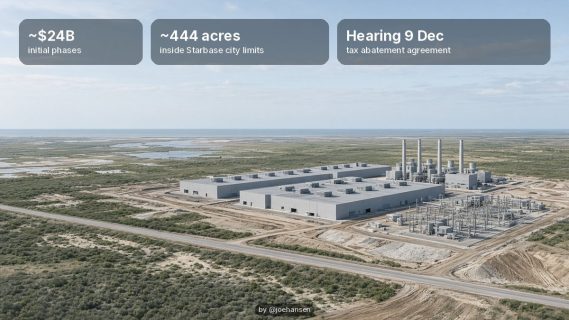
$24 Billion Starbase Gas Plant and Supercomputer: Project Facts
- Project: SpaceX gas-fired power plant and supercomputing facility
- Developer: Space Exploration Technologies Corp. (SpaceX)
- Location: Starbase, east of Brownsville, Cameron County, Texas
- Site area: Approximately 444 acres
- Estimated initial-phase investment: Approximately $24 billion
- Proposed initial generation configuration: 35 natural gas turbines
- Proposed initial generating capacity: Approximately 748 MW
- Later configuration described in the air permit filing: Eight GE Vernova 7E turbines totaling approximately 708 MW
- Incentives under consideration: Chapter 312 property tax abatement and Chapter 380 economic development agreement
- Public hearing notice posted: November 6, 2026
- Public hearing: December 9, 2026, at 7 p.m.
- Project status: Proposed; local agreements and relevant permits remain subject to review


Leave a Reply